Philippine Financial Reporting Standards (PFRS) Reporting
The Philippine Financial Reporting Standards (PFRS) is the national framework for preparing corporate financial statements, aligning local practice with international accounting principles to improve transparency and comparability. This guide explains what the PFRS covers, key compliance requirements and timelines, and how ESG reporting platforms can help streamline implementation for companies.

Free AI Gap Analysis for Your ESG Framework Report
Understand where your existing disclosures meet framework requirements and where gaps still exist
"*" indicates required fields
Talk to a local ESG expert about how Presgo can help you!
Our local ESG Experts are on-hand to understand your ESG Reporting needs and cater our solution to you. Get in touch to discuss how we can help.
What is the PFRS?
The Philippine Financial Reporting Standards (PFRS) are the accounting standards mandatory for all publicly accountable entities in the Philippines, covering listed companies, banks, insurers, and more.
PFRS is fully aligned with the International Sustainability Standards Board (ISSB)’s IFRS S1 and S2. It governs how financial statements are prepared and presented to ensure transparency, comparability, and investor confidence.
PFRS and ISSB
The Philippines recently adopted PFRS S1 and S2, which are sustainability disclosure standards modeled directly on the ISSB’s IFRS S1 and S2:
- PFRS S1
-
-
- PFRS S1, based on IFRS S1, sets general requirements for sustainability-related financial disclosures that provide investors, lenders, and other primary users with information on material sustainability risks and opportunities reasonably expected to affect the entity’s cash flows, access to finance, or cost of capital over the short, medium, and long term.
-
- PFRS S2
-
- PFRS S2, based on IFRS S2, requires companies to disclose climate-related risks and opportunities, including governance, strategy, risk management, and scopes 1 to 3 emissions, as well as the management processes used to address them.
Why is the Philippines adopting the PFRS?
The Philippines is adopting PFRS S1 and S2 to align with global sustainability reporting standards and strengthen investor confidence through mandatory, comparable ESG disclosures:
- Align with global investor expectations: Enables Philippine companies to produce sustainability reports that match international investor demands for comparable, high-quality ESG data.
- Join ASEAN’s regional shift: Positions the Philippines alongside Singapore, Malaysia, Thailand, and Indonesia in adopting IFRS-based sustainability reporting across ASEAN.
- Move from voluntary to mandatory ESG disclosure: Transforms sustainability reporting from optional to enforceable, improving consistency and reliability of ESG data.
- Allow phased reporting compliance: Transitional reliefs like delayed scope 3 reporting, comparative disclosure reliefs, and exemptions for subsidiaries covered in parent reports help build capacity while aligning with international best practices.
Who needs to comply with the PFRS?
To ensure financial transparency and following the shift away from voluntary “comply or explain” (SEC Memorandum Circular No. 16, Series of 2025), the Securities and Exchange Commission (SEC) strictly enforces PFRS compliance for the following entity groups:
- Publicly listed companies: All securities trading on the Philippine Stock Exchange
- Financial institutions: Banks, insurance companies, and other regulated financial entities
- Entities with public accountability: Organisations holding assets in a fiduciary capacity for broad groups of stakeholders
- Large private corporations meeting SEC size thresholds
SMEs that do not meet the above criteria can instead use the simplified PFRS for SMEs standard.
What are the requirements of the PFRS?
The core of the PFRS sustainability framework consists of two standards: PFRS S1 and S2, which establish specific disclosure requirements for sustainability-related financial information. Provisions include:
Governance and Board Oversight Requirements
A crucial requirement, regardless of a company’s tier, is that the board of directors reviews and approves all sustainability reports before issuance. This means the board cannot simply delegate sustainability reporting to a compliance team; they must actively review the content and formally approve it. The requirement ensures that sustainability governance is treated at the same level of importance as financial governance.
Companies must disclose their governance structure for overseeing sustainability risks and opportunities, including which board committees are responsible. They must also explain how sustainability is integrated into overall risk management and the frequency of board reporting.
Third-Party Assurance Requirements
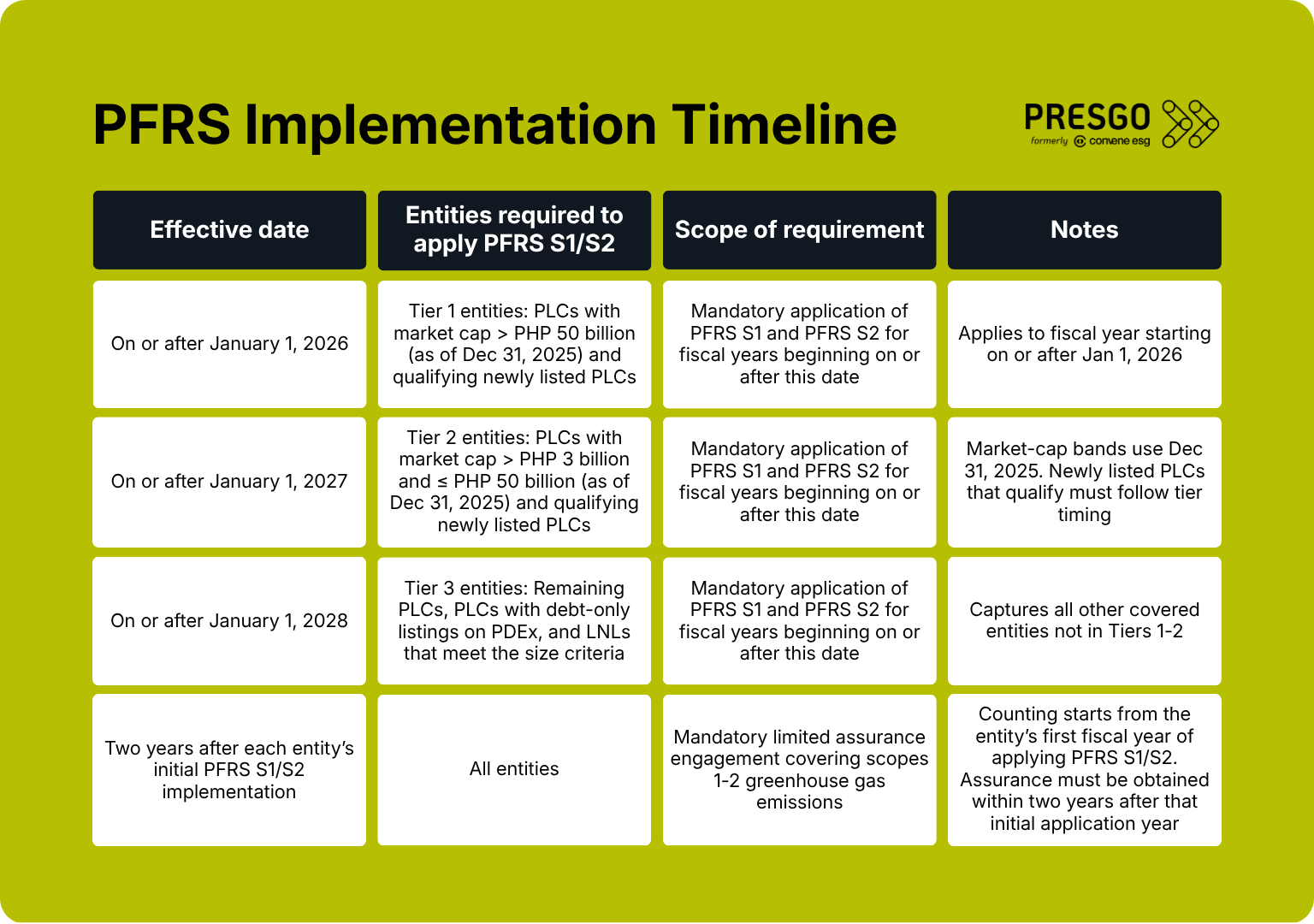
Two years after the initial implementation of PFRS S1 and S2, companies must obtain mandatory limited assurance on scopes 1 and 2 emissions. This assurance must be conducted by an independent certified public accountant or a qualified non-accountant practitioner who meets the competency requirements set by relevant professional bodies. The limited assurance requirement will eventually progress toward reasonable assurance over time, meaning companies should plan for increasingly rigorous external verification as the framework matures.
Planning for this assurance requirement should begin early. Companies need to ensure their greenhouse gas emissions data collection systems are robust, that methodologies are documented and consistent, and that internal controls exist around emissions calculations.
Integration with Financial Reporting
The PFRS sustainability requirements are not standalone and must be integrated with financial reporting. Companies must disclose sustainability-related information alongside financial statements in the same reporting period. This integration means that sustainability risks and opportunities should be reflected in financial statements where appropriate, such as through impairment assessments, fair value measurements, or provision calculations.
The requirement also means that sustainability disclosures should use the same reporting entities and boundaries as financial statements, ensuring consistency in how the company is defined across both types of reporting.
Exemption for Subsidiaries
Companies that are considered a large non-listed (LNL) entity that are subsidiaries of a parent company may qualify for an exemption from submitting a separate sustainability report. This exemption applies if three conditions are met:
- The parent company prepares a sustainability report under a recognized framework (PFRS S1/S2, ESRS, or IFRS-aligned).
- The company’s sustainability disclosures are included in the parent’s publicly available report.
- The company submits a Certificate of Exemption as prescribed by the SEC, along with its annual financial statements.
This exemption prevents duplicate reporting for Philippine companies that are subsidiaries of multinational corporations already complying with sustainability reporting requirements in other jurisdictions.
PFRS Implementation Timeline
The PFRS implementation timeline varies depending on the entity group a company belongs to. Below is the implementation timeline for the three entity groups in the Philippines since the SEC Memorandum Circular No. 16, Series of 2025, took effect on January 8, 2026.
How does the PFRS affect different sectors?
The PFRS affects sectors differently depending on whether the issue is the new sustainability reporting standards (PFRS S1 and S2) or the broader accounting framework used for financial statements. For sustainability, the most notable differences are by entity type: PLCs and LNLs face the new SEC reporting requirements. At the same time, banks and insurance companies also have their own sector-specific rules set by their regulators.
Listed Companies
Publicly listed companies are the main group affected by PFRS S1 and S2. They must disclose sustainability-related financial risks and opportunities under PFRS S1, and climate-related matters under PFRS S2, with adoption phased by market-cap tier.
Large Non-Listed Entities
Large non-listed entities are also covered by the SEC sustainability rules. Some may qualify for exemption if their parent company already reports the required sustainability information, but others must prepare their disclosures under PFRS S1 and S2.
Banks and Other Financial Institutions
Banks and other financial institutions are affected both by the general PFRS framework and by sector-specific rules from the BSP, known as the Manual of Regulations for Banks (MORB). These entities also follow standards such as PFRS 9 for financial instruments (based on IFRS 9), and they may also need to address PFRS S1 and S2 if they fall within the SEC’s sustainability reporting scope.
Insurance Companies
Insurance companies must comply with PFRS 17 for insurance contracts (based on IFRS 17), alongside any applicable sustainability reporting obligations. If they are within the SEC scope, they also need to consider climate-related and sustainability disclosures under PFRS S1 and S2.
Other Operating Sectors
For sectors like manufacturing, retail, telecom, construction, food, and services, the impact is mostly based on disclosure readiness. These companies must identify material sustainability risks, explain how they manage them, and disclose climate impacts where relevant.
How Presgo Supports PFRS Reporting
Presgo is an AI-first ESG reporting platform designed by industry experts to support your organization’s compliance with PFRS reporting. The software is equipped with built-in modules to scale their sustainability reporting journey according to business growth and shifting regulatory expectations.

Data Hub
Presgo’s Data Hub helps centralize data collection from finance, HR operations, and other teams, with structured workflows and audit-ready storage. For compliance with PFRS S1 and S2, the feature streamlines the process by assembling reliable, auditable data across the business.

Goals and Performance
Presgo’s Goals and Performance module lets companies set ESG goals, monitor KPIs, and highlight underperformance before reporting cycles. Under PFRS S1 and S2, organizations need to disclose not just risks and governance but also metrics, targets, and progress over time.

Report Builder
The Report Builder module helps ESG teams assemble disclosures into a structured report faster using pre-mapped data, charts, and narrative components. For PFRS reporting, organizations need consistent, traceable disclosures that can be reviewed internally and prepared for external assurance.

Materiality Assessment
Presgo’s Material Assessment module helps teams evaluate financial and impact materiality, facilitating a structured and more transparent process. The materiality assessment is a core step before writing PFRS-aligned disclosures. Organizations can use Presgo to determine which ESG topics are most significant for PFRS reporting.