Contents
- What is sustainable tourism?
- How does tourism impact the environment?
- The State of Sustainable Tourism in the Philippines
- What are the benefits of sustainable tourism and hospitality?
- How can ESG and sustainable tourism help attract investors to the Philippines?
- How do tax incentives support green investments in Philippine tourism?
- Best Practices for Sustainable Tourism in the Philippines
- How Presgo Can Help Your Organization
For many countries, tourism has become a key contributor to economic growth and development. As travelers become increasingly environmentally and socially aware, many governments and tourism organizations have shifted toward sustainable practices to meet the growing demand.
The Philippines, boasting various natural and cultural tourist attractions, is one such country pursuing more environmentally- and ecologically-friendly tourism practices to support local communities and wildlife. Explore in this article the current landscape of sustainable tourism in the Philippines and how the movement is expected to evolve in the coming years.
What is sustainable tourism?
Sustainable tourism is defined as a form of tourism “that takes full account of its current and future economic, social, and environmental impacts.” It aims to address the needs of visitors, the local tourism industry, the environment, as well as host communities through inclusive, governance-driven strategies and responsible practices.
According to the UN Tourism, sustainable tourism development guidelines and management practices apply to all types of tourism, from mass tourism to more niche travel segments. These guidelines and best practices emphasize the environmental, economic, and socio-cultural factors that impact tourism development. Striking a balance among these three can foster long-term sustainability in tourism.
Sustainable tourism relies on three interconnected principles:
- Environmental stewardship: Use natural resources responsibly by protecting ecosystems, conserving biodiversity, and maintaining the landscapes that support long-term tourism.
- Cultural integrity: Respect the character and heritage of local communities by preserving traditional practices, protecting cultural sites, and fostering meaningful exchange between tourists and local residents.
- Economic resilience: Sustain viable local economies through stable employment, fair income opportunities, and community-driven programs aimed at reducing poverty and offering long-term benefits for all stakeholders involved.
How does tourism impact the environment?
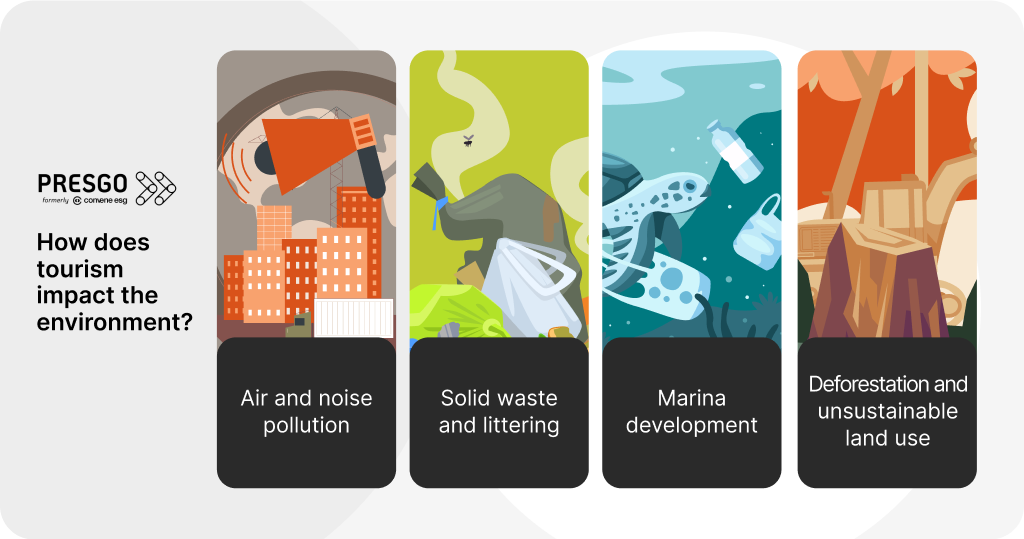
The environmental impact of tourism is a major consideration for sustainable development. While tourism can bring economic opportunities and foster environmental awareness, it also creates several challenges that threaten ecosystems and local communities. Understanding both the positive environmental impacts of tourism, such as conservation funding and eco-awareness, and the negative effects of tourism, including pollution and resource depletion, is essential for building a sustainable future.
Air and noise pollution
One of the most significant environmental impacts of tourism is the increase in air and noise pollution from transport and leisure activities. A study assessing noise levels in tourist and recreation spaces in Turkey found that traffic density is closely related to noise intensity. As such, the highest noise levels were recorded on weekdays and weekend evenings.
Meanwhile, high levels of air pollution can also be detrimental to tourism. A Polish study highlights that high amounts of pollution may cause health risks and a decrease in tourist attractiveness. In turn, this can significantly impact the availability of employment in the sector.
Solid waste and littering
According to One Planet, tourism contributes significantly to plastic pollution, with 80% focus on coastal areas, leading to eight million tons of plastic in the ocean each year. Inland and urban tourism also add to this problem, worsening the environmental impacts of tourism on rivers and marine ecosystems.
Unfortunately, much of the plastic used in tourism activities isn’t recyclable, typically single-use items and product packaging such as those found in water bottles, film wraps, disposable cutlery and plates, bags, and other consumer and hospitality disposables. The most common plastics found as a result of tourism include polyethylene, polypropylene, and polyethylene terephthalate.
Marina development
Aside from littering and plastic pollution, the influx of tourist activities can also lead to water and marine damage. Insights from The Global Development Research Center highlight that tourism development practices such as dynamiting and mining of coral for resort building materials are especially damaging to fragile coral reefs in the Philippines. These negative effects of tourism contribute to declining fish populations and habitat destruction, particularly in popular island destinations.
Deforestation and the unsustainable use of land
Finally, tourism development also has a considerable impact on land and, subsequently, the natural habitats and wildlife. The construction of tourism infrastructure often requires excessive deforestation and land use.
For example, as of 2022, the province of Palawan has lost 170 thousand hectares of forest due to rising demands for wood as a construction material, threatening the region’s biodiversity. This relationship works both ways, as the World Tourism Organization (UNWTO) states that climate change and environmental degradation are threats to the tourism industry’s sustainability. The degradation of natural and cultural resources may reduce tourist attractions and even prompt shifts in tourist behavior, impacting the industry in the long-term.
To mitigate the negative effects of tourism, adopting principles of environmental tourism, which prioritize conservation, resource efficiency, and community inclusion, is vital. By promoting sustainable practices, renewable energy, and waste reduction, destinations can transform the environmental impact of tourism from harmful to regenerative. Strengthening environmental management systems and public awareness can amplify the positive environmental impacts of tourism, ensuring that tourism contributes to both economic growth and environmental resilience.
The State of Sustainable Tourism in the Philippines
The economic impact of tourism in the Philippines continues to grow, as the industry plays a key role in the country’s overall economic development. In June 2025, the World Travel & Tourism Council (WTTC) announced that the Philippines’ tourism is set to break more records. The sector will contribute Php 5.9 trillion to the local economy this year, which is a 13.5% increase from 2019. More Filipinos also benefit from the boost in employment, with a record 11.7 million expected to be supported by the sector.
In addition to the Philippines’ sustainability, the country is also known for its hospitality and “cosmopolitan environmental brand”, as the Tourism Promotions Board of the country introduced a “green marketing” approach to promote eco-tourism in the Philippines. Through this, the agency aims to support sustainable community-based tourism destinations focusing on environmental conservation, cultural heritage, and ecological balance.
Government-led Sustainable Tourism Practices
Today, the number of tourists visiting the country is increasing every year. The Bureau of Immigration (BI) highlighted an almost 8% increase in total arrivals from January to June 2025 compared to the previous year, including international tourists from the United States, South Korea, Japan, China, and Australia.
As the tourism industry continues to grow, the government has gradually shifted towards more sustainable tourism practices. Some high-level recommendations and suggestions that are encouraged by the Philippine government include:
- Local governments to conduct seminars and training on tourism practices for all tourism establishments
- Strict implementation of guidelines and policies for sustainable tourism practices
- Regular monitoring and evaluation of tourism establishment business operations
Tourism Development Monitoring
Implementing sustainable tourism practices is one, but it’s also vital to keep track of insights and findings from these new adaptations. This would allow local government units and tourism businesses to adjust their approaches accordingly.
In 2021, the Philippine Statistics Authority compiled the developmental satellite account, Measuring the Sustainability of Tourism (MST), to monitor insights on the economic, environmental, and social aspects of local tourism development. As of 2024’s press release, the initiative has reported detailed insights on crucial resource consumption from local tourism. For example, the MST recorded an 8.7% increase in total tourism water consumption, a 20.9% increase in total energy consumption, and a 25.2% increase in carbon dioxide (CO2) emissions compared to findings from 2023.
What are the benefits of sustainable tourism and hospitality?
As with other forms of sustainable practices, the shift towards sustainable tourism can provide various benefits for local communities and the environment. The World Bank states that nature-based tourism can help:
- Create jobs
- Strengthen value chains
- Drive growth
- Develop the private sector
- Diversify rural incomes
- Finance protected areas and biodiversity conservation
- Empower communities
The World Bank also recommends that developing countries invest in improving the local policy environment, building foundations for more sustainable tourism practices, and attracting necessary private capital to create jobs from nature-based tourism. This includes the conservation of local and natural environments and resources, such as preventing pollution, poaching, and other irresponsible use of natural resources.
Today, sustainable tourism drives about eight billion unique tourist visits each year to protected areas around the world, representing 17% of the world’s land and 8% of the world’s marine areas. This highlights the importance of tourism in the Philippines, where tourist hotspots such as the Siargao Islands saw a boost in local economy and employment, increased public revenue, and a growth in small businesses. This included opportunities in fields such as guiding, transportation, accommodation, culinary services, and entrepreneurship.
How can ESG and sustainable tourism help attract investors to the Philippines?
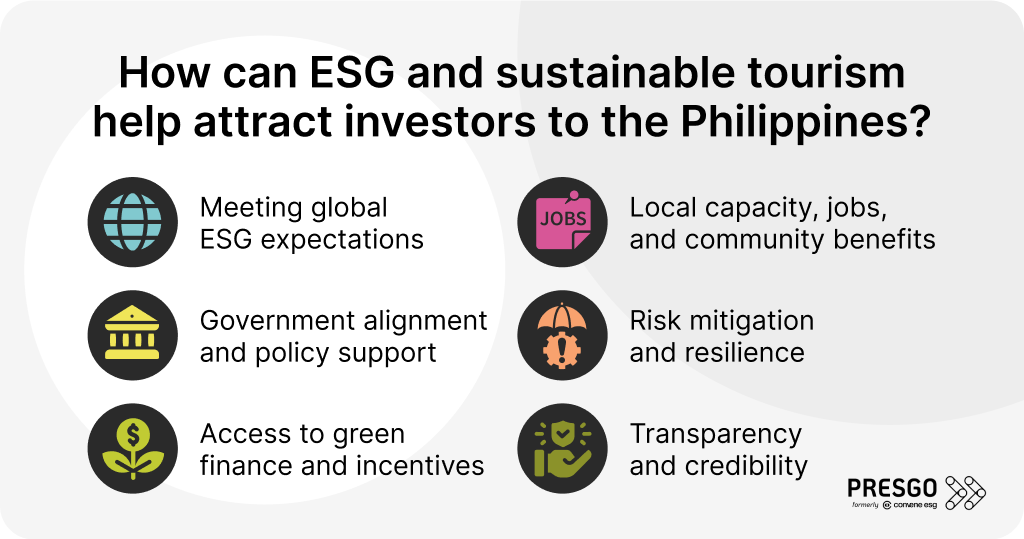
To attract capital into the Philippines’ sustainable tourism agenda, ESG and resilient, purpose-driven initiatives must clearly demonstrate financial viability, risk mitigation, and broad-based social and environmental value for local communities and the economy.
Meet global ESG expectations
Adopting robust ESG practices signals to investors that the tourism sector in the Philippines effectively manages environmental risks, delivers social value, and maintains strong governance by aligning with international frameworks such as the GRI or TCFD. Clear disclosures, credible targets, and third-party verification further reduce perceived risk and enhance the bankability of sustainable tourism projects.
Government alignment and policy support
Ongoing government initiatives, such as updated accommodation standards, capacity-building programs, and targeted investment enablers, provide a predictable policy environment. This alignment lowers permitting uncertainty and strengthens investment certainty for sustainable tourism ventures.
Access to green finance and incentives
Projects with credible ESG performance can access preferred financing, blended capital, and potential incentives. For example, TIEZA-registered enterprises are granted fiscal and non-fiscal incentives for complying with sustainability initiatives. Demonstrating progress on waste reduction, energy efficiency, and responsible procurement can improve financing terms and unlock capital for green developments.
Local capacity, jobs, and community benefits
Investments that help create jobs and develop local skills also build long-term support. In 2024, the Department of Tourism partnered with the Asian Institute of Management, creating sustainable tourism education opportunities for members of the Association of Tourism Officers. This initiative ensures that local tourism strategies employ sustainability principles in destinations across the country. As of April 2025, over 280,000 Filipinos have received training to improve the quality of services offered, while still aligning with sustainability standards.
Risk mitigation and resilience
Climate resilience and environmental risk management reduce operational disruptions. Investors favor projects with explicit adaptation plans, diversified supply chains, and sustainable infrastructure that withstands extreme weather events and resource constraints. One example of this is the rehabilitation of Boracay, which was initiated in 2018, and was aimed to provide financial support programs and train local workers for sustainability in tourism projects. This included the beach clean-ups, removal of illegal constructions in wetlands, and the construction of new sewer systems and sewage treatment plants for waste management.
Transparency and credibility
Public-facing ESG metrics, annual sustainability reporting, and independent audits build trust with investors and lenders. Transparent performance data enables benchmarking and demonstrates consistent progress toward defined goals. Tourism venues and organizers may pursue third-party audits against recognized sustainability standards such as the ISO 20121 and ISO 14001 to demonstrate robust ESG governance in the region.
How do tax incentives support green investments in Philippine tourism?
Tax incentives in the Philippines play a vital role in supporting green investments in the tourism sector. The country promotes sustainability through ESG-aligned policies, including the CREATE MORE Act, which was passed in 2024 and stands for “Corporate Recovery and Tax Incentives for Enterprises to Maximize Opportunities for Reinvigorating the Economy”. These tax incentives in the Philippines aims to attract sustainable tourism enterprises and encourage responsible investment practices. Key tax incentives for green investments include:
- Lowered corporate income tax: Registered businesses can enjoy a 20% income tax rate under the Enhanced Deduction Regime. This aims to improve post-tax profitability and cash flow for environmental projects, sustainable infrastructure, energy efficiency upgrades, and waste management facilities.
- Income Tax Holiday of up to six years: Available for new tourism enterprises, the income tax holiday reduces the initial tax burden. In the long run, this helps support capital investments in sustainable operations.
- 5% tax on gross income for qualifying tourism enterprises: Significantly lower than standard national and local tax rates (up to 25%). This is paired with revenue distribution between local governments, national government, and TIEZA to fund community projects and environmental initiatives.
- Duty- and tax-free importation of capital equipment and transportation tools: Supports investment in sustainable infrastructure and eco-friendly tourism operations.
- 50% tax deduction on expenses for environmental protection, cultural preservation, and sustainable development: This requires TIEZA approval and demonstrates green finance readiness. Subsequently, this enhances eligibility for funding, grants, and public-private partnerships.
Best Practices for Sustainable Tourism in the Philippines

In 2019, as part of the United Nations Environment Programme, the Waste & Resources Action Programme (WRAP), UNEP DTU Partnership, Philippine Department of Tourism, UN Environment, and the Philippine Center for Environmental Protection and Sustainable Development, Inc. (PCEPSDI) released a roadmap for low-carbon and resource-efficient tourism. This roadmap, which supports the delivery of the UN Sustainable Development Goals (SDGs) and the Philippines’ Nationally Determined Contributions (NDCs), offered four systemic solutions to help reach the goal of achieving sustainable tourism:
- Promote sustainable food value chains
Educate communities on food sustainability and implement food waste monitoring and reduction systems in kitchens. Highlight local agriculture, aquaculture, and Filipino food culture in tourism offerings. For example, the Mountain Partnership Secretariat, Slow Food, and the Philippines’ Department of Tourism developed “Food & Tourism for Mountain Development”, connecting local farmers with tourism service providers to promote high-quality mountain products from the Cordillera region.
- Build capacity for sustainable events
Train and equip the workforce for sustainable event management. Strengthen research, policy, and institutional support for event sustainability, and invest in a greener Meetings, Incentives, Conferences, and Exhibitions (MICE) structure. Notably, adopt or align with international frameworks such as the ISO 20121, which provides guidelines for organizations to follow ethical, eco-friendly, and socially conscious practices for sustainable event management.
- Eliminate pollution in tourism operations
Improve solid waste management and phase out single-use plastics in hotels and other accommodation facilities. Adopt eco-friendly initiatives such as Plastic Free Foundation’s Plastic Free July, which is implemented by the El Nido Resorts of Palawan province through the refusal of single-use items such as balloons, confetti, glitter, and plastic streamers at events.
- Transition to sustainable energy use
Upgrade to energy-efficient equipment and adopt renewable energy solutions. Provide training and promote the use of smart, energy-efficient technologies to create sustainable hospitality spaces. For example, investing in inverter AC units and improved insulation can help reduce cooling loads, which are known to be a significant source of GHG emissions.
Under the UNFCCC Paris Agreement, the set reduction goal of the Philippines is around 70% by 2030. By following the best practices according to the UN Environment, organizations in the country can reduce greenhouse gas (GHG) emissions by implementing the best practices in the energy, transport, waste, forestry, and industry sectors.
How Presgo Can Help Your Organization

Sustainable tourism practices and best practices may sound abstract at times. Using the right ESG reporting software or platform can help convert these sustainability commitments into measurable, reportable impacts.
Presgo is an all-in-one sustainability reporting platform developed by ESG experts, designed to help organizations, tourism operators, developers, and government partners keep track of sustainability performance. Built as an AI-first platform, it uses intelligent automation to simplify data management and analysis. Presgo’s modular setup also allows users to tailor features to their reporting needs and scale as requirements grow.
Featuring automated data collection, standardized metrics, and alignment with global reporting frameworks, Presgo helps streamline how tourism organizations in the Philippines track key indicators such as energy use, waste management, carbon emissions, and community impact. These insights can help support compliance with the Philippines’ sustainability tourism roadmap and bolster stakeholder confidence from local communities as well as investors.
Turn sustainable tourism goals into measurable impact. Book a Presgo demo today!