The Philippines is already past the policy stage for sustainability reporting. In March 2026, the SEC and UNCTAD (UN Trade and Development) launched a joint project to level up PFRS implementation, addressing gaps, training, and policy recommendations. For publicly listed companies (PLCs) and large non-listed entities (LNLs), the initiative means compliance with the PFRS requirements and timeline.
What follows is a breakdown of what PFRS is, its components, who must report, what and when to disclose, and under what conditions.
What are PFRS S1 and S2?
PFRS S1 and S2 are adopted in the Philippines, modeling the IFRS S1 and S2 released by the International Sustainability Standards Board (ISSB), under the IFRS Foundation.
Through Memorandum Circular No. 16, Series of 2025, the SEC formally adopted the PFRS or the Philippine Financial Reporting Standards on sustainability disclosures. This change repeals the earlier “comply or explain” framework from MC No. 4, Series of 2019. PFRS also introduces binding obligations for publicly listed companies (PLCs) and large non-listed entities (LNLs) beginning in FY2026.
PFRS S1
The PFRS S1 covers general sustainability-related financial disclosures. It requires companies to report on sustainability risks and opportunities that are material to their business value or that carry some financial weight for the business.
PFRS S2
The PFRS S2 is the standard that focuses specifically on climate. It covers how climate-related risks and opportunities affect a company’s business as a whole, including its strategy, model, and financial position.
Both PFRS S1 and S2 are structured around the four disclosure pillars, which are governance, strategy, risk management, and metrics and targets. These same pillars run through the IFRS sustainability disclosure standards.
Why is the Philippines implementing PFRS sustainability reporting?
The SEC mandated PFRS to make risks financially visible, support the country’s emissions commitments, align with APAC markets, and help standardize ESG data.
Physical Risks
The Philippines is known to be one of the most climate-vulnerable economies in the world. The country’s geological and climate hazards can damage infrastructure, agriculture, and financial operational systems. The PFRS pushes companies to quantify these risks and test their business models against different climate scenarios.
National Commitment
The SEC’s adoption of PFRS S1 and S2 directly reflects national climate commitments. Under its Nationally Determined Contribution, the Philippines has pledged a 75% reduction in greenhouse gas (GHG) emissions by 2030. Mandatory corporate disclosure is one way to make that commitment credible.
Regional and Global Advantage
The development of the PFRS also places the country alongside Asia-Pacific markets, such as Singapore and Hong Kong, which have already aligned ISSB disclosure requirements. As the SEC chairperson put it, the PFRS Philippines is a “commitment to high-quality, comparable, and globally aligned sustainability reporting.”
Capital Access
As a result of the market advantage, investors are looking into standardized and ESG-screened portfolios for sustainability-linked loans and investments. In 2025, the Philippine banks alone had issued Php 664.7 billion in green, social, and sustainability-linked bonds. This shifts the focus of capital markets towards ESG and sustainability initiatives.
Who must report under PFRS, and when?
Under MC No. 16, all PLCs and LNLs with annual revenues above PHP 15 billion are covered in the PFRS reporting timeline. Government-owned and controlled corporations (GOCCs) and entities under the Insurance Commission are currently exempt, with separate frameworks to be expected.
The SEC uses a three-tier rollout based on company size:
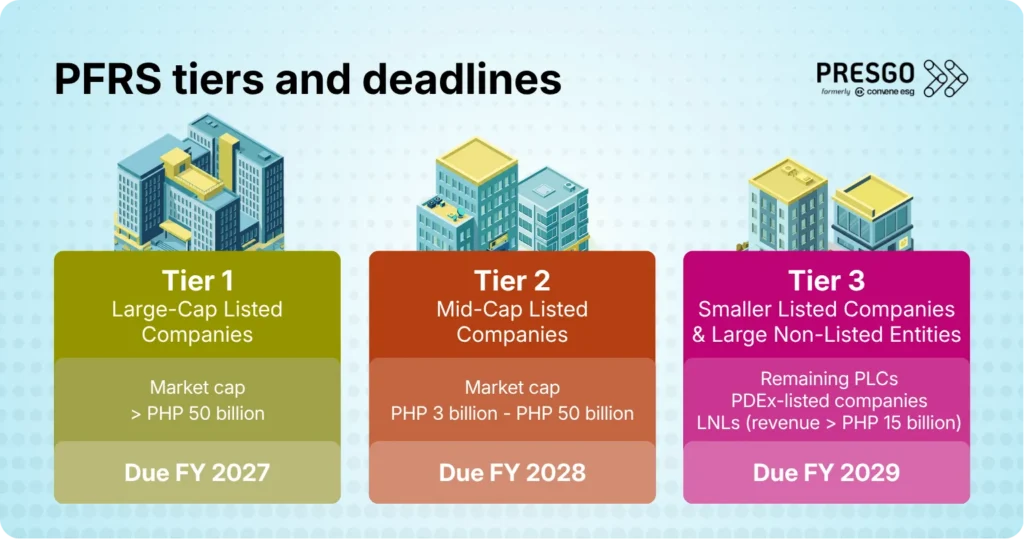
Tier 1: Large-Cap Listed Companies
A market cap above PHP 50 billion as of December 31, 2025, qualifies for this tier. The first report covers FY2026, due in 2027. Limited assurance on scopes 1 and 2 is required from FY2028.
Tier 2: Mid-Cap Listed Companies
The qualifying threshold is PLCs with a market cap between PHP 3 billion and PHP 50 billion as of December 31, 2025. The first report covers FY2027, due in 2028. Limited assurance will be required from FY2029.
Tier 3: Smaller Listed Companies and Large Non-Listed Entities
Listed companies with a market cap below PHP 3 billion as of December 31, 2025, and companies listed solely on PDEx fall under this tier. This also includes LNLs with revenues above PHP 15 billion. The first report covers FY2028 and is due in 2029. Limited assurance is required starting FY2030.
All reports must be reviewed and approved by the Board of Directors before submission. PLCs file as an attachment to the annual report. LNLs covered under Section 17.2 of the Securities Regulation Code follow the same process. Other LNLs file alongside their audited financial statements.
The Bangko Sentral ng Pilipinas (BSP) has also announced plans to adopt parallel sustainability reporting standards for banks under similar tier thresholds. PFRS adoption begins in FY2026.
What are the PFRS transitional reliefs?
The SEC built several temporary provisions into the Philippine Financial Reporting Standards rollout, designed to reduce what companies must publish in year one.
- Climate-only reporting in year one: Tier 1 and Tier 2 companies can limit their first report to PFRS S2 or climate disclosures, rather than covering all sustainability topics under PFRS S1.
- No comparative data required: First-year reporters do not need to provide prior-year comparative figures.
- Alternative GHG methodologies: In year one, companies may use measurement methodologies other than the GHG Protocol, provided they disclose which method they applied.
- Filing extension: First-year reporters receive additional time beyond standard statutory deadlines.
- Scope 3 deferral: Scope 3 emissions disclosures are not required for the first two years of reporting for any tier.
Several Philippine companies, however, are already disclosing scope 3 voluntarily. Ayala Corporation’s scope 3 made up 97.1% of its total 2024 footprint, which they tied to coal consumption in its investment portfolio. Manila Water’s reported scope 3 emissions cover 69% of its total footprint. SM Investments nearly tripled its scope 3 disclosure from 2023 to 2024, which was the result of improving emissions tracking and data collection. Overall, this proactive effort gives a useful glimpse into the kind of adjustments companies can expect to their data and reporting practices later on.
Although these reliefs reduce what companies publish, the data infrastructure, governance structures, and board-level reporting processes still need to be in place before filing deadlines arrive
Are there penalties for non-compliance with PFRS?
Non-submission of sustainability reports for PLCs is treated as an incomplete annual report under SEC guidelines. Financial penalties follow under SEC Memorandum Circular No. 6, Series of 2005 (Consolidated Scale of Fines).
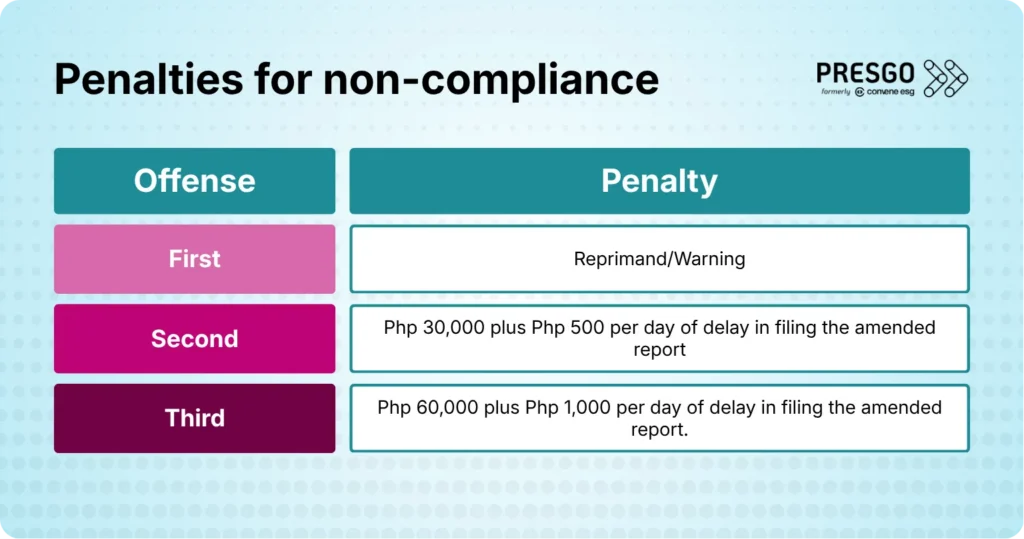
The SEC also stated that non-submission or late submission violations are subject to a separate scaling of penalties under SEC Resolution No. 581, Series of 2021. Exact penalty structures for LNLs will follow in subsequent SEC issuances.
What do companies need to include in a PFRS-aligned sustainability report?
The four disclosure pillars from the Task Force on Climate-Related Financial Disclosures (TCFD) apply across both PFRS S1 and PFRS S2. The depth of disclosure, though, depends on what is material to the reporting company.
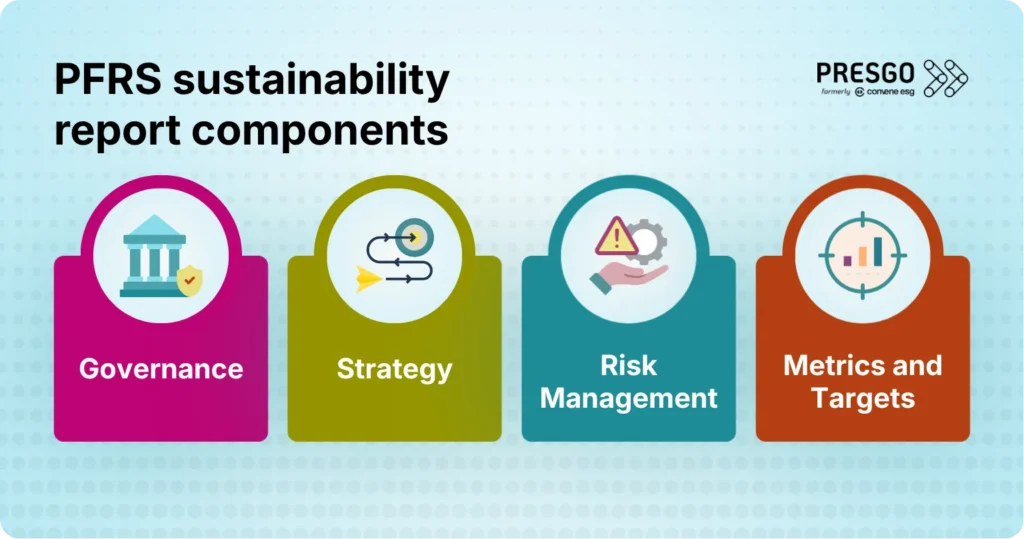
Governance
Companies must name the board committees or individuals responsible for overseeing sustainability and climate-related risks. The disclosure should cover the frequency of oversight, relevant governance controls, and how leadership tracks progress against targets.
Strategy
This covers how sustainability and climate risks and opportunities affect the company’s business model, value chain, and financial planning, including under different climate scenarios. Ayala Corporation, one of the Philippine companies reporting ESG, has explicitly linked its climate action materiality to ACEN’s renewable energy investments and its publicly stated net-zero target. This is a model of how strategy and material topics connect in practice.
Risk Management
Companies must describe how sustainability and climate risks are identified, assessed, prioritized, and monitored, and how those processes sit within the broader enterprise risk management (ERM) framework.
Metrics and Targets
This includes quantitative data, such as scope 1 and scope 2 GHG emissions that are mandatory in the first year of each tier. The needed data also includes internal carbon pricing, capital deployment toward climate initiatives, and the company’s progress against its committed targets.
Materiality runs through all these pillars. This is why companies must conduct a materiality assessment, disclosing what matters to the company and its stakeholders. These material topics cover the risks and opportunities that could reasonably affect cash flows, access to finance, or capital.
Related reading: Why Start with Materiality Assessments in ESG: A Guide for Philippine Companies
Frequently Asked Questions
How can companies submit the PFRS report?
Sustainability reports are filed with the SEC through its electronic filing and submission tool, or eFAST, either as part of the annual report or as an annex.
For companies that do not issue financial statements in the meantime, the report may be submitted within nine months of the reporting period’s close. Companies that do issue interim statements can file alongside Q2 or half-year financials.
What are the assurance requirements for PFRS?
Limited assurance on scope 1 and scope 2 GHG emissions is required two years after each tier’s first mandatory report. For Tier 1 entities reporting from FY2026, that means the FY2028 report, which is filed in 2029, must carry assurance. Tier 2 follows from FY2029. Tier 3 from FY2030.
Limited assurance will likely shift to reasonable assurance as reporting matures.
How Presgo Software Advances PFRS Disclosure and Compliance
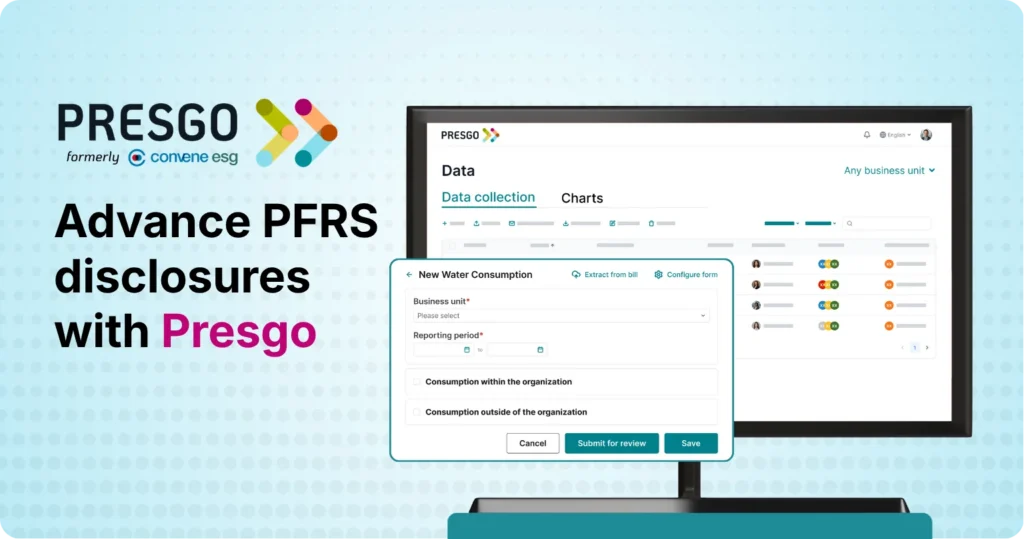
Reporting PFRS S1 and S2 exposes weak and underdeveloped data systems. The accuracy and efficiency of collaboration, audit trails, workflows, and data analysis depend on what the company uses to hold everything together.
Presgo is an AI-first, modular ESG reporting software built for all that. The platform has the solutions for data collection, carbon accounting, materiality assessment, disclosure management, and report generation. It supports frameworks such as GRI, SASB, ISSB, and local frameworks, like the PFRS, as mandated by the SEC.
Book a demo and see how Presgo can support your PFRS reporting.