
Talk to an ESG Expert about how Presgo can help you!
Our ESG Experts are on-hand to understand your ESG Reporting needs and cater our solution to you. Get in touch to discuss how we can help.
Talk to an ESG ExpertContents
As the urgency to address the impacts of climate change grows, Singapore is taking a significant step forward to strengthen corporate responsibility. The city-state mandated climate reporting for listed companies starting in 2025 to improve transparency, accountability, and sustainability practices across Singapore businesses, making them the first in Asia to do so.
If you want to learn more about this initiative and its impact on the corporate landscape and the broader community, this article provides a detailed overview.
Mandatory Climate Reporting Singapore: Timeline and Requirements
In 2024, the Second Minister for Finance, Chee Hong Tat, announced the new rules in the Parliament of Singapore. In his talk, he detailed the regulations’ requirements for aligning businesses with IFRS’s International Sustainability Standards (ISSB) and promoting responsible practices.
The Accounting and Corporate Regulatory Authority (ACRA) and the Singapore Exchange Regulation published updated climate reporting requirements in August 2025.
Below are the key elements you need to know:
Timeline
ESG reporting in Singapore is being done in phases for listed and non-listed companies. This allows companies and authorities to assess risks, adapt gradually, build capacity, and align their processes with sustainability goals. Here is the timeline for the latest ESG reporting mandate:
1. Listed Companies
- FY2025
In the first year, listed companies must prepare climate reporting consistent with the International Sustainability Standards Board (ISSB). This involves reporting on scope 1 and scope 2 emissions. Scope 1 emissions refer to direct greenhouse gas (GHG) emissions from company-owned sources, such as emissions from the combustion of fossil fuels. Scope 2 emissions encompass indirect emissions like purchased electricity, heat, or steam. - FY2026
Listed companies adopt a phased approach based on size and market capitalisation. The largest listed companies, Straits Times Index (STI) constituents, must report scope 3 emissions starting FY2026, while scope 3 remains voluntary for all other listed issuers for now. These emissions represent the entire value chain, including those from suppliers, customers, and other stakeholders. - FY2028
Broader ISSB-aligned climate disclosures for non-STI listed companies with a market cap of no less than S$ 1 billion. This will begin in phases from FY2028 onwards, depending on market capitalisation, with smaller listed issuers given a longer transition period. - FY2029
External limited assurance on scope 1 and scope 2 emissions is expected to be required from FY2029 for all listed companies.
Related Reading: Singapore Exchange (SGX) Sustainability Reporting Guide
2. Large Non-Listed Companies
Larger, non-listed companies will follow a similar timeline. Large non-listed companies with revenue exceeding S$1 billion and assets in excess of S$500 million will begin mandatory climate reporting from FY2030, with scope 1 and scope 2 disclosures following ISSB-aligned requirements. External limited assurance for scopes 1 and 2 is expected in FY2032.
Scope 3 reporting may require more time for companies to build their data collection and verification capabilities. Because of that, scope 3 disclosures remain voluntary for now. Any future decision to mandate scope 3 reporting will depend on the readiness of the industries, with sufficient notice provided to them in advance.
Exemptions
There are, however, several exemptions and transitional provisions from mandatory climate reporting in large non-listed companies.
Firstly, they are relieved of the mandatory reporting if the parent company, whether immediate or intermediate, is already subject to climate reports in Singapore or similar standards, such as the European Sustainability Reporting Standards (ESRS).
Secondly, recognising that some companies may have started climate reporting using different internationally recognised standards and frameworks, large non-listed companies may be exempt from filing in Singapore if their publicly available parent company reports under ISSB-aligned or equivalent standards are subject to conditions. A transitional exemption also applies to some companies that report under widely recognised frameworks before the ISSB rules become mandatory.
Scope of the Mandate
Companies need to disclose in their ESG report information related to their climate-related impact, including:
- Greenhouse gas emissions, particularly scope 1, 2, and 3 emissions
- Energy consumption and energy-related emissions that are relevant to climate performance
- Climate-related risks, opportunities, and governance that are in line with ISSB requirements
Benefits of the New Mandate to Singapore Businesses
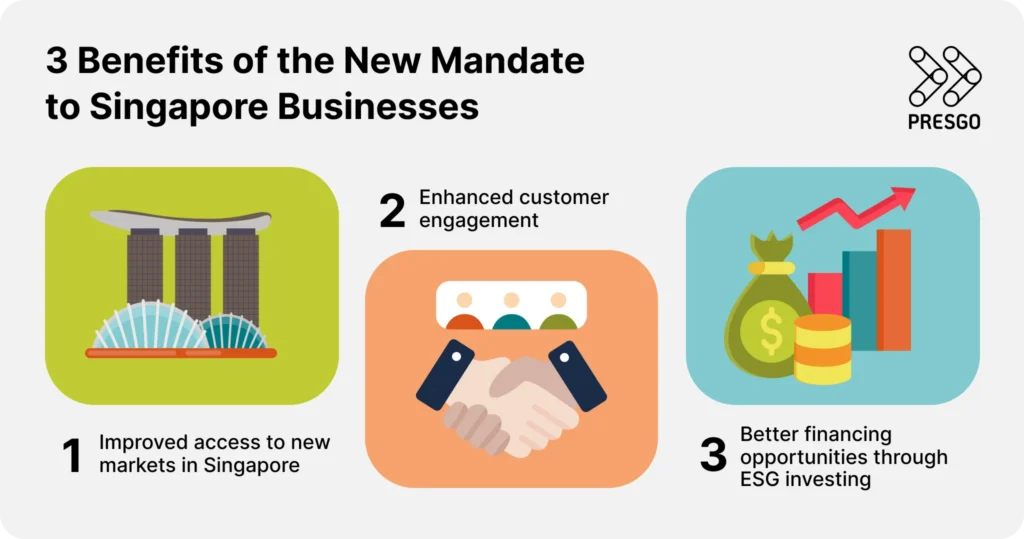
Preparing for the new ESG reporting regulation may be challenging or burdensome for some companies, but the pros outweigh these initial difficulties. In the statement announcing the new rules, Singapore companies that are able to provide climate disclosures will benefit from:
Improved access to new markets in Singapore
Companies that disclose climate-related information transparently gain a competitive edge because stakeholders now prioritise sustainability. Recent SGX-listed companies have shown an increasing trend of valuing eco-friendly practices. By prioritising environmental responsibility, firms can tap into these emerging markets that are heavily focused on renewable energy, sustainable supply chains, and green technologies.
Enhanced customer engagement
Climate-conscious consumers seek products and services from companies aligned with their values. Therefore, companies that actively address climate risks and opportunities appeal to these customers, who are more inclined to support and advocate for such businesses.
Better financing opportunities through ESG investing
Investors increasingly integrate environmental, social, and governance factors into their decision-making. In this sense, Singapore businesses with robust climate reporting are more attractive to investors seeking sustainable investments. This increased appeal gives these companies easier access to capital markets and offers them more financing options.
Singapore Government’s Sustainability Reporting Grant
The government’s push for better sustainability reporting shows its dedication to a greener economy. But, along with this commitment comes the rising cost obligations. A study by the Sustainability Institute by ERM reveals that corporate issuers spend over $675,000 annually on climate-related disclosures. In comparison, institutional investors spend nearly $1.4 million on average to gather, analyse, and report climate data.
To aid large companies in getting ready for the new regulation, Singapore offers funding to cover almost one-third of the cost of producing their initial ESG reports. Qualifying expenses may include data collection, analysis, and seeking external assurance for the report.
This initiative was administered by the Singapore Economic Development Board (EDB) and Enterprise Singapore (EnterpriseSG) to support large companies with annual revenues of $100 million and above. The guidelines state that these companies can avail of financial aid for up to 30% of their expenses, which is capped at S$150,000, or whichever is lower.
While SMEs are not mandated to report, the government has announced its plans to provide funding support covering up to 70% of the costs incurred from their first sustainability reports. This program, specific to SMEs, offers additional support, covering up to 50% of sustainability reporting costs for the following two years through EnterpriseSG.
Additionally, due to skill gaps in sustainability reporting, EDB and EnterpriseSG are collaborating with the National University of Singapore and Nanyang Technological University to create training programmes focused on carbon management, services, and trading. These courses enable workers and interns to seize opportunities in this area.
Future of Climate Reporting in Singapore
Despite its limited land area, Singapore has emerged as a beacon of environmental consciousness. The city-state seamlessly integrates green spaces into its urban landscape, promotes smart infrastructure, and actively embraces circular economy principles through initiatives like the Closing the Waste Loop campaign, among other initiatives. These efforts also reflect the broader ambitions of the Singapore Green Plan 2030, which targets sustainable development across the economy.
As Singapore continues to lead by example in environmental stewardship, the introduction of mandatory climate reporting further solidifies the country’s commitment to sustainability. It sets a precedent for corporate responsibility on a global scale. This new mandate allows companies to:
- Promote more accountability and transparency in the companies’ environmental practices.
- Establish specific metrics to measure climate risks and set up quantitative targets to ensure companies actively work toward reducing their environmental impact.
- Better understand the financial implications of climate-related risks and opportunities and allow them to make informed decisions that align with their financial goals.
In the coming years, smaller companies may eventually face reporting obligations, and technology will play a bigger role in streamlining the process.
Future-Proof Your ESG Reporting with Presgo

Singapore’s mandatory climate reporting initiative continues to evolve as companies prepare for one of Asia’s most advanced carbon disclosure policies. This gives companies time to build capabilities and data systems that meet global expectations.
Businesses can utilise sustainability software like Presgo to navigate this process effectively.
Presgo is a reliable reporting software that provides a modern, practical solution for organisations managing complex sustainability requirements. Built as an AI-first, modular ESG platform, Presgo consolidates performance tracking and ESG data collection, including emissions tracking and supplier data intake, into one audited record. This includes report generation tailored to evolving regulations with built-in compliance support for GRI, SASB, ISSB, ESRS, and local rules, such as SGX and other stock exchange requirements. Presgo is designed to go beyond basic reporting. Book a demo with us.