


Talk to an ESG Expert about how Presgo can help you!
Our ESG Experts are on-hand to understand your ESG Reporting needs and cater our solution to you. Get in touch to discuss how we can help.
Talk to an ESG ExpertFor most banks, the largest source of climate impact is not the electricity used in office operations or the fuel consumed by a company fleet. It is embedded in the loan book and investment portfolio. This area is what Scope 3 Category 15 covers: the emissions attributable to an institution’s lending and investment activities.
This category carries particular weight in Singapore, where climate disclosure requirements for banks and listed issuers are tightening on a defined timeline. In this article, understand why reporting Category 15 emissions has moved from a voluntary practice to a compliance priority.
What is Scope 3 Category 15?
Scope 3 Category 15, commonly known as financed emissions, is the GHG Protocol category covering the greenhouse gas emissions attributable to a bank’s loans, investments, and other financial activities. From the categories set out in the GHG Protocol’s Corporate Value Chain (Scope 3) Standard, this category is the most relevant to banks and other financial institutions.
In practice, this means that when a bank funds a manufacturing plant, extends a mortgage, or holds equity in a listed company, it becomes indirectly responsible for a proportional share of that borrower or investee’s emissions, based on the size of its financial exposure.
Category 15 reporting relies on a methodology developed by the Partnership for Carbon Accounting Financials (PCAF), now used by most banks to calculate this exposure. The GHG Protocol has reviewed and endorsed the resulting standard as the recognised approach for the financial sector.
Why does Category 15 matter for Singapore banks?
Category 15 matters for Singapore banks primarily because the MAS treats it as a core part of climate risk management, not a voluntary add-on. Under its Guidelines on Transition Planning, MAS expects banks to identify, measure, and manage this exposure across their loan and investment portfolios. Among the 15 Scope 3 emissions categories, Category 15 has been the most scrutinised by regulators, as lending and investment are at the core of what banks do.
For Singapore banks specifically, the city-state’s ambitions to be a regional green finance hub further compounded this scrutiny. The Monetary Authority of Singapore (MAS) first proposed its Guidelines on Transition Planning in an October 2023 consultation, and finalised them in March 2026 as an addendum to its 2020 Environmental Risk Management Guidelines, with an effective date of September 2027 following an 18-month transition period. The finalised guidelines make clear that financial institutions are expected to actively support borrowers and investee companies in decarbonising, rather than simply divesting from harder-to-abate sectors. That expectation depends on banks first being able to measure where their Category 15 exposure sits.
What types of investments fall under Scope 3 Category 15?
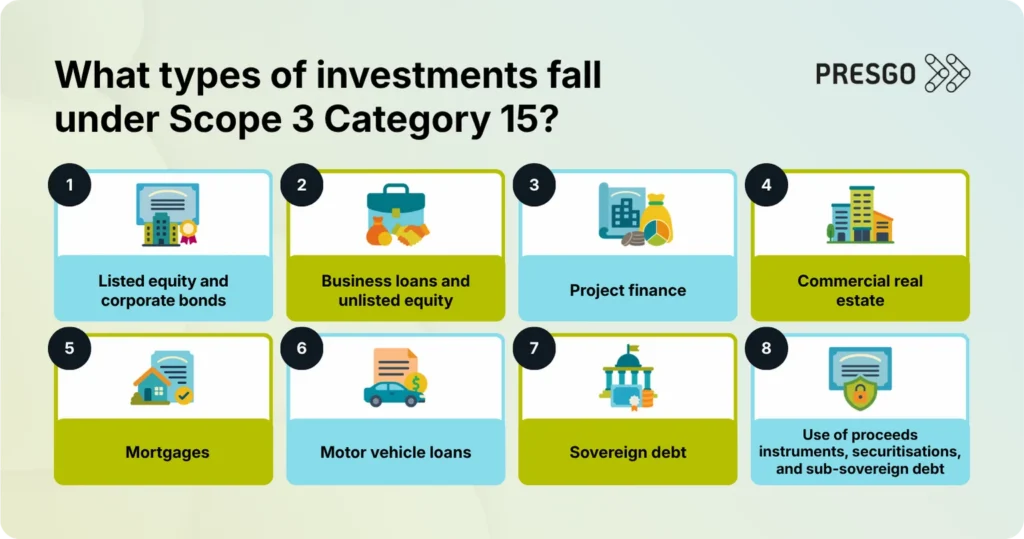
The GHG Protocol defines Scope 3 Category 15 as a single category covering all financed emissions but does not prescribe how to break it down by investment type. PCAF’s Global GHG Accounting and Reporting Standard, now in its third edition, fills that gap, dividing Category 15 into ten distinct asset classes, each with its own calculation methodology. These asset classes include:
- Listed equity and corporate bonds: Publicly traded shares and debt instruments
- Business loans and unlisted equity: Lending to and stakes in private companies
- Project finance: Loans tied to specific infrastructure or industrial projects
- Commercial real estate: Loans secured against commercial property
- Mortgages: Consumer and/or residential property loans
- Motor vehicle loans: Auto financing
- Sovereign debt: Government bonds and related instruments
- Use of proceeds instruments, securitisations, and sub-sovereign debt: Added in more recent editions to reflect the growing range of financial instruments banks hold
Most Singapore banks will find their exposure concentrated in business loans, commercial real estate, and listed equity and bonds, given the structure of the domestic banking sector.
What are the climate disclosure requirements for Singapore banks?
Singapore banks face a phased set of climate disclosure requirements, aligned with the ISSB’s IFRS Sustainability Disclosure Standards. SGX-listed issuers must report scopes 1 and 2 emissions from FY2025, while Straits Times Index constituents must meet broader ISSB-aligned disclosures from FY2025. Scope 3 emissions, including Category 15, are mandatory from FY2026.
Specifically for banks and other financial institutions, MAS has adopted a supervisory approach rather than a pure disclosure mandate. Its Guidelines on Transition Planning set expectations that banks identify, measure, and manage this exposure as part of broader climate risk management, building on the environmental risk management guidelines MAS first introduced in 2020.
Large non-listed companies with at least S$1 billion in annual revenue will also face ISSB-aligned reporting requirements from FY2027. However, scope 3 disclosure for this group is being phased in more gradually, per the World Resources Institute‘s analysis of Singapore’s climate disclosure trajectory.
Taken together, this means Singapore banks are working against two overlapping timelines: MAS’ Guidelines on Transition Planning, effective from September 2027, and the phased scope 3 disclosure requirements landing on their listed clients from FY 2026. Category 15 data needs to be reliable before either deadline arrives, both to meet MAS’ supervisory expectations for transition risk planning and to support the emission disclosure requirements of banks.
How can Singapore banks measure and calculate Category 15 emissions?
Singapore banks calculate Category 15 emissions by multiplying a borrower’s total emissions by the bank’s proportional financial stake in that borrower. The stake is calculated as the outstanding loan or investment value divided by the borrower’s total value, typically total equity plus debt.
Category 15 emissions = (Outstanding loan or investment value Borrower’s total value) Borrower’s total emissions
Beyond this attribution formula, the PCAF standard also structures Category 15 accounting into three parts, based on the type of financial activity involved:
- Part A covers the emissions embedded in loans and investments held on the balance sheet
- Part B covers facilitated emissions from capital markets activity such as underwriting
- Part C covers insurance-associated emissions
For most banks, Part A is the starting point.
A key feature of the PCAF methodology is its scoring system for data quality, which rates the reliability of the underlying emissions data from 1 (verified, reported data) to 5 (proxy data based on sector averages or estimates). Most Singapore banks use this methodology, at least initially, as they rely heavily on estimated data for smaller or unlisted borrowers, and being transparent about that data quality is itself part of credible reporting.
What are the key challenges for Singapore banks in measuring Scope 3 Category 15 emissions?
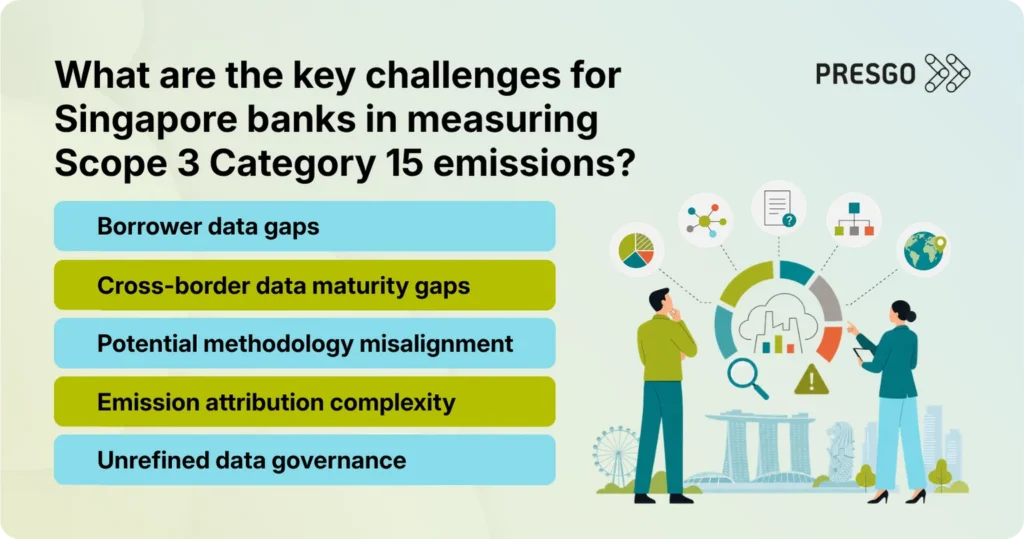
Singapore banks face these recurring obstacles when building out Category 15 reporting:
- Borrower data gaps: Many small and medium-sized enterprises, which make up a large share of Singapore bank lending, do not measure or report their own emissions, forcing reliance on sector-average proxy data.
- Cross-border data maturity gaps: Singapore banks lend and invest across Southeast Asia and beyond, where disclosure maturity and data availability vary significantly by market.
- Potential methodology misalignment: Reconciling the PCAF asset-class approach with ISSB and MAS supervisory expectations requires careful mapping, particularly as guidance continues to evolve.
- Emission attribution complexity: Calculating proportional emissions attribution across diverse asset classes, from project finance to mortgages, requires different data inputs and formulas for each.
- Unrefined data governance: The underlying data typically needs to be pulled from credit systems, portfolio management platforms, and third-party emissions databases, none of which were built with this reporting requirement in mind. This results in inconsistency, and sometimes, inaccuracy.
How can Singapore banks reduce and improve Category 15 reporting?
Singapore banks can reduce and improve Category 15 reporting through a mix of borrower engagement, better data practices, and underwriting changes. This is not just about divesting from carbon-intensive sectors.
When MAS first announced its supervisory approach to transition planning in 2023, Managing Director Ravi Menon said indiscriminate divestment from carbon-intensive activities would not achieve a net-zero economy. Banks should instead help clients decarbonise through credible transition plans, even if doing so leads to a short-term increase in portfolio emissions.
In practice, this means banks can:
- Engage borrowers directly on their own emissions measurement and transition planning, rather than waiting for regulation to force the issue.
- Prioritise data quality improvements where they will have the most impact, starting with the largest or highest-emitting exposures in the portfolio.
- Build sector-specific decarbonisation criteria into lending and investment decisions, so climate risk becomes part of underwriting rather than an afterthought.
- Standardise data collection across credit, risk, and sustainability teams, so Category 15 figures are consistent and auditable year over year.
- Document data quality scores transparently, so stakeholders understand which figures are based on verified data versus estimates, and can track improvement over time.
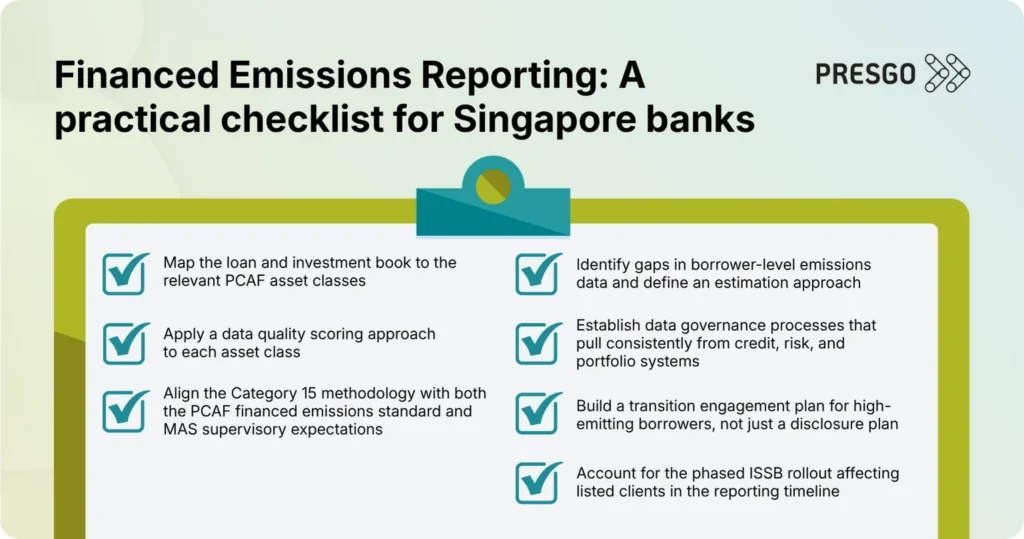
Financed Emissions Reporting: A Practical Checklist for Singapore Banks
Before the next reporting cycle, it’s important to work through the following:
How Presgo Can Help Singapore Banks Manage Scope 3 Category 15 Emissions
Category 15 reporting touches credit data, portfolio data, and emissions factors all at once, which is exactly the kind of fragmented, multi-source reporting challenge that becomes unmanageable in spreadsheets.
Presgo is a modular, AI-first ESG reporting platform built to handle exactly this kind of complexity, letting banks pull together disparate data sources into a single, auditable reporting workflow. The platform’s Carbon Calculator supports emissions calculations using sector-specific and global emissions factors, giving banks a transparent, auditable way to convert portfolio data into Category 15 figures.
The ESG reporting software is also built to support the full range of scope 3 emissions categories, from Category 15 to the value chain reporting that non-financial clients will increasingly ask their lenders about. Combined with its Data Hub for centralising data across teams, and AI validation and anomaly detection for catching gaps before they reach a regulator or auditor, Presgo helps Singapore banks build Category 15 reporting that is ready for what MAS and the ISSB rollout expect next.
Book a demo today to learn how Presgo can support your Scope 3 Category 15 reporting.