Contents
- What are financed emissions?
- How can Hong Kong companies measure in scope 3 category 15?
- Where do financed emissions fit in Hong Kong disclosure rules?
- What are the steps to measure and disclose financed emissions?
- Why should Hong Kong financial institutions measure financed emissions?
- What are the best practices for reporting financed emissions for Hong Kong institutions?
- FAQs on Financed Emissions under HKFRS S2
- Streamline HKFRS S2 Financed Emissions Reporting with Presgo
Financial institutions rarely produce carbon emissions directly within their offices, staff travel, or data centres. The bulk of their emissions come from the loans they issue and the investments they make. Due to the risks of these emissions, Hong Kong has recently been requiring its banks, insurers, and asset managers to disclose them through standards such as the HKFRS.
This article covers what Hong Kong companies should know about financed emissions and how banks and insurers can measure and report them.
What are financed emissions?
Financed emissions are scope 3 greenhouse gases (GHGs) produced by the companies and projects that financial institutions lend to or invest in.
The GHG Protocol’s Corporate Value Chain Standard lists 15 scope 3 categories. Scope 3 category 15 covers a company’s investments and financed emissions. These emissions include a company’s investment portfolio, equity, debt, project finance, and managed investments. For a bank or insurer, this one category usually overshadows everything else scope 3 could capture.
How can Hong Kong companies measure in scope 3 category 15?
The Partnership for Carbon Accounting Financials (PCAF) is the practical bridge between the accounting standard and the actual calculation.
A coalition of Dutch banks, founded in 2015, has since grown to more than 700 financial institutions across five continents. The reporting standard built the calculation method that almost everyone now uses to measure PCAF-financed emissions. The GHG Protocol reviewed the calculation framework and found that it conforms to the protocol’s scope 3 emissions category 15.
Where do financed emissions fit in Hong Kong disclosure rules?
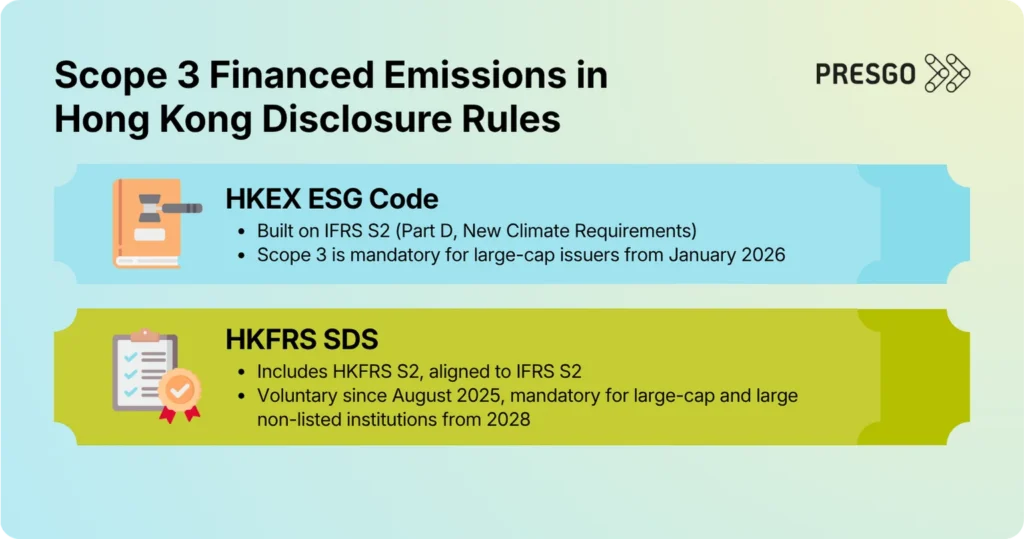
Financed emissions sit inside two Hong Kong disclosure regulations, HKEX ESG Code and HKFRS SDS. Both frameworks touch on scope 3 emissions reporting but they are not on the same timeline.
HKEX ESG Code
HKEX ESG Code’s interim climate rules are under Part D for New Climate Requirements, built directly on IFRS S2. Scope 1 and 2 GHG disclosure has been mandatory for all listed issuers since 2025. The wider scope 3 started in January 2026 for large-cap issuers, while the main board issuers still report on a comply-or-explain basis, and the GEM-listed issuers stay voluntary.
HKFRS SDS
The Hong Kong Institute of Certified Public Accountants (HKICPA) published the HKFRS Sustainability Disclosure Standards (SDS), which include the HKFRS S2. It has been available for voluntary use since August 2025 and became mandatory for large-cap issuers and large non-listed institutions from 2028.
A further consultation in 2027 will look at shifting listed entities from these interim HKEX rules to the full HKFRS SDS.
What are the steps to measure and disclose financed emissions?
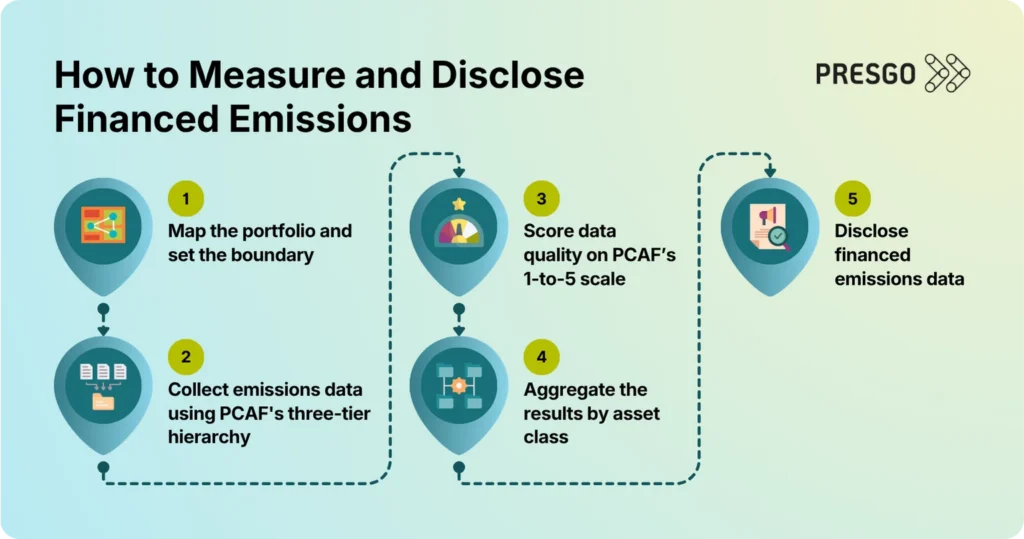
Measuring financed emissions, or scope 3 category 15, runs from mapping the portfolio to collecting data, then calculating and disclosing the final figure.
1. Map the portfolio and set the boundary
PCAF’s Part A, first published in 2020, is the core financed emissions standard. It sets out calculation methods for the seven core asset classes to identify the specific scope and boundary of the emissions to be disclosed.
- Listed equity and corporate bonds: This asset class covers enterprise value including cash (EVIC) of publicly traded stocks and bonds market.
- Business loans and unlisted equity: This refers to the borrower’s total equity plus debt.
- Project finance: This amount is for the bank’s share of total project value.
- Commercial real estate: The asset class pertains to the property value at origination, specifically made for businesses and corporate revenue.
- Mortgages: The asset class pertains similarly to the property value at origination but to individual consumers for personal, residential purposes.
- Motor vehicle loans: This asset class refers to the vehicle value at origination.
- Sovereign debt: This covers the country’s public-private partnerships (PPP)-adjusted GDP share of production- or consumption-based emissions.
For capital market issuances and underwriting, like bond arranging or share placements, these fall under the separate Part B (facilitated emissions) and Part C (insurance-associated emissions). Identifying the boundary early ensures that scope emissions remain consistent once HKFRS S2 disclosure begins.
2. Collect emissions data using PCAF’s three-tier hierarchy.
The PCAF standard is structured with a three-tier hierarchy of data types.
- Emissions the borrower has already reported and verified
- Physical activity data when reported figures aren’t available
- Least precise option applies sector-average economic proxies, based on revenue or output, when no other data exists
The strict hierarchy of preferred data follows that institutions first work on actual verified data specific to the borrower. The logic then follows that companies can only move to the next tiers when the preferred data is unavailable.
3. Score data quality on PCAF’s 1-to-5 scale
The three tiers map onto PCAF’s wider five-point data quality score. The scale runs from one for verified data through five for fully estimated figures. This means the lower the score, the better, and the score should travel alongside the emissions figure in any disclosure. Continuous reporting improves a portfolio’s average data quality score, as more borrowers start reporting directly instead of relying on estimation.
In 2022, HSBC disclosed an exposure-weighted PCAF score of 2.9 for scope 3 oil and gas financed emissions, based on its 2019 and 2020 data. By 2024, the score was 2.8, calculated as a weighted average based on financing. Following the PCAF scoring range, with 1 being the highest, this shows an improvement in reported data quality.
4. Aggregate the results by asset class
Once every exposure has an attribution factor and a data quality score attached, the total results are then documented. Scope 3 emissions are separated from scopes 1 and 2 within the borrower’s footprint, since HKFRS S2 expects the visibility of that distinction. The final numbers are then disclosed against the governance, strategy, risk, management, and metric pillars the standard requires.
5. Disclose financed emissions data
Disclosure runs through the same channel as the rest of a company’s climate reporting. Listed issuers publish their figures in their ESG report, which is released alongside the annual report on HKEX news and the company’s own website, within four to five months of financial year-end. Non-listed financial institutions will file the same numbers inside their own annual reporting once HKFRS S2 becomes mandatory for them in 2028.
Why should Hong Kong financial institutions measure financed emissions?
For most banks, financed emissions are often larger than emissions from offices, branches, and business travel. Because of this, financial institutions are at risk in several aspects:
Actual carbon footprint impact is much larger
Based on 2021 estimates in a policy paper by CSHK, or the Research Centre for Sustainable Hong Kong, banks were associated with 34.57 million tCO₂e of scope 3 financed emissions. The number is about 93 times the 370,000 tCO₂e of operational emissions shown for banks in the same analysis. That gap changes the way climate exposure shows up on a bank’s balance sheet. A borrower with carbon-heavy assets can create risk for the lender, and tighter regulation, carbon footprint, and reputational impact can all travel back to the institution providing the capital.
Regulators see financed emissions as risk
Given the overall weight of financed emissions compared to scope 1 and 2 numbers, regulators see this underreported data as a financial risk. Banks that can’t see a borrower’s emissions exposure can’t price or trace that borrower’s transition risk either. Whether that is future carbon costs or mispricing, it eventually shows up as credit risk. This importance shows in the Hong Kong Monetary Authority’s Sustainable Finance Action Agenda, calling on banks to reach net-zero financed emissions by 2050. Scope 3 and financed emissions disclosure won’t stay optional for some companies. HKFRS S1 and S2 standards are becoming mandatory in phases, with full adoption, including financed emissions, expected for large-cap issuers and large financial institutions by 2028.
Local and global market advantage
Banks may feel the pressure from regulators when it comes to data, but they also know investors weigh that data the same way. When a Hong Kong bank issues its own bonds or raises capital from institutional investors, that bank becomes an asset on somebody else’s books. Plenty of those local and global investors are legally required by their home regulators to report their own financed emissions. This is the case in the EU with the SFDR and CSRD regulations and frameworks. This means banks that produce clear and clean data are at a high advantage for these financial transactions.
What are the best practices for reporting financed emissions for Hong Kong institutions?
Banks with effective disclosures treat emissions as a live and continuously developing figure. To improve financed emissions reporting, these are the best practices of Hong Kong banks:
Set targets for specific carbon-intensive lending sectors
KPMG’s 2025 benchmark of 33 major banks found most institutions already limit targets to a handful of carbon-intensive lending sectors, since that’s where the data is strongest and the exposure most concentrated. HSBC follows this model with its 2030 financed emissions targets. It separates them across seven sectors, including oil and gas, power and utilities, and thermal coal mining, instead of having only one number to cover the whole portfolio.
Improve data quality scores year over year
The PCAF standard grades every position on a 1-to-5 scale, from verified reported emissions down to sector-average estimates. Getting a score on PCAF is a baseline to start with financed emissions reporting.
The Bank of East Asia has used PCAF’s technical guidance since joining as a signatory in 2022 and co-organised a workshop with PCAF and the Hong Kong Green Finance Association in December 2025 to help other local banks move up that same scale.
Match HKFRS S2’s reporting boundary
HKFRS S2 requires scope 1 and 2 emissions to be presented separately from scope 3 emissions data. Each scope 3 data is categorised per asset class with its own calculation method and scoring. Presgo’s HKFRS S1 and S2 guide breaks down that boundary requirement in full.
Feed the data into credit risk models
The HKMA’s GS-1 Climate Risk Management module already expects banks to include climate risk into governance, strategy, and risk management. Hang Seng Bank has already built this in, folding climate considerations into its new money request process for wholesale lending after identifying the six sectors carrying its highest climate transition risk.
Getting there without a centralised system means stitching together counterparty data, attribution factors, and PCAF scores by sector. ESG reporting software built for financial institutions can hold that structure natively, applying attribution calculations, data quality tagging, and audit trails in one place.
FAQs on Financed Emissions under HKFRS S2
1. Is PCAF mandatory under HKFRS S2?
No. Although PCAF has become the default standard and most institutions now expect it, HKFRS S2 doesn’t mandate a specific calculation method.
2. How often does a company need to update its financed emissions figures?
Annually, alongside the rest of its climate disclosures. Numbers can change year to year even without new financing activity, since emissions, company valuations, and outstanding loan balances all move.
3. Does a lower PCAF score mean a company is doing something wrong?
No. It is more a reflection of data availability. A high initial reliance on estimates is normal in early reporting years and is expected to improve as counterparty disclosure matures.
Streamline HKFRS S2 Financed Emissions Reporting with Presgo
Financed emissions data touches carbon accounting, credit risk, and disclosure teams at once, which is where manual and outdated processes can risk reporting accuracy and credibility.
Presgo is an AI-first, modular ESG reporting software built to hold all that data together. Its carbon calculator applies verified emission factors across scopes 1, 2, and 3, and its supplier ESG module targets the complexity of scope 3 data. Presgo ESG software is equipped with a data hub that centralises portfolio and counterparty data, enabling financial institutions to map exposures to HKFRS S2’s disclosure pillars, which are aligned with PCAF’s framework.
Book a demo today to optimise your financed emissions reporting.