Contents
- What are the HKFRS S1 and S2?
- What other HKEX and Hong Kong ESG reporting requirements should companies comply with?
- Why Hong Kong ESG Reports Fall Short of HKFRS S1 and S2
- How can businesses prepare for compliance with the HKFRS?
- How can ESG software help with preparing HKFRS-aligned reports?
- Creating HKFRS-Aligned Reports With Presgo
Since FY 2025, the Hong Kong Exchange’s “New Climate Requirements” have made scope 1 and 2 emissions disclosure mandatory for all listed issuers, extending to full requirements (including scope 3) for LargeCap issuers from FY 2026. HKFRS S1 and S2, meanwhile, took effect on August 1, 2025, on a voluntary basis, with mandatory adoption for listed Publicly Accountable Entities (PAEs) expected only from 2028.
Layered on top of each other, these new requirements are adding pressure to reporting gaps that were already proving difficult for most Hong Kong companies to close. These challenges include thin scope 3 data, missing scenario analysis, weak data governance, and little to no independent assurance.
Explore why Hong Kong companies fall short in complying with ESG requirements and how best practices and ESG reporting software can help.
What are the HKFRS S1 and S2?
The HKFRS S1 and S2 were issued by the Hong Kong Institute of Certified Public Accountants (HKICPA) in December 2024. Fully aligned with the ISSB Standards, the HKFRS S1 sets the general requirements for sustainability-related financial disclosures, while the HKFRS S2 provides the climate-specific disclosures. Together, they form Hong Kong’s baseline sustainability disclosure standards for publicly accountable entities.
HKFRS S1 (General Requirements)
This standard sets the objective, scope, reporting entity concept, materiality process (enterprise value focus), presentation and cross-cutting disclosure requirements, value-chain boundaries, and how sustainability-related financial information should be disclosed.
HKFRS S2 (Climate Disclosures)
This standard requires climate-related risk and opportunity identification, governance and risk management disclosure, metrics and targets (including GHG emissions scopes), and scenario analysis where relevant.
What other HKEX and Hong Kong ESG reporting requirements should companies comply with?
HKFRS S1 and S2 are layered on top of other Hong Kong disclosure regimes that companies are already expected to comply with, which is part of why full HKFRS alignment is proving difficult.
- HKEX ESG Reporting Code: All HKEX-listed issuers, Main Board and GEM alike, must publish an annual ESG report under the ESG code (renamed from the ESG Reporting Guide effective January 1, 2025), covering environmental and social KPIs on a mandatory or comply-or-explain basis.
- HKEX’s New Climate Requirements: Layered on top of the ESG Code, these require scopes 1 and 2 emissions reports from all listed issuers since FY 2025, with full climate disclosures, including scope 3, mandatory for Hang Seng Composite LargeCap Index constituents from FY 2026.
- SFC Fund Manager Code of Conduct (FMCC): Since August 2021, licensed fund managers with investment discretion have had to implement climate-related practices covering governance, investment management, risk management, and disclosure, with a subset of “Large Fund Managers” subject to more comprehensive “enhanced standards”, including the collection and disclosure of scopes 1 and 2 emissions data.
- HKMA Supervisory Policy Manual (GS-1): Since December 2021, the Hong Kong Monetary Authority has provided guidance to authorised institutions on climate risk management, including effective risk governance, risk management principles, and recommendations for climate-related financial disclosures.
For companies operating across these overlapping regimes, the sheer number of disclosure frameworks to track makes it easy to fall behind. This also reinforces why so many Hong Kong businesses aren’t positioned yet to meet HKFRS S1 and S2 on top of everything else already in motion.
Why Hong Kong ESG Reports Fall Short of HKFRS S1 and S2
Even companies that have started preparing for the new standards tend to stumble in the same six areas. Much of the problem comes down to the standards’ recency. A 2025 joint research report by DBS Hong Kong and KPMG identified three critical gaps in the climate disclosure and transition readiness of Hong Kong-listed companies: gaps in data, knowledge, and financial plans. However, the gaps go deeper than awareness alone.
Scope 3 emissions collection and measurement gaps
Scope 3 (value chain) emissions are consistently the hardest metric for companies to report accurately, since the data sits with suppliers, customers, and other third parties outside the reporting entity’s direct control.
In Hong Kong, this gap is about to become a compliance problem rather than just a data problem. Globally, a lack of data from suppliers is the most commonly cited barrier to scope 3 measurement, followed by a lack of standardised methodologies and the sheer complexity of the calculations involved. Most companies still lack the supplier engagement processes and estimation methodologies needed to produce scope 3 figures that would hold up under HKFRS S2’s climate metrics and targets requirements.
Lack of scenario analysis
HKFRS S2 requires entities to assess climate resilience using scenario analysis where relevant, typically modelling outcomes across different global warming pathways. Many Hong Kong companies have never conducted this exercise, largely because it requires technical capabilities that lie outside traditional sustainability or finance teams, such as climate modelling and financial forecasting under uncertainty.
Without conducting scenario analysis, companies can’t credibly demonstrate how climate risk translates into financial impact over the short, medium, and long term, which is central to what HKFRS S2 is asking for.
Financial materiality overlaps
HKFRS S1 and S2 are built on a single materiality (enterprise value) lens: a sustainability matter is disclosable if it could reasonably affect the entity’s cash flows, access to finance, or cost of capital.
This is a significant shift for companies used to double materiality frameworks like GRI and CSRD, which also capture a company’s impact on the environment and society regardless of financial consequence. Reports built this way often surface impact-level disclosures without clearly isolating the enterprise-value case HKFRS expects. More broadly, many companies still struggle to translate sustainability topics into disclosures that show a clear effect on strategy, cash flows, risk, and enterprise value.
Inadequate data governance
Sustainability data in most companies is still collected through fragmented systems, manual spreadsheets, or ad hoc requests to different departments, with no single owner accountable for accuracy. Few companies have the internal ownership, controls, or audit trails robust enough to meet the rigour that HKFRS S1 expects of sustainability-related financial disclosures.
Misaligned reporting timelines
HKFRS S1 requires sustainability-related financial disclosures to be reported at the same time as, and covering the same period as, the corresponding financial statements. Most sustainability teams still run on a separate reporting cycle from finance, often compiling ESG data months after the annual report is finalised, a gap that becomes a compliance issue once HKFRS S1 requires the two to move in lockstep.
Lack of independent assurance
Third-party assurance over ESG data remains the exception rather than the rule in Hong Kong. While assurance over sustainability disclosures is not yet mandated, the Accounting and Financial Reporting Council (AFRC) is developing a local sustainability assurance framework, and the Hong Kong Exchange (HKEX) plans a market consultation on mandatory assurance in 2027.
Companies that have not started building assurance-ready data trails now will find themselves scrambling once assurance requirements are formalised, alongside the broader move towards mandatory HKFRS S1/S2 adoption.
How can businesses prepare for compliance with the HKFRS?
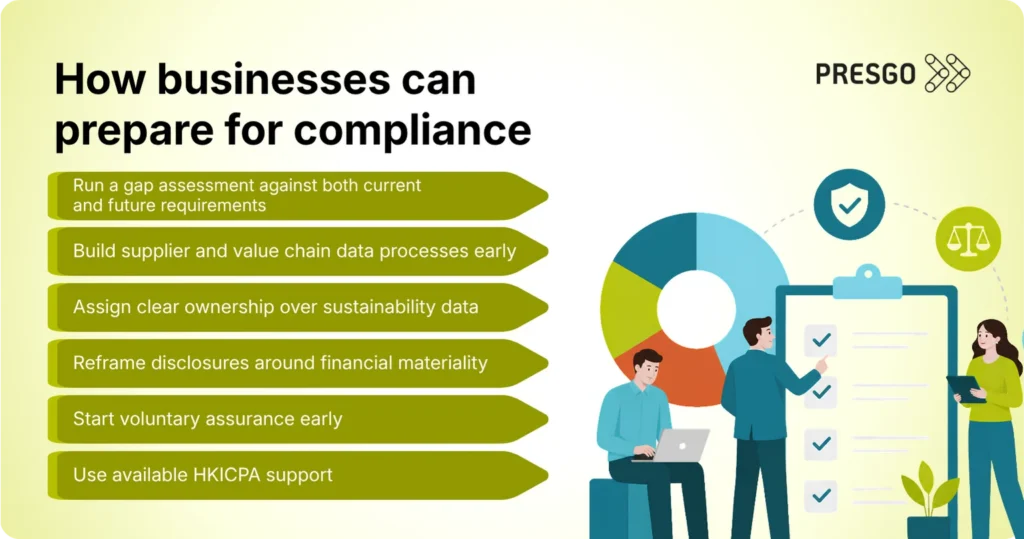
Closing these gaps doesn’t require comparing everything at once, but it does require starting now rather than waiting for the 2028 deadline. A few practical steps can move companies meaningfully closer to compliance:
- Run a gap assessment against both current and future requirements. Benchmark existing disclosures against HKEX’s Part D climate requirements (for what’s mandatory today) and HKFRS S1/S2 (for the 2028 target state), rather than treating them as one exercise.
- Build supplier and value chain data processes early. Since scope 3 emissions depend on data outside the company’s direct control, engaging suppliers now, before it becomes mandatory for LargeCap issuers in FY 2026, avoids a scramble later.
- Assign clear ownership over sustainability data. Moving off spreadsheets and into a governed system, with a named owner accountable for accuracy, positions companies to meet HKFRS S1’s expectation that sustainability disclosures are prepared with the same rigour as financial statements.
- Reframe disclosures around financial materiality. Companies used to double materiality frameworks like GRI should revisit how sustainability topics are translated into effects on cash flows, financing, and cost of capital.
- Start voluntary assurance early. With HKEX planning to consult on mandatory assurance in 2027, companies that begin assurance-readiness work now will be better positioned than those waiting for the mandate.
- Use available HKICPA support. HKICPA has published FAQs and an implementation support platform for stakeholders to raise technical questions, helping companies interpret ambiguous requirements before they become mandatory.
Companies that treat these steps as a phased roadmap rather than a last-minute compliance push are far more likely to meet the 2028 deadline without disruption to their financial reporting cycle.
How can ESG software help with preparing HKFRS-aligned reports?
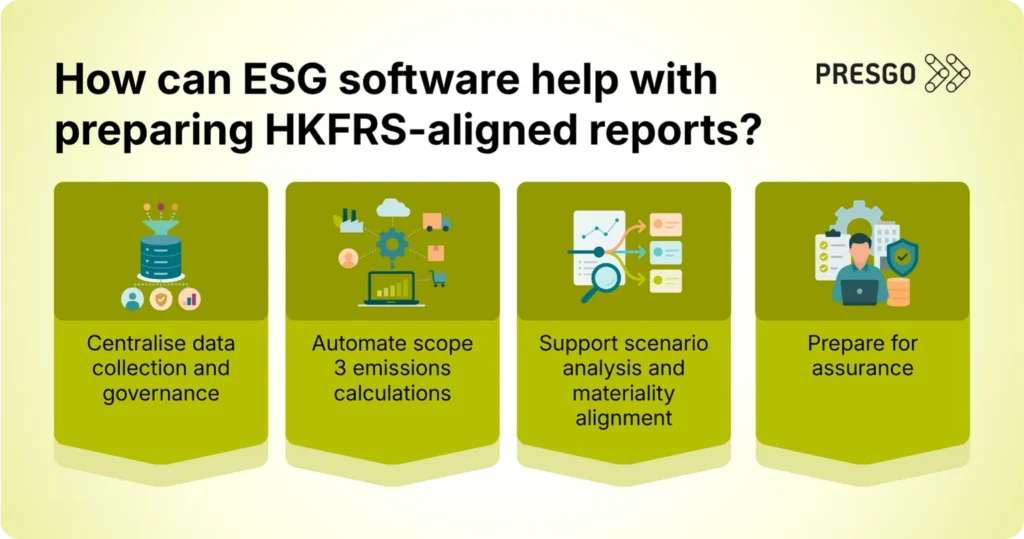
Much of the compliance gap outlined above isn’t a strategy problem but an operational one. Purpose-built ESG software, like Presgo, addresses the mechanics that spreadsheets and manual processes struggle with:
Centralise data collection and governance
ESG software consolidates inputs from multiple departments, sites, and systems into a single source of truth, with audit trails showing who entered what data and when. This directly addresses the data governance gap and supports HKFRS S1’s expectation that sustainability disclosures should carry the same rigour as financial statements.
Automate scope 3 emissions calculations
Modern platforms integrate with procurement, logistics, and supplier systems to estimate and refine scope 3 emissions using recognised methodologies (such as the GHG Protocol), rather than relying on one-off manual data requests. Many also include supplier engagement tools, such as portals or automated survey workflows – making it easier to request and track primary data directly from suppliers instead of chasing responses over email. This gives companies a head start before scope 3 becomes mandatory for LargeCap issuers in FY 2026.
Support scenario analysis and materiality alignment
Some ESG platforms include built-in climate scenario modelling tools, letting companies test financial exposure under different warming pathways without building the capability in-house from scratch. Software with HKFRS- or ISSB-aligned templates can also help translate sustainability topics into the cash flow, financing, and cost-of-capital language the standards require, making it easier to surface the enterprise-value case even for companies used to reporting through a double materiality lens.
Preparing for assurance
Because ESG software maintains a documented, timestamped data trail, it makes voluntary and eventual mandatory assurance considerably easier, since assurance providers can trace disclosed figures back to their source rather than relying on retrospective construction.
Creating HKFRS-Aligned Reports With Presgo
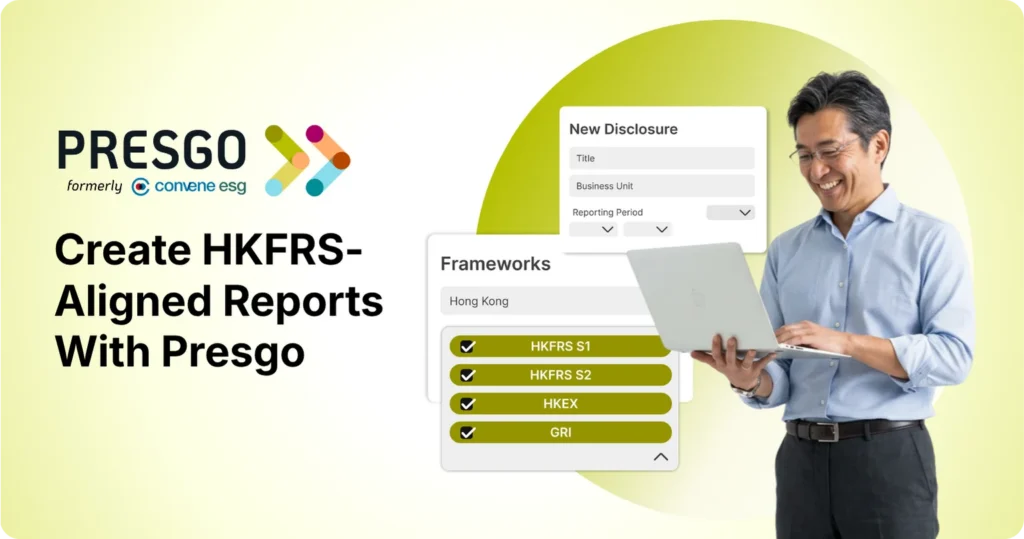
Presgo is an AI-first, modular ESG reporting platform that helps organisations close exactly the gaps outlined above. For companies working toward HKFRS S1 and S2 alignment, Presgo offers a few features that map directly onto the compliance challenges Hong Kong businesses face:
- Centralised Data Hub: Presgo consolidates ESG data across departments and subsidiaries, with validation checks and audit trails that support the governance rigour expected by HKFRS S1 for sustainability-related financial disclosures.
- Carbon Calculator: The platform tracks and reports greenhouse gas emissions across all three scopes, helping companies get ahead of scope 3 requirements before they become mandatory for LargeCap issuers in FY 2026.
- Disclosure Hub: Presgo structures narratives aligned to HKEX and IFRS S2 requirements, including comply-or-explain disclosures, reducing the manual effort of translating raw data into standards-compliant language.
- Framework Mapping: Because Presgo maps data to HKEX ESG Code, IFRS S1/S2, GRI, TCFD, and other frameworks simultaneously, companies preparing for HKFRS S1/S2 don’t need to duplicate work already done for existing HKEX disclosures.
For Hong Kong businesses that recognise they’re behind on requirements, Presgo offers a practical way to close the gap without building every capability in-house from scratch.
Book a demo today to learn how Presgo can get your business HKFRS-ready.