Talk to an ESG Expert about how Presgo can help you!
Our ESG Experts are on-hand to understand your ESG Reporting needs and cater our solution to you. Get in touch to discuss how we can help.
Talk to an ESG ExpertContents
Back then, the only important milestone that mattered to an investor was the steady increase in the company’s profit. However, things began to change, especially when climate change proved to be more than just an imaginary scenario. Affected businesses have experienced lower profits, which have affected their labourers. These non-financial factors have pushed investors to pressure organisations to incorporate ESG into their businesses.
What is ESG?
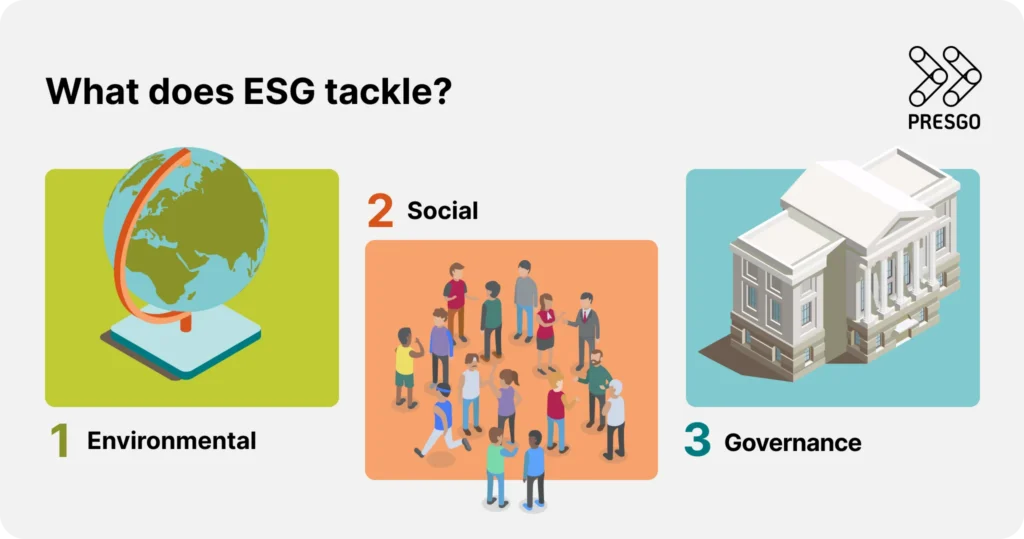
ESG stands for Environment, Social, and Governance, and is a set of criteria that investors are considering in searching and filtering companies that are “socially responsible”. These standards create a holistic approach for business strategies and investor screening by accounting for all the stakeholders — investors, company staff, environment, and society.
Marked by its acronym, ESG focuses on approaching and addressing issues fitting into the categories of environment, social, and governance.
Environment
Environmental standards include the company’s usage of energy resources, policies on waste management, and its impact and efforts towards net-zero emissions and climate change.
With the adverse effects of climate change, like the “climate change bankruptcy” of Pacific Gas and Electric (PG&E), investors are now looking at how company operations manage and disclose their impact on the environment. These specific environmental issues include deforestation, water pollution, and carbon emissions, among others.
Social
Social criteria cover social relationships, focusing on management and employee relationships. This includes human rights, workers’ rights, workplace policies, employee wellness and training, DEI (diversity, equity, and inclusivity), and wages.
Is there armed conflict in a company’s headquarters or at the manufacturing base? Are the workers on strike? Are they paying their workers unfairly? Is the company utilising child labour? These questions are important in the light of social unrest or political instability. The presence of conflict or policies that run counter to an investor’s values will ultimately affect the company’s reputation in the international business community. Sharing obstructive views on social factors adversely affects value creation, making it less attractive for future investments.
Governance
Governance criteria encapsulate issues and efforts involving decision-making, and corporate cultures of transparency, accountability, inclusivity, and compliance. This also includes the relationship with stakeholders, such as shareholders, investors, and customers.
Under this set of criteria, companies must evaluate concerns such as board composition, board-shareholder relationships, financial report transparency, suppliers and regulators’ policies, partner compensation, customer relations, and political stances.
Corporate social responsibility, or CSR, is related to ESG, but these two terms do not mean the same thing. CSR is a business model that drives companies to develop and implement socially responsible programs to bring a positive impact on the community while maximising profit. ESG, on the other hand, is the criterion for assessing the corporations’ impact and initiatives towards being socially responsible.
CSR provides the vision and mission for businesses to be accountable in their sustainability and responsibility agenda, while ESG offers the standards to which social actions and measures are made. To put it simply, CSR is the qualitative side of social commitments, whereas ESG is the quantitative side.
What is the importance of ESG for businesses?
In recent years, there has been growing support for stakeholder capitalism and the long-term impact of companies on society. The effects of the COVID-19 pandemic and climate change have greatly furthered ESG as a long-term initiative. This deviates from how companies take decisive actions for short-term changes. Incorporating ESG is not only essential in risk approaches but has now been seen as an emerging factor for financial growth.
In 2005, a landmark report entitled “Who Cares Wins” resulted from the initiative of incorporating ESG values into the company’s actions. The report argued that non-financial issues, such as environmental, social, and governance concerns, were impacting companies financially and would have long-term effects on the business’s longevity. ESG reports paint a holistic picture of a company’s supply chain management and sustainability in the long term, factors that investors look at before investing in your business.
ESG investing has now become vital for investors as they have seen how the stock price of ESG-focused companies has become more stable, outperforming those with low ESG rankings. Such a statement confirms that companies that are highly oriented in ESG can expect high returns.
Likewise, ESG is not only relevant to the investors but also to the companies themselves. With the pieces of evidence of how incorporating ESG affects their bottom line, companies are now pressured to disclose their impact and further ESG efforts. Pressure mounts also from society and the government, primarily, people issues and regulations. By prioritising sustainable and socially responsible initiatives, it can improve the company’s reputation, potentially attracting more investors.
How can boards take action in initiating ESG?
Incorporating and reporting on ESG can help companies realise the huge potential of ESG within and beyond the organisation. However, some may feel overwhelmed and would not know where to start. Here are some essential actions boards may take to start ESG reporting.
- Understand the stakeholders’ demands: Investors, regulators, and customers are demanding transparency and change towards ESG efforts and performance. Boards must actively engage with the stakeholders to know their perspectives on ESG issues. From there, you can craft an ESG strategy that embeds their demands.
- Understand the ESG data: From your data, you can gain insights to identify the gaps and opportunities. In extracting data, your company needs the right data professionals. They should be able to manage the reporting requirements while regularly checking your ESG performance and the granular ESG data. Understanding the data can help your board develop data-driven ESG strategies.
- Comply with regulatory frameworks: Investors appreciate investing in companies that follow a recognised framework, as it provides a “familiar” and cohesive ESG narrative. There have been various standards and frameworks established, such as TCFD, GRI, and SASB. You need to evaluate the best framework that suits your company.
- Creating a dialogue with the investors: ESG reporting is one way to create conversations with the investors on ESG efforts. It must be accurate, clear, consistent, comparable, and compliant with regulations. With the software made available today, boards can streamline the data compilation and reporting processes that do not compromise the quality of the report.
What does ESG reporting do for a company?
The Institute for Management Development once said that the larger the company, the more inefficient it can be. Without checks and balances in place, sustainability can become a distant reality. In Southeast Asia, where smaller economies flourish, six countries have mandated all listed companies to submit ESG disclosure reports, specifically in Singapore, where ESG reporting is implemented on a comply-or-explain basis.
Annual reports are meant to primarily present the corporate plans, initiatives, and outcomes regarding the financial side. At the same time, sustainability or ESG reporting aims to focus on the direct and indirect environmental and social impact and efforts of the company. Leaving your sustainability data to the annual report may not encompass all your ESG data. Committing to comprehensive ESG reporting can help companies embody the “triple bottom line” or the three Ps: profit, planet, and people. ESG reports present not just the financial performance, but also the environmental and social impact.
How Presgo Empowers the Expansion of ESG and the Demand for Transparency

ESG is more than just a buzzword in the industry. It is a sound strategy for sustainable growth and development, achieving net-zero emissions, taking good care of your employees, and transparency in the decision-making process — all elements that make up a successful enterprise that will help people improve their lives for the long term. With this trend, companies that fulfil their ESG goals will be around for much longer than their non-compliant counterparts.
As the ESG or the sustainability landscape continues to evolve, expectations from different stakeholders will mature, resulting in the increased demand for sustainability reporting requirements globally. Presgo is an AI-first ESG reporting platform focused on accuracy, compliance, and reaching measurable results. The tool is built with ESG expert support to provide automation-ready features to evolve alongside the shifting frameworks and regulatory landscape.
Thinking of how to better capture, report, and track ESG performance? Talk to us today!