Talk to an ESG Expert about how Presgo can help you!
Our ESG Experts are on-hand to understand your ESG Reporting needs and cater our solution to you. Get in touch to discuss how we can help.
Talk to an ESG ExpertContents
- What is ESG reporting?
- Why is ESG reporting important?
- ESG Reporting Standards and Frameworks
- How to Choose the Right ESG Framework
- ESG Reporting Regulations Around the World
- How to Effectively Implement ESG Reporting (Step-by-Step Process)
- Common ESG Reporting Challenges
- Best Practices in ESG Reporting
- Examples of ESG Reports from Top Companies
- How is AI transforming ESG reporting?
- ESG Reporting as a Strategic Advantage
ESG reporting is becoming a core business function, not just a sustainability update. As expectations from investors, regulators, customers, and lenders continue to rise, companies are under increasing pressure to disclose ESG information that is clear, comparable, and credible.
This guide explains what ESG reporting is, why it matters, the standards and regulations shaping it, and the practical steps involved in doing it effectively. It also looks at common challenges, best practices, and how AI-enabled tools can help companies build more efficient and reliable ESG reporting processes.
What is ESG reporting?
ESG reporting is the practice of disclosing data on a company’s environmental, social, and governance (ESG) performance to investors, regulators, and other stakeholders. A company’s ESG report measures the ethical impact and operational risks of its business practices alongside traditional financial metrics.
Compared to annual reports that focus on financial performance for investors and creditors, an ESG report focuses on a company’s non-financial performance. It discloses qualitative policies and quantitative indicators such as greenhouse gas emissions, energy use, and more.
ESG reporting practices vary depending on jurisdiction, company size, and investor expectations:
- Standalone sustainability report: Many companies publish a separate ESG/sustainability report annually or biannually.
- Integrated report: Some firms produce an integrated report that combines financial statements with ESG disclosures in one document, which is common among organisations adopting TCFD principles.
- Incorporated in the annual report: Companies may include material ESG sections within the annual report or provide a sustainability summary alongside it.
- Web disclosures: Increasingly, companies publish ESG data on websites or disclosure platforms rather than as a formal printed report.
ESG Disclosure vs Sustainability Reporting
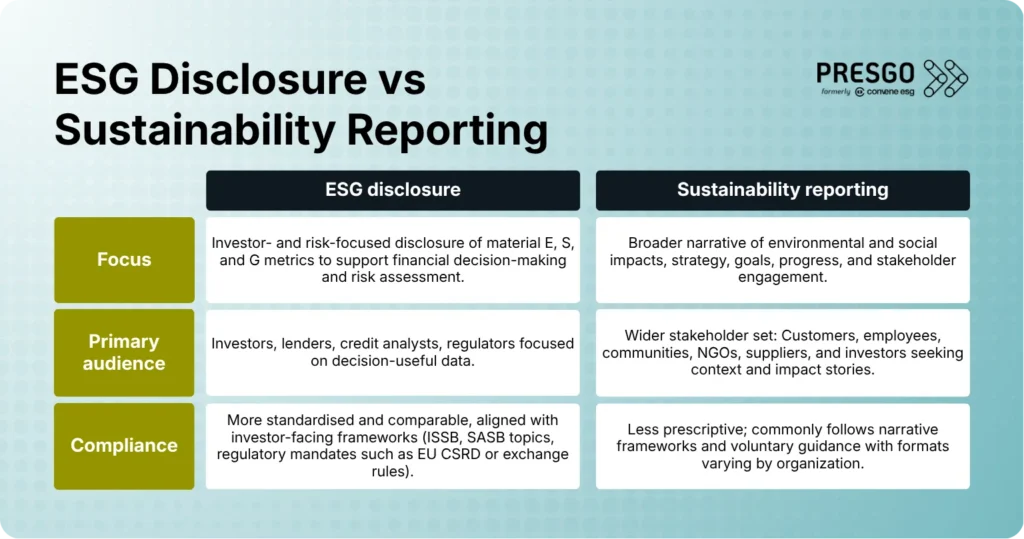
ESG disclosure is a more investor- and risk-focused version of reporting, and tells stakeholders how a company performs on environmental, social, and governance metrics. On the other hand, sustainability reporting is broader and more narrative-based, showing the company’s wider environmental and social impacts, goals, and progress over time.
Who uses ESG reports?
ESG reports are used by different stakeholders for different reasons. In general, they help outside parties assess a company’s risks, performance, and credibility on ESG issues.
- Investors: They use ESG reports to judge long-term risk, resilience, and whether a company is managing sustainability issues well before investing.
- Regulators: They use them to monitor compliance, compare disclosures across companies, and benchmark reporting against global standards.
- Customers: They use ESG reports to evaluate whether a company’s products and practices align with their values, especially on sustainability and ethics.
- Lenders: They use ESG reports to assess credit risk and whether a borrower’s environmental or social exposures could affect repayment or financial stability.
The importance of ESG reporting has grown as it gives stakeholders a clearer view of how a company manages risk, responsibility, and long-term value. It is now a key part of how businesses show accountability and stay credible with the market.
Why is ESG reporting important?
ESG reporting is important because it helps companies show how sustainability issues affect performance, risk, and long-term competitiveness. It also supports clearer communication with investors, regulators, customers, and other stakeholders.
Shows the sustainability impact on business performance
ESG reporting matters because it helps companies see how sustainability issues affect day-to-day performance and longer-term competitiveness. It turns ESG from a compliance exercise into a management tool that can support better decisions, clearer priorities, and stronger alignment with business strategy.
Aligns with investor expectations
Investors increasingly want reliable ESG information to understand a company’s resilience, growth prospects, and exposure to sustainability-related risks. Strong reporting can improve credibility and support access to capital by giving investors something consistent to evaluate.
Supports risk management and compliance
ESG reporting helps companies identify environmental, social, and governance risks earlier, before they become larger operational or financial problems. It also matters more today because disclosure requirements and regulatory scrutiny are continuing to increase across markets.
Upholds stakeholder transparency
Clear ESG reporting builds trust by showing how a company is addressing issues that matter to stakeholders. It gives customers, employees, regulators, and other audiences a fuller picture of performance beyond financial results alone.
Exemplifies ESG maturity
A company’s ESG reporting often reflects how mature its ESG systems, governance, and data processes are. More structured reporting usually signals that the organisation manages ESG in a more disciplined and integrated way.
ESG Reporting Standards and Frameworks
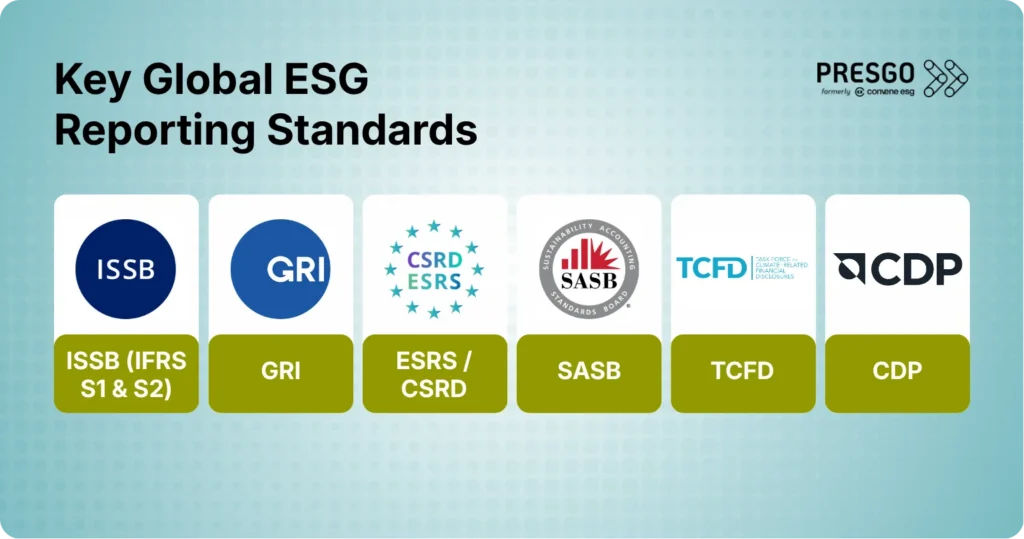
Standards and frameworks give companies a common language for ESG reporting, making disclosures more comparable, decision-useful, and credible across markets. They also help organisations align their reporting with investor expectations, regulatory requirements, and stakeholder needs.
Key Global ESG Reporting Standards
- ISSB (IFRS S1 & S2)
- Set a global baseline for sustainability-related financial disclosures. IFRS S1 covers general sustainability risks and opportunities, while IFRS S2 focuses specifically on climate-related disclosures.
- GRI
- One of the most widely used frameworks for sustainability reporting, GRI emphasises a company’s impact on the economy, environment, and people. It is especially useful for organisations that want to report to a broad range of stakeholders, not just to investors.
- ESRS / CSRD
- The ESRS are the disclosure standards used under the EU’s CSRD, creating detailed sustainability reporting requirements for in-scope companies. They are designed around double materiality, meaning companies report both how sustainability issues affect the business and how the business affects society and the environment.
- SASB
- SASB standards identify industry-specific sustainability topics that are financially material to investors. They are often used to make ESG reporting more focused, comparable, and relevant to capital markets.
- TCFD
- Although many organisations now align with ISSB climate reporting, TCFD remains a key reference point for climate-related financial disclosure centred on governance, strategy, risk management, and metrics and targets.
- CDP
- CDP is a disclosure platform through which companies report environmental data, especially on climate, water, and forests. It is widely used by investors and customers to assess environmental performance and supply chain risk.
How to Choose the Right ESG Framework
With a variety of ESG frameworks and standards available, companies should choose the one that best fits their reporting needs, audience, and compliance obligations.
Review sector-specific guidance
Select frameworks or standards that provide industry-focused metrics or sector guidance. Identify two to three sector-specific guidance sources and map their topic sets against the organisation’s materiality assessment. For example:
- SASB offers industry-specific, financially material metrics appropriate for sectors with clear operational ESG risks (e.g. energy, mining, financials, transport).
- GRI provides sector supplements suited to organisations whose stakeholders require broader sustainability-impact disclosures (e.g. consumer goods, agriculture, public sector).
Confirm mandatory vs voluntary obligations
Establish whether reporting is mandated in relevant jurisdictions and apply the prescribed standard as the primary basis for disclosure and supplement with voluntary frameworks where beneficial. Develop a compliance matrix listing each operating jurisdiction, the mandated standard, and the additional voluntary frameworks required to meet stakeholder expectations.
- Mandatory: Follow jurisdictional requirements where specified (e.g. ESRS under the EU CSRD in the European Union). Some national regimes reference or require elements of ISSB or bespoke national rules.
- Voluntary: ISSB standards are commonly adopted for investor-oriented, globally consistent disclosures, while the GRI remains the leading voluntary choice for comprehensive stakeholder-focused reporting.
Align with investor and lender expectations
Prioritise frameworks that deliver decision-useful, comparable data for capital providers. Consult principal investors and lenders to determine preferred frameworks or metrics, then prioritise alignment with ISSB, SASB, and TCFD as appropriate for capital-market reporting.
- ISSB emphasises enterprise-value relevance and investor decision-usefulness, pairing ISSB with SASB industry metrics enhances sector-level financial materiality.
- SASB continues to be requested by investors for sector comparability and risk assessment.
- TCFD-aligned disclosures remain widely used for climate-related financial disclosures and complement ISSB or SASB reporting.
Map regional and local compliance requirements
Adopt a core-and-layer approach: Select a primary global framework for consistency, then integrate jurisdictional requirements, taxonomies, and local guidance where necessary. Select a core framework for global comparability, then map and integrate jurisdiction-specific layers to meet regulatory and local stakeholder requirements.
- EU: ESRS, under CSRD, is detailed and may require disclosures beyond those in ISSB. Organisations operating in the EU should apply ESRS where applicable.
- Asia-Pacific: Jurisdictions may reference ISSB, require TCFD-aligned climate disclosures, or impose national reporting rules.
- Stakeholder-facing reporting: Use GRI or national sustainability guidance when regulators, communities, or other non-investor stakeholders expect comprehensive impact information.
ESG Reporting Regulations Around the World
ESG reporting is moving quickly from a voluntary practice to a regulated requirement in many markets. The biggest trend today is that companies are increasingly providing more structured, auditable, and comparable sustainability disclosures.
| Framework | Primary purpose | Best suited for |
|---|---|---|
| EU ESRS (CSRD) | Comprehensive, regulatory sustainability disclosures with prescriptive requirements and sector-specific detail | Large and listed companies operating in the EU or organisations required to comply with CSRD |
| ISSB (IFRS S1/S2) | Global baseline for investor-focused, decision-useful sustainability disclosures. Emphasises enterprise value and financial materiality | Organisations seeking ivnestor/lender-aligned, cross-border comparability |
| SASB | Industry-specific, financially material metrics to support capital-market decision-making | Companies in sectors with clear financial ESG risks that require sector comparability (e.g. energy, mining, financials, transport) |
| GRI | Broad stakeholder-focused impact reporting covering environmental, social, and governance impacts, with sector supplements | Organisations reporting to a wide range of stakeholders or needing comprehensive impact disclosures (e.g. consumer goods, agriculture, public sector) |
| TCFD | Climate-related financial risk disclosure guidance focused on governance, strategy, risk management and metrics | Any organisation needing structured climate-risk reporting, commonly used alongside ISSB or ESRS |
| National/regional rules and taxonomies | Jurisdiction-specific compliance requirements, green labelling and definitions of sustainable activities | Organisations operating across multiple jurisdictions that must meet local legal or taxonomy requirements |
- EU CSRD / ESRS
- The EU remains one of the most advanced ESG reporting regimes, with CSRD and ESRS setting detailed disclosure expectations for large companies and listed firms. Recent 2026 changes have simplified parts of the regime and adjusted scope and timing, but the direction is still toward more formalised sustainability reporting.
- ISSB global adoption trend
- ISSB adoption is expanding across jurisdictions as countries look for a globally aligned baseline for sustainability disclosures. The trend is strongest in markets that want investor-focused, financially material reporting that they can apply consistently across borders.
- Accelerating ESG regulations in APAC
- APAC is becoming increasingly active, with several markets phasing in climate and sustainability disclosure requirements for listed and large companies. The region is not uniform; however, the overall pattern includes clearer rules, staged implementation, and stronger alignment with ISSB-style reporting.
- Increasing mandatory ESG disclosure movement
- Around the world, more regulators are turning ESG disclosure into a mandatory obligation rather than a voluntary best practice. This shift reflects growing pressure from investors, governments, and capital markets for more consistent and decision-useful sustainability data.
How to Effectively Implement ESG Reporting (Step-by-Step Process)
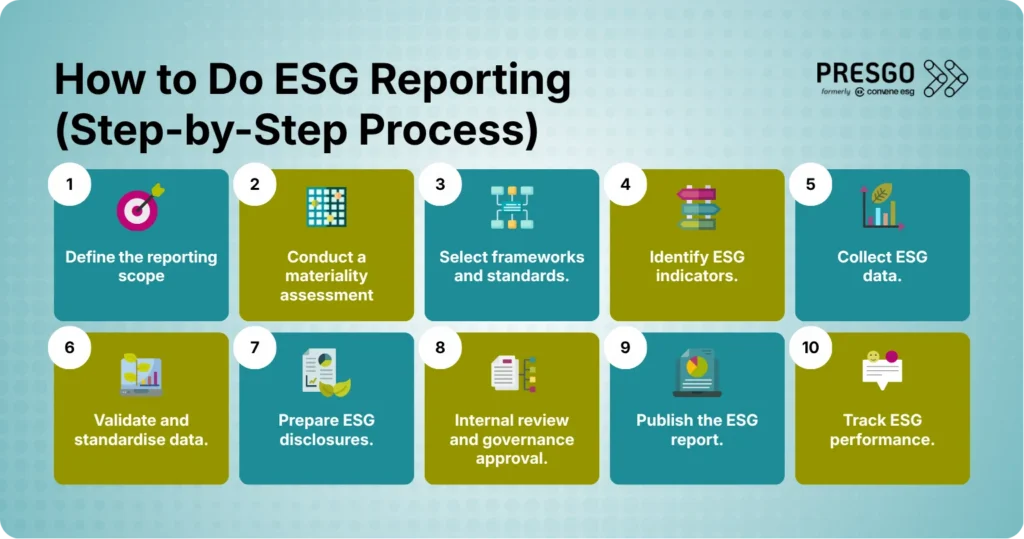
ESG reporting is typically a structured process that moves from identifying what matters most to collecting data, validating it, and turning it into a report that can be reviewed and published. A clear strategy for how to do ESG reporting helps keep disclosures consistent, credible, and useful over time.
- Define the reporting scope. Start by clarifying which entities, operations, time period, and reporting boundaries are covered. This keeps the process focused and ensures the report matches the company’s structure and obligations.
- Conduct a materiality assessment. Identify the ESG topics that matter most to the business and its stakeholders. This helps prioritise what should be reported, ensuring the disclosure remains relevant and decision-useful.
- Select frameworks and standards. Choose the reporting framework or combination of frameworks that fits your industry, geography, and audience. Many companies use a single core approach and add local or investor-specific requirements where needed.
- Identify ESG indicators. Translate material topics into specific metrics, targets, and narrative disclosures. This step defines exactly what data needs to be gathered, such as emissions, diversity, safety, energy use, or governance measures.
- Collect ESG data. Gather information from the relevant teams, systems, and sites across the business. Consistent ownership and clear data templates are important here because ESG data often comes from multiple departments.
- Validate and standardise data. Check the data for accuracy, completeness, and consistency before reporting. Standardising units, methods, and assumptions makes the final disclosures more comparable and credible.
- Prepare ESG disclosures. Convert the data into report-ready content, including metrics, explanations, progress updates, and targets. This phase is when the technical information is shaped into a clear, structured narrative.
- Internal review and governance approval. Have the draft reviewed by key functions, such as sustainability, finance, legal, risk, and leadership. Governance approval is important because ESG reporting often carries reputational, regulatory, and assurance implications.
- Publish the ESG report. Release the report in the required format and on the appropriate channels. The report should be easy to access and aligned with the expectations of regulators, investors, and other stakeholders.
- Track ESG performance. Use the reporting process as a baseline for ongoing monitoring and improvement. Tracking results over time helps the company refine targets, strengthen controls, and improve future disclosures.
While companies worldwide recognise the need for ESG reporting, many still struggle to know where to begin. For a more detailed walkthrough, see our whitepaper, Creating a High-Impact ESG Report, which covers the essentials of ESG reporting from strategy to software selection.
Common ESG Reporting Challenges
Common ESG reporting challenges usually come from fragmented data, inconsistent methods, and complex reporting requirements across the business.
Data collection and management
ESG data often comes from many systems and teams that weren’t designed to talk to each other or feed into a sustainability report, e.g. utility bills, HR platforms, procurement tools, spreadsheets. As such, teams spend disproportionate time manually chasing and reconciling data instead of analysing it, which delays reporting timelines, raises the risk of errors reaching auditors or regulators, and makes it harder to track performance trends year over year.
Lack of standardisation
Different business units often calculate the same metric differently, including different emission factors, definitions of “renewable energy”, reporting boundaries, because there’s no single internal methodology enforced across the organisation. This makes ESG reporting inconsistent and harder to compare. Inconsistent numbers undermine credibility with investors and regulators, complicate year-on-year comparisons, and can trigger restatements once an external assurance provider or auditor catches the discrepancy.
Fragmented data across departments
No single function typically “owns” ESG data end-to-end, so information spreads across finance, HR, operations, procurement, and sustainability, with each department collecting only what’s relevant to its own function and little process to share it centrally. This turns sustainability teams into data collectors rather than analysts, causes reporting deadlines to slip while data is chased department by department, and leaves it unclear who is accountable when data is wrong or missing.
Scope 3 and value chain data gaps
External emissions and supplier data are especially hard to obtain because they depend on parties outside the company’s direct control. Many suppliers don’t measure emissions at all, use inconsistent methods, or lack the resources to report, forcing companies to rely on rough industry-average estimates instead of real supplier data. The GHG Protocol reports that 83% of companies struggle to access accurate emissions data for this reason, weakening net-zero targets and hiding where real reduction opportunities lie.
Regulatory complexity
Companies operating across jurisdictions face overlapping and at times conflicting requirements, including differing disclosure frameworks, materiality thresholds, and assurance requirements. These requirements continue to evolve and expand in scope, making it difficult to know what to report and how. This forces compliance teams to track and interpret multiple regimes at once, raising legal and compliance costs. Meanwhile, misalignment between frameworks can duplicate reporting effort, and non-compliance may lead to penalties, reputational damage, or exclusion from certain markets or investor portfolios.
Audit readiness and system maturity
Many companies built their ESG reporting process around annual, manual processes such as spreadsheets rather than the controlled, auditable systems used for financial reporting. As such, there’s often no clear trail from raw data to final disclosed figure, weakening controls and traceability. As assurance requirements shift from limited to reasonable assurance in various jurisdictions, companies with immature systems face higher audit costs, longer close cycles, greater risk of restatements, and reduced confidence from investors and regulators in the reliability of disclosed figures.
Best Practices in ESG Reporting
Implementing the best practices for ESG reporting helps companies produce disclosures that are more accurate, consistent, and useful over time. They also make the reporting process easier to manage and more aligned with business and stakeholder needs.
- Materiality-driven reporting
Start with the ESG topics that are most important to the business and its stakeholders. This helps keep reporting focused, relevant, and easier to manage. A materiality-driven approach also reduces clutter by making sure the report highlights what truly affects performance, risk, and impact.
- Data validation and assurance readiness
Build in checks early so ESG data is accurate, complete, and traceable before it goes into the report. Strong validation processes make disclosures more credible and prepare the company for external assurance. They also reduce the risk of errors, inconsistencies, and last-minute corrections.
- Framework alignment strategy
Choose a primary reporting framework and align your disclosures to it consistently. This makes the reporting process more organised and helps avoid unnecessary duplication. If the company must meet multiple requirements, mapping them to one core structure can make reporting much more efficient.
- Stakeholder engagement
Engage internal and external stakeholders to understand what information they need and what concerns matter most. This improves the relevance of the report and helps build trust in the company’s ESG commitments. It also supports better coordination across departments since ESG reporting usually depends on many contributors.
- ESG integration into corporate strategy
Treat ESG reporting as part of business planning, not just as a communications exercise. When companies integrate ESG into their strategy, the report reflects how they manage risks, opportunities, and long-term value. This also helps ensure that targets, actions, and disclosures connect.
- Use of ESG reporting software
ESG reporting software can help centralise data, improve workflow efficiency, and reduce manual errors. It is especially useful when companies need to manage multiple teams, sites, or reporting frameworks. Good software also improves traceability, version control, and readiness for review or assurance.
- Continuous improvement loop
Use each reporting cycle to identify gaps, refine processes, and strengthen data quality. ESG reporting works best when it becomes a repeatable improvement process rather than a one-time exercise. Over time, this process helps the company mature its ESG governance, systems, and disclosures.
Examples of ESG Reports from Top Companies
Across industries and around the world, companies have started integrating ESG practices into their operations to drive sustainability and social impact. Below is a rundown of how the top global companies communicate key environmental and social issues.
JPMorgan Chase & Co.
The company has the longest list of governance topics in ESG, including geopolitical risk, succession planning, political engagement, and public policy and lobbying. For environmental impact, JPMorgan focuses on carbon-cutting initiatives and sustainable sourcing, such as using metal instead of plastic for credit cards to reduce scope 3 emissions.
ExxonMobil
ExxonMobil’s sustainability approach is built around 14 Sustainability Focus Areas shaped by its environmental and social impacts, business strategy, current events, and stakeholder input. The company also plans to invest about $20 billion in lower-emission capital projects from 2025 through 2030, supporting both operational emissions reductions and lower-emission technologies such as carbon capture, hydrogen, and biofuels.
Siemens
Siemens focuses on decarbonisation through its net-zero targets for operations and its supply chain, using measures such as electrifying its vehicle fleet, improving buildings and operations, increasing renewable electricity use, and engaging suppliers to reduce scope 3 emissions.
Jason Marine
Jason Marine integrates climate resilience and sustainability into its operations, focusing on waste reduction and optimised logistics to lower carbon emissions. The organisation facilitated Adopt-a-Precinct and Adopt-a-Family programmes for their community engagement initiatives and uses advanced technology to monitor and analyse vessel health, minimising operational expenses and energy consumption.
How is AI transforming ESG reporting?
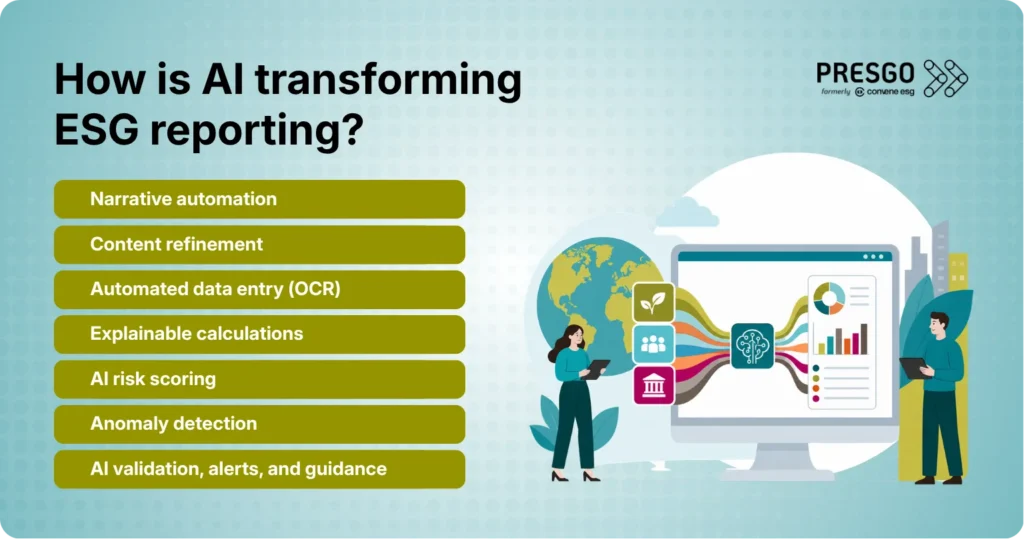
AI can streamline ESG report creation by reducing the manual work involved in collecting and organising large amounts of data. It can help pull information from multiple sources, flag inconsistencies, standardise formats, and draft first-pass narrative text, saving time on repetitive reporting tasks. These earlier, more repetitive stages of reporting tend to benefit most, since the output can still be reviewed before anything is finalised.
Still, some parts of ESG reporting still need human judgement. Assessing materiality, interpreting how a regulation applies to the business, and checking that figures and narratives are accurate all rely on expert review. Aligning data with multiple frameworks like GRI, ISSB, and TCFD also still takes human interpretation, as AI cannot fully replace that judgement. As such, AI works best as support for a team rather than mere replacement.
AI also allows teams to spot risks earlier, keep disclosures compliant, and maintain stronger data integrity. These efficiencies also create the foundation for more structured and scalable ESG reporting, which is where reporting platforms and specialised tools become especially valuable.
The AI-first ESG reporting platform, Presgo, helps streamline the reporting process through features designed to support teams across the full reporting cycle, from collecting and organising data to drafting reports, validating figures, and keeping disclosures compliant. Here’s a closer look at those features:
Narrative automation
Presgo supports the drafting of report narratives, helping ESG teams turn data and inputs into clearer first-pass disclosure text. This is especially useful for recurring sections that need to be written consistently across reporting cycles.
Content refinement
Presgo can help improve and standardise ESG content, making disclosures more coherent and easier to review. That matters when information comes from multiple contributors and needs to be aligned into one consistent report.
Automated data entry (OCR)
Presgo’s data collection workflow can support automated entry by extracting information from source documents such as utility bills and other records. This reduces manual encoding and helps teams capture data faster and with fewer transcription errors.
Explainable calculations
Presgo’s built-in carbon calculator supports emissions calculations using country-specific, sector-specific, and global emission factors. This gives companies a more transparent way to convert activity data into emissions figures and strengthen the traceability of their disclosures.
AI risk scoring
The AI Scoring feature helps evaluate reports and supplier responses against frameworks and risk criteria, automatically highlighting gaps, weak spots, and high-risk items. For example, you can upload a sustainability report or supplier survey and have it instantly scored against CSRD, GRI, ISSB, or internal benchmarks, making it faster to see where controls, disclosures, or value-chain practices need improvement.
Anomaly detection
The anomaly detection continuously monitors ESG data coming into the Data Hub, flagging outliers, missing values, and entries that don’t match verified sources or expected patterns. This helps safeguard data accuracy and audit readiness by catching issues early before they flow into emissions calculations, supplier scores, or final disclosures.
AI validation, alerts, and guidance
Beyond scoring and anomalies, Presgo uses AI to validate data against frameworks, issue smart alerts when compliance gaps appear, and benchmark performance versus external standards and peers. Combined with modules like the Carbon Calculator and Supplier ESG, this means ESG risk and compliance are supported end-to-end, from capturing value-chain data and calculating scopes 1-3 emissions to ensuring the final reports are consistent, explainable, and ready for regulatory or investor scrutiny.
ESG Reporting as a Strategic Advantage
ESG reporting is rapidly shifting from voluntary disclosure to a mix of mandatory compliance and strategic value creation. As regulations tighten and investor expectations rise, ESG reports are no longer just “nice to have” communications. Instead, they are part of core business risk management and market positioning.
In this landscape, ESG reporting maturity has become a competitive advantage. Companies that understand their impacts, can report clearly, and use ESG data to inform strategy are better placed to attract capital, meet regulatory expectations, and build trust with stakeholders over the long term. Software and AI can strengthen this maturity by automating end-to-end workflows, improving data validation and compliance tracking, and turning ESG information into more actionable insights for strategy and decision-making.
Book a demo today to learn how Presgo can support your organisation’s ESG reporting process.