Talk to an ESG Expert about how Presgo can help you!
Our ESG Experts are on-hand to understand your ESG Reporting needs and cater our solution to you. Get in touch to discuss how we can help.
Talk to an ESG ExpertContents
- What is ESG reporting?
- ESG Reporting in the Middle East: An Overview
- State of ESG Reporting: UAE, Saudi Arabia, and Egypt
- ESG Reporting Hurdles Faced by Middle Eastern Companies
- Four Strategies to Enhance ESG Reporting in the Middle East
- Predicting the Future of ESG in the Middle East
- Multi-Framework ESG Reporting with Presgo
ESG reporting has been a corporate mainstay across various industries worldwide. This sustainability initiative requires organisations to be more transparent on how they manage sustainability risks. In fact, many government agencies and regulatory bodies have mandated ESG reporting — pushing more businesses to practice sustainability and transparency.
This guide gives you a glimpse into the current state of ESG reporting in the Middle East, as well as strategies for improving sustainability disclosures.
What is ESG reporting?
ESG reporting, also widely known as ESG disclosure, is a type of public reporting that discloses a company’s performance on environmental, social, and governance (ESG) criteria.
- Environmental: This aspect considers how an organisation manages or performs in areas like climate change, energy efficiency, air and water quality, carbon emissions, and biodiversity.
- Social: This criterion focuses on how an organisation fosters its culture and people and how it contributes to its community. Facets under the category include employee engagement, inclusivity, gender and diversity, community relations, labour standards, and customer satisfaction.
- Governance: This part of the report discloses the organisation’s internal system of practices, procedures, and controls adopted to govern itself. Corporate governance also considers how a company fosters transparency and follows industry best practices. Other factors included are board composition, shareholder rights, bribery and corruption, and the company’s leadership.
The disclosures must also be prepared and presented following the guideline principles set forth by major ESG reporting standards and frameworks. Some notable ones include the Global Reporting Initiative (GRI), the Sustainability Accounting Standards Board (SASB), and the IFRS S1 and S2 by the International Sustainability Standards Board (ISSB), and jurisdiction-specific requirements such as European Sustainability Reporting Standards (ESRS) for EU exposures.
ESG Reporting in the Middle East: An Overview
It is quite evident how the Middle East’s engagement with ESG reporting has significantly transformed over the past few years. Traditionally, the region was focused on only financial metrics, like other parts of the world. Its emphasis on sustainability and responsible practices, however, has grown remarkably — leading to an upsurge in ESG reporting initiatives.
Early Beginnings and Regional Trends (Pre-2020)
Prior to 2020, the region remained nascent with limited awareness of the significance of ESG reporting. While environmental concerns such as climate change were put into the spotlight, social and corporate governance issues received less attention. This limited awareness stemmed from:
- The region’s economic reliance on fossil fuels overshadowed broader sustainability concerns.
- Lack of comprehensive ESG reporting or regulatory frameworks, resulting in limited transparency and accountability.
- Traditional investors primarily focused on short-term financial gains with limited consideration for ESG factors.
Turning Point and Key Developments (2020-Present)
The global shift towards sustainability and increased investor focus on ESG criteria has led to a paradigm shift. Middle Eastern companies began recognising the long-term risks and opportunities linked to ESG. What started as voluntary guidelines has, in several markets, developed into binding law with financial penalties attached. A few examples are:
- Bahrain: The Central Bank of Bahrain is already past voluntary guidance, mandating ESG reporting for financial institutions and listed corporations. This mandate covers scopes 1, 2, and 3 emissions aligned mainly with the GRI standards and recognises TCFD, CDP, and SASB guidelines, among others.
- Saudi Arabia: In 2023, Tadawul, or the Saudi Exchange, urged listed companies to prioritise and assess their most relevant ESG factors. Later in 2025, the Capital Markets Authority (CMA) introduced disclosure obligations tied to sustainability financing for green, social, sustainable and sustainability-linked debt instruments.
- UAE: Listed companies on the Dubai Financial Market (DFM) and Abu Dhabi Securities Exchange (ADX) must publish annual sustainability reports aligned to international standards and report environmental, social, and governance metrics. Federal Decree-Law No. 11 of 2024, the UAE’s climate law, took effect on 30 May 2025. It requires specific companies in the UAE that generate greenhouse gas (GHG) emissions to measure and report in full compliance in 2026.
- Qatar: Aligned with its national commitments on sustainability, the Qatar Stock Exchange issued ESG reporting guidelines in 2022 after its first in 2016. The guide has since been refined, with Qatar Central Bank (QCB)-regulated banks and insurers disclosing an annual sustainability report, complying with IFRS S1 and S2.
- Kuwait: The Capital Markets Authority of Kuwait (CMA) first implemented regulations to drive sustainability in the financial sector in 2022. Boursa Kuwait also released a voluntary ESG reporting guide for listed companies in the same year. In 2025, the CMA Circular 04/2025, started requiring Premier Market companies to publish an ESG report from FY2025 onwards. It covered ISSB-aligned KPIs, with a first filing deadline in June 2026.
- Oman: The Muscat Stock Exchange (MSX) made sustainability disclosure mandatory for listed companies starting with 2024 performance data, which should be filed in March 2025. By late 2025, MSX reported full compliance across its main and parallel markets. Then, recently in 2026, Oman’s Financial Services Authority formally adopted IFRS S1 and S2 for the wider financial sector, which is expected to phase in 2029.
Besides the regulatory push, increased demand from socially conscious investors and growing green finance initiatives have also spurred interest in ESG reporting. ESG disclosures now influence capital allocation and investor decision-making across MENA markets, with green finance columns and sustainability-linked investment criteria gaining importance. The MENA ESG 2025 report highlighted responses from 361 senior executives, showing more than 50% of UAE firms now balance all three ESG pillars equally, with 99% of these companies already monitoring their ESG performance.
State of ESG Reporting: UAE, Saudi Arabia, and Egypt
As the region’s journey towards sustainability gains momentum, certain countries in the Middle East are emerging as frontrunners for their ESG initiatives on responsible practices and reporting. Among these are the United Arab Emirates (UAE), Saudi Arabia, and Egypt, all with active plans to achieve an environmentally conscious future.
UAE
At the 2023 COP28 Summit, the UAE announced a $30 billion pledge to fund clean energy and other climate projects worldwide. These are just one of the many pledges the host country made at the summit. COP28 focused on four facets:
- Fast-track the energy transition
- Transform climate finance
- Put nature, people, lives, and livelihoods at the heart of climate action
- Mobilise for the most inclusive COP ever
From hosting the COP28, businesses are encouraged to support the UAE national agenda, and in line with the UN Sustainable Development Goals (SDGs).
In the UAE, listed companies on the DFM and ADX must publish sustainability disclosures using recognised frameworks. In 2020, the UAE Securities and Commodities Authority (SCA) mandated sustainability reporting for public joint stock companies. Additionally, the Abu Dhabi Global Market (ADGM) also implemented its Sustainable Finance Regulatory Framework in 2023 to set further standards for ESG disclosures in the country. This framework underwent review and consultation from 2025 up until January 2026. The FSRA has since implemented the proposals under Consultation Paper No. 13 of 2025, adding climate-related financial risk requirements to ADGM’s insurance regulatory framework.
Saudi Arabia
Driven by its Vision 2030 plan, Saudi Arabia is on the course of achieving sustainability goals and practices across various sectors. Hence, creating a more sustainable future. The country is currently taking concrete steps towards integrating ESG into its economic and social landscape.
The Saudi Exchange’s ESG Disclosure Guidelines guide listed companies to align disclosures with global practices, such as GRI, SASB, and ISSB. These guidelines also target improving awareness in listed companies about ESG practices and the importance of transparency. And in 2023, the Saudi Exchange also urged listed companies to prioritise and assess the most relevant ESG factors to them, driving responsible business practices within the Saudi capital market.
Egypt
Egypt’s Financial Regulatory Authority (FRA) released regulations and guidance (Green Bond Guidelines in 2018 and Decrees 107 and 108 in 2021), which required companies in the non-banking sector to submit ESG reports related to sustainability and the financial impacts of climate change.
Also in 2021, the country launched its Environmental Sustainability Criteria Guidelines, created to encourage the integration of environmental sustainability best practices into business initiatives. The guidelines sought to contribute to Egypt’s long-term sustainability by promoting environmentally responsible development.
In February 2026, the FRA introduced Decision No. 36 of 2026, requiring non-bank financial institutions with capital or net equity above EGP 100 million to measure and disclose scope 1 and 2 emissions annually, verified by accredited bodies. The decision also requires these institutions to offset at least 20% of their reported emissions through Egypt’s voluntary carbon market, with the first filing deadline in June 2026 already passed.
ESG Reporting Hurdles Faced by Middle Eastern Companies
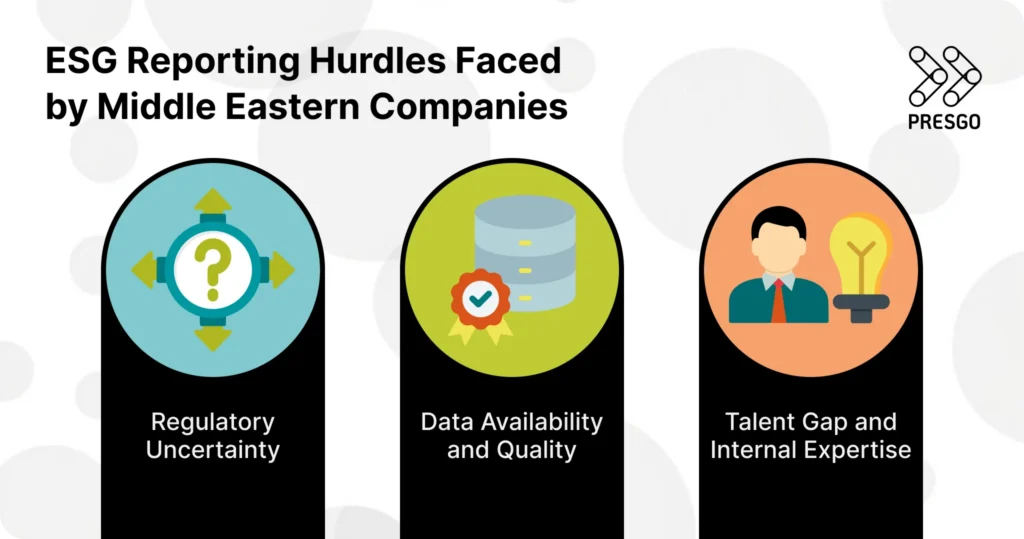
Despite the evolving ESG landscape in the region, Middle Eastern companies still face several challenges in their reporting journey. Some notable hurdles are:
Regulatory Uncertainty
Unlike Western counterparts, companies in the Middle East currently lack harmonised and standardised reporting frameworks to produce complete and compliant disclosures. Such inconsistency creates confusion and compliance difficulties for reporting companies across the region. A 2023 report suggests that this lack of clarity makes it challenging for organisations to interpret or implement regulations, which demands additional standardised guidance. It is a persistent challenge, as a 2024 survey shows that, for Middle Eastern companies, there are not enough government policies that support their sustainability strategies
Data Availability and Quality
An effective ESG reporting process requires a robust data infrastructure. Limited access to standardised and reliable data makes it challenging for Middle Eastern companies to accurately measure and report their ESG performance. One primary cause is the lack of unified reporting metrics and standards, which hinders the companies’ ability to obtain accurate and comparable data.
Talent Gap and Internal Expertise
The human resource gap also exists as a hurdle in ESG reporting. Implementing effective sustainability practices requires qualified professionals and dedicated ESG teams. In the PwC’s 2023 Middle East report, 41% of the respondents considered the absence of adequate internal skills and expertise to be the biggest challenge in progressing an organisation’s ESG strategy. This talent gap necessitates upskilling and training programs to better equip professionals with expertise for robust ESG practices and reporting.
These challenges require collective efforts — involving governments, regulators, and businesses — to foster a conducive environment for effective reporting. By addressing such gaps, Middle Eastern companies can not only comply with ESG regulations but also thrive as true sustainability leaders.
Four Strategies to Enhance ESG Reporting in the Middle East
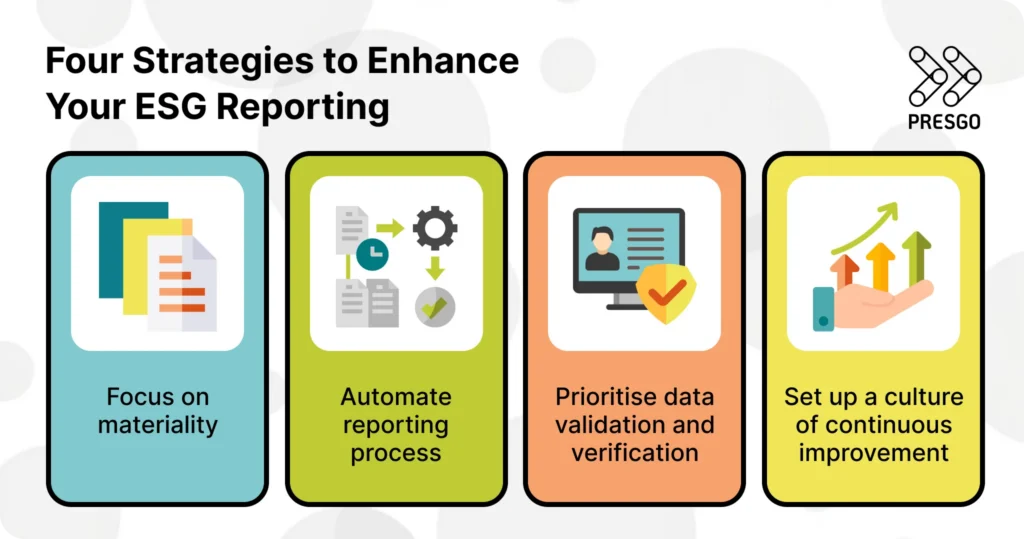
As discussed above, collecting and reporting ESG data does come with several challenges. But all these can be addressed with the right strategies and practices in place. Here are four ways to drive more effective sustainability reporting.
1. Focus on materiality
ESG reporting is not a one-size-fits-all process, which means a company should know what issues are material and relevant to them. The first step is to outline the boundaries by considering your industry, type of operations, and geographical reach. Next is to compile potential ESG matters based on your internal and external sources.
- Internal data sources: Includes risk assessments, employee surveys, sustainability policies, and community engagement reports.
- External data sources: Involves industry reports, governmental regulations, sustainability reporting frameworks, and data from peer benchmarking.
It is also a good idea to create a materiality map to easily visualise the most relevant ESG issues. Make sure to only select ones that have a material impact on your business strategy, financial performance, and bottom line.
2. Automate the reporting process
Manually collecting and analysing data can both be time-consuming and prone to errors. To guarantee the accuracy and completeness of the ESG report, consider automating your process through a reliable reporting platform.
ESG reporting software like Presgo offers extensive features and tools for easy data collection, management, and report generation. Look for one that aligns with global standards and frameworks, such as SASB and GRI. This ensures your ESG disclosure is not just accurate but also relevant and compliant.
3. Prioritise data validation and verification
If you want to ensure the accuracy and reliability of your ESG data, having robust data validation and verification practices is necessary. Besides utilising reporting software, make sure you have clear procedures for data collection across your departments. This ensures your team knows what data to gather and input, reducing risks of errors and inconsistencies.
Independent data verification is another strategy that can help ensure data integrity in your report. Seek help from external auditors or assurance providers to independently review and validate the collected data. Doing so adds an objective layer of scrutiny and credibility to your company’s reported performance.
4. Set up a culture of continuous improvement
The sustainability reporting process does not end once the disclosure has been published. Companies should conduct debriefing with stakeholders to identify gaps in their strategy and reporting. Also, get feedback from investors and analysts on how to enhance your report’s quality and relevance.
Keep in mind that the ESG reporting landscape is constantly evolving, which means continuous improvement in reporting practices is essential. Stay informed on the latest regulations, standards, and best practices to maintain investment-grade data.
Predicting the Future of ESG in the Middle East
As sustainability takes centre stage in the Middle East, ESG reporting is quickly emerging as a great force for change. But while the region is still finding its footing in this field, there are some emerging trends and predictions to look forward to.
As global companies take advantage of technology, Middle Eastern companies are also expected to utilise more advanced technologies to improve ESG reporting. Cloud-based platforms and data analytics are playing a larger role in streamlining data collection, verification, and reporting processes. AI, in particular, can help companies efficiently analyse large volumes of ESG data to identify gaps, improve accuracy, and boost sustainability-related opportunities through forecasting and risk management. In the 2023 Middle East ESG Reporting Summit, technology solutions for effective ESG reporting were highlighted, enabling data security and traceability.
Driven by global momentum, the Middle East is likely to see greater standardisation in reporting frameworks. Mandatory requirements for certain sectors and company sizes will materialise, as they have already with Oman, UAE, Bahrain, and Egypt. Also, due to the previous COP28, a surge of ESG initiatives is expected in the region, with more Middle Eastern companies recognising the importance of sustainability.
Multi-Framework ESG Reporting with Presgo
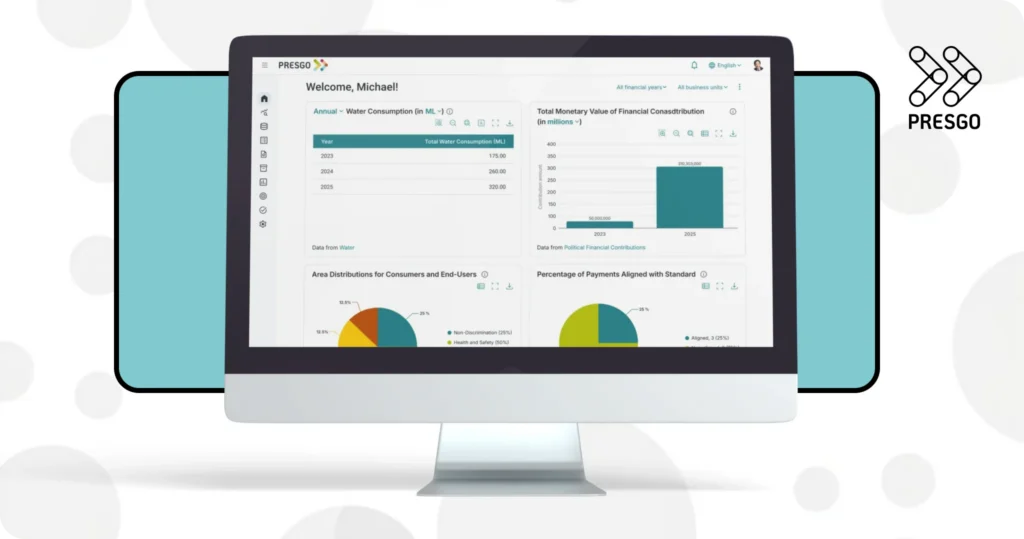
As data-driven ESG reporting emerges as a key driver of sustainability, Presgo stands as the technology partner for Middle Eastern companies in this transformative journey.
Presgo, a reliable AI-first ESG reporting software built for multi-framework reporting across GRI, ISSB, CSRD, and other jurisdiction-specific requirements. It is backed by a growing regional presence and local experts who understand the region’s evolving regulatory landscape. The platform offers modular solutions that simplify materiality assessments, data collection, and overall compliant reporting. Users will have access to tailored dashboards and advanced report generation and automation.
Reports created and generated using Presgo are guaranteed to be compliant with the latest guidelines and standards, such as ISSB and GRI.
Contact our dedicated team today to schedule a demo and discover how Presgo can transform your ESG reporting journey.