Talk to an ESG Expert about how Presgo can help you!
Our ESG Experts are on-hand to understand your ESG Reporting needs and cater our solution to you. Get in touch to discuss how we can help.
Talk to an ESG ExpertContents
- From CSR to ESG: Morocco’s Growing Sustainability Momentum
- ESG Momentum in Morocco: What’s Driving the Shift?
- Why are ESG reporting expectations increasing?
- How European ESG Regulations Are Influencing Moroccan Businesses
- Common ESG Reporting Challenges for Moroccan Organisations
- The Role of ESG Data Governance
- Preparing for Assurance, Audits, and Stakeholder Scrutiny
- How Digital ESG Platforms Can Help
- Moving from Reporting Obligation to Strategic Value With Presgo
For years, CSR (RSE) in Morocco has shaped how companies think about their role in society, encouraging voluntary commitments to labour practices, community engagement, environmental stewardship, and governance. That foundation has been especially important in Morocco, where the AMMC, Casablanca Stock Exchange, and the General Confederation of Enterprises of Morocco (CGEM) helped build an early CSR (RSE) reporting culture and later prepared the market for ESG disclosure requirements.
That CSR (RSE) foundation is shifting Morocco’s corporate sector toward measurable ESG disclosure: firms increasingly report specific climate targets, social-impact metrics, governance practices, and risk assessments as investors and market intermediaries push for comparable, decision-useful data.
From CSR to ESG: Morocco’s Growing Sustainability Momentum
Morocco’s sustainability momentum is accelerating as the broader African market enters a more defined phase of sustainable finance and ESG adoption. With Africa having validated its first continent-wide Sustainable Finance Taxonomy and IFRS S1 and S2 standards, global expectations around climate disclosure and strategy are clear: Sustainability is no longer being treated as a voluntary add-on but as a core part of business strategy, capital allocation, and investor confidence.
Within this shifting landscape, Morocco stands out as a regional leader. The country has built a strong foundation through CSR (RSE), which remains the more familiar term in local business circles, but ESG is now increasingly being adopted by listed companies, financial institutions, multinational organisations, and international investors. This reflects a deeper shift in emphasis from broad corporate responsibility commitments toward a more structured framework for governance, reporting, transparency, and accountability.
Morocco’s near-universal compliance among listed companies, along with large-scale green hydrogen investments ($32.5 billion) and growing sectoral adoption of ESG principles, underscores how quickly the market is evolving.
What makes this transition especially important is the need for more disciplined ESG reporting and data governance. As investors and regulators place greater weight on measurable progress, data accuracy, board oversight, and credible disclosures have become essential to maintaining trust. In Morocco and across Africa, organisations are increasingly expected to move beyond CSR (RSE) narratives and build systems that can reliably capture, validate, and communicate ESG performance. That shift is not only about compliance but also about strengthening resilience, improving access to capital, and positioning businesses for long-term competitiveness in a market that is becoming more sustainability-driven.
ESG Momentum in Morocco: What’s Driving the Shift?
ESG in Morocco is increasingly shifting from a voluntary sustainability initiative to a strategic governance priority. What was once often framed as part of CSR (RSE) or a broader corporate social commitment is now being pulled into the core of how organisations are governed, financed, and evaluated. For Moroccan companies, the ESG standard is no longer just about demonstrating good intentions but also becoming a practical requirement for managing risk, meeting disclosure expectations, and maintaining credibility with key stakeholders.
A key driver is the Moroccan Capital Market Authority (AMMC), which has helped move ESG reporting from the margins into formal market practice. Through guidance and supervisory signals, the AMMC has framed ESG information as part of issuers’ core disclosure duties rather than an optional corporate-communications exercise. That shift reinforces expectations around credibility, comparability, and disclosure quality, contributing to investor confidence in the Casablanca Stock Exchange and broader capital markets. That broader market shift is also reflected in the Casablanca Stock Exchange’s ESG index, MASI ESG, which brings together listed companies with the strongest ESG ratings and further normalises ESG performance as a market expectation.
The clearest example of this shift is Circulaire no 03/19 de l’Autorité Marocaine du Marché des Capitaux. The directive requires listed issuers to publish an annual ESG report alongside their financial disclosures. It specifies that companies disclose governance arrangements, social practices, environmental impacts, and related policies and risks, following the formats and annex templates provided in the directive. By embedding ESG into mandatory periodic reporting, 03/19 raises the bar for consistency and makes non-financial information more decision-useful for investors and regulators.
Bank Al-Maghrib also plays an important role by shaping expectations in the financial sector through its supervisory approach to climate and risk disclosure. Under Directive 2/W/2025, Moroccan banks are now required to report climate-related risk exposure for large borrowers, bringing ESG considerations directly into credit oversight and prudential reporting. This makes ESG relevant not only as a sustainability topic, but also as a core element of risk management, lending discipline, and portfolio resilience.
These regulatory pressures are reinforced by the expectations placed on listed companies and regulated sectors more broadly. Organisations are increasingly expected to demonstrate clearer board oversight, stronger internal controls, and more reliable data on environmental, social, and governance matters. That means ESG is moving into the boardroom, not just as a sustainability conversation but as a governance matter tied to accountability, strategic planning, and market trust.
As Morocco strengthens its position as one of Africa’s leading sustainability markets, these expectations are becoming more visible and more consequential. Inevitably, the shift contributes to an increase in ESG reporting complexity, accelerating the need for stronger governance and data management.
Why are ESG reporting expectations increasing?
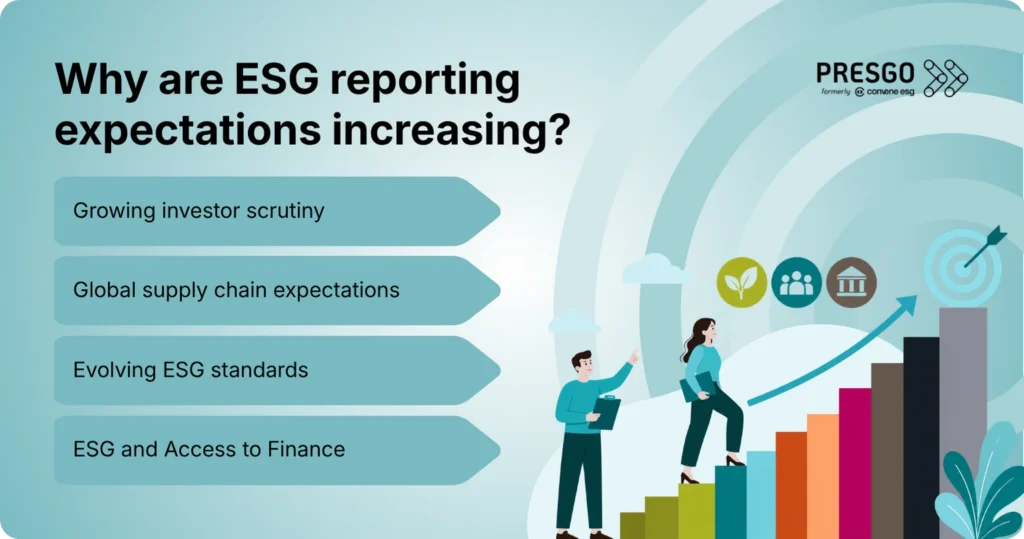
As ESG moves from a voluntary sustainability conversation to a more formal governance and market priority, reporting expectations are rising across the region. Regulators in several markets are moving toward more structured, ISSB-aligned disclosures by 2027-2028, while investors, lenders, and supply chain partners increasingly expect companies to provide consistent, comparable, and decision-useful ESG data.
Growing investor scrutiny
Investors no longer accept generic sustainability statements. They demand rigorous, auditable data showing measurable carbon reduction progress, concrete climate transition plans, and demonstrable social impact integrated into core business strategy. The enforcement of IFRS S1 and S2 standards globally helps reshape investor expectations and sets a higher benchmark for comparability and verification.
Global supply chain expectations
Multinational corporations and international buyers increasingly require African partners to provide verified ESG data, traceability, and responsible sourcing evidence to maintain access to premium markets, particularly in the mining and agriculture sectors. The Marrakech Declaration’s digital platform, hosted in Morocco, coordinates these certifications to connect producers with responsible buyers, making verified ESG data essential for market access.
Evolving ESG standards
In Morocco, ESG reporting expectations are becoming more structured through the AMMC’s disclosure framework, which draws heavily on established reporting principles such as GRI. Rather than relying on broad sustainability claims, the framework pushes companies toward clearer, more comparable, and more verifiable disclosures on governance, social issues, environmental impacts, and risk management.
ESG and Access to Finance
Stronger ESG practices are increasingly shaping access to finance in Morocco. International investors, lenders, and development finance institutions are giving greater weight to governance, climate resilience, and credible ESG disclosure when assessing risk and allocating capital. For example, programmes such as MorSEEF show how sustainability-focused capital can support real projects with measurable energy and emissions benefits, while market infrastructure such as green bond guidelines, ESG reporting rules, and the Casablanca Stock Exchange ESG index signal a broader shift toward sustainability-based capital allocation.
How European ESG Regulations Are Influencing Moroccan Businesses
European ESG regulation is influencing Moroccan businesses mainly through the companies they supply, finance, or sell to in Europe. Morocco-based exporters and service providers are increasingly being asked by EU clients to provide more detailed ESG data, especially on climate, labour, governance, and due diligence, because European rules such as the CSRD and related supply chain expectations push accountability beyond Europe’s borders.
A clear example is the AMMC-driven ESG reporting environment in Morocco, which has already pushed listed companies toward more structured non-financial disclosure, making it easier for them to respond to European requirements. For Moroccan businesses, compliance with European ESG regulations is vital if they want to keep or expand access to European markets, capital, and partners.
Common ESG Reporting Challenges for Moroccan Organisations
Moroccan organisations face significant hurdles in implementing structured ESG reporting. While regulatory momentum is accelerating and investor expectations are rising, many companies still lack the systems, standardisation, and technical capacity needed to produce auditable, compliant disclosures. Some of the most common challenges in Morocco include:
ESG data scattered across business units and reliance on spreadsheets
ESG data is often fragmented across departments. In Moroccan banks, industrial groups, and listed companies, sustainability or compliance teams may need to manually request information from multiple business units before compiling a report. Without centralised systems, organisations struggle to aggregate metrics, maintain consistency, or produce disclosures aligned with the AMMC’s reporting expectations. This increases the risk of duplicates, gaps, and outdated information.
Difficulty collecting consistent ESG indicators
The absence of standardised indicators makes it difficult to collect comparable ESG data. Moroccan companies may track similar topics, such as energy use, water consumption, workforce composition, or governance practices, but apply different definitions or calculation methods. For example, one company may report electricity consumption by site while another consolidates it across operations without clear methodological notes. Without clearer internal guidance and sector-specific interpretation, organisations struggle to produce disclosures that are consistent and decision-useful.
Challenges in measuring carbon footprint data
Accurately measuring carbon footprint remains highly technical. Many Moroccan organisations still lack complete baseline emissions data, reliable monitoring infrastructure, or integrated systems for tracking direct and indirect emissions. This is especially challenging for companies with complex supply chains or operations spread across multiple sites. In sectors such as manufacturing, energy, logistics, and agriculture, emissions data collection often depends on manual estimates, incomplete supplier information, or inconsistent records. Moroccan green hydrogen projects face similar challenges in verifying lifecycle emissions across the full value chain.
Multiple frameworks and stakeholder requirements
Moroccan companies often need to navigate overlapping frameworks and expectations, including the AMMC’s ESG reporting framework, IFC Performance Standards, UN Principles, and the UN Sustainable Development Goals. Each framework can emphasise different priorities, metrics, or narrative approaches, which makes reporting more complex for companies seeking both local compliance and international credibility. This can create reporting fatigue and make it difficult to determine which disclosures should be prioritised for a clear and unified ESG strategy.
Limited audit trails and documentation
Many organisations still lack robust audit trails to support ESG claims. Without documentation of data sources, calculation methodologies, assumptions, and approval processes, disclosures may not withstand internal review or third-party verification. This is especially important for Moroccan companies preparing for more structured ESG reporting expectations, where transparency and traceability are becoming more important. Weak documentation can increase reputational risk and undermine investor confidence.
These operational gaps are increasingly why organisations around the world are turning to dedicated ESG software to manage documentation and audit trails systematically, rather than relying on manual processes.
The Role of ESG Data Governance
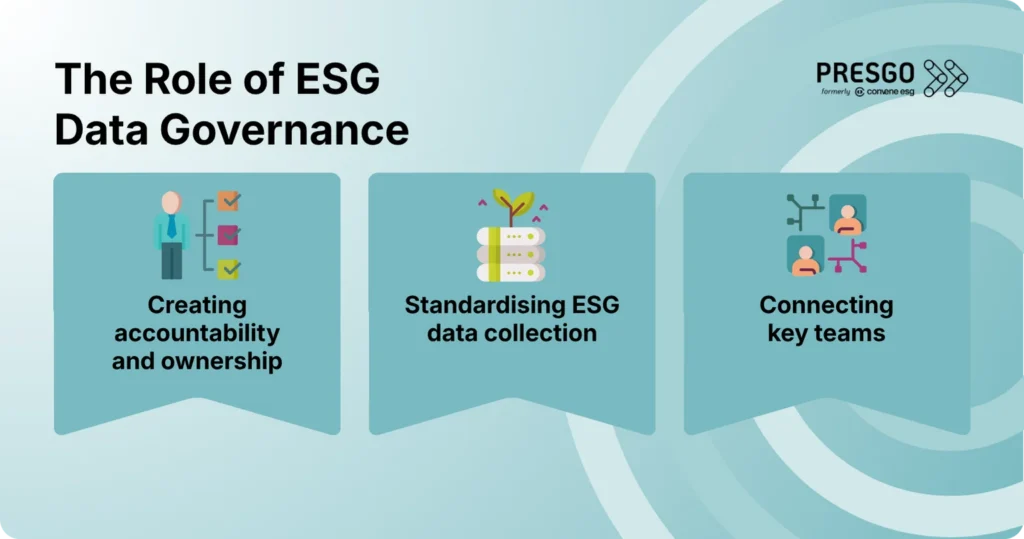
ESG data governance turns sustainability reporting into a structured, auditable process. As reporting expectations become more formal, Moroccan companies need clear ownership, standardised methods, and cross-functional coordination to produce reliable ESG data:
- Creating accountability and ownership: Governance clarifies who owns each data point, who collects it, and who checks it for accuracy. This helps prevent gaps, inconsistencies, and weak oversight.
- Standardising ESG data collection: The AMMC framework pushes Moroccan companies toward more consistent ESG data definitions, calculation methods, and reporting formats. This helps ensure that disclosures are comparable across business units and easier to verify over time. This is increasingly where digital ESG platforms play a role, embedding standard definitions and calculation methods directly into the data collection process rather than leaving them to individual interpretation.
- Connecting key teams: Strong ESG reporting depends on coordination between sustainability, finance, legal, risk, and operations teams. In Moroccan organisations, this cross-functional approach is essential for producing disclosures that are both compliant and decision-useful.
As Moroccan companies move toward more structured ESG reporting, the real challenge is no longer only disclosure, but the ability to manage ESG information across teams, systems, and reporting cycles.
Preparing for Assurance, Audits, and Stakeholder Scrutiny
As ESG disclosure becomes more formal, organisations need repeatable processes, traceable data, and controls that can withstand review. Listed companies, financial institutions, and other regulated entities now face higher expectations from the AMMC, the Casablanca Stock Exchange, lenders, and international partners, so ESG information must be not only well presented but also verifiable and consistent. Building audit-ready processes now helps organisations improve transparency, prepare for future assurance requirements, and respond more confidently to scrutiny from both local and international stakeholders.
- Audit readiness: Moroccan companies should treat ESG reporting like other formal disclosure processes, with clear review and approval steps.
- Evidence and documentation management: Keep supporting documents, calculations, and source data organised so ESG claims can be verified if requested by regulators, investors, or auditors.
- Data traceability: Reported ESG metrics should be traceable back to their source, especially for climate, workforce, and governance data. This is where structured ESG reporting tools can support traceability by design, rather than as an afterthought.
- Internal controls: Basic governance checks help reduce errors and improve consistency across reports, especially where data comes from multiple business units or sites.
- Confidence in ESG disclosures: Stronger controls make disclosures more reliable and more credible for banks, investors, and business partners.
- Responding to stakeholder scrutiny: As Moroccan firms engage more with European markets and sustainability-focused financiers, they need to answer questions quickly and with evidence.
These requirements make reporting infrastructure increasingly important, especially for organisations managing ESG data manually or across disconnected systems.
How Digital ESG Platforms Can Help
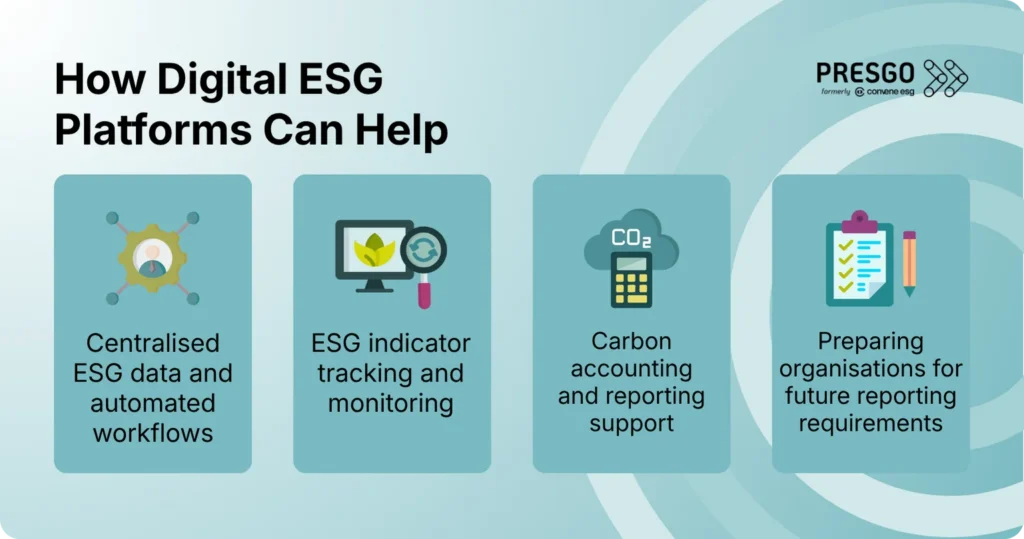
Digital ESG platforms support the operational side of reporting: collecting data, standardising it, routing it through approvals, and consolidating it across teams. In Morocco, where ESG expectations are becoming more structured, these tools help organisations move from ad hoc reporting to a more reliable, repeatable process.
Centralised ESG data and automated workflows
Digital platforms consolidate ESG data from multiple departments into a single system of record, replacing fragmented, spreadsheet-based collection. Automated workflows then guide that data through validation, review, and approval steps, with alerts notifying the right people when action is needed.
ESG indicator tracking and monitoring
Digital platforms help enforce standardised data dictionaries and consistent calculation methodologies across business units. They also provide validation checks at the point of entry to catch inconsistencies early.
Carbon accounting and reporting support
Digital ESG tools often include carbon accounting tools that automate emissions measurement across scopes 1-3. This can help organisations manage the technical demands of carbon reporting and improve the reliability of emissions data.
Preparing organisations for future reporting requirements
ESG reporting software can help companies stay aligned with evolving regulatory requirements by standardising outputs and making reports easier to update. That is especially useful for organisations preparing for more formal disclosure expectations and increasing stakeholder scrutiny.
Moving from Reporting Obligation to Strategic Value With Presgo
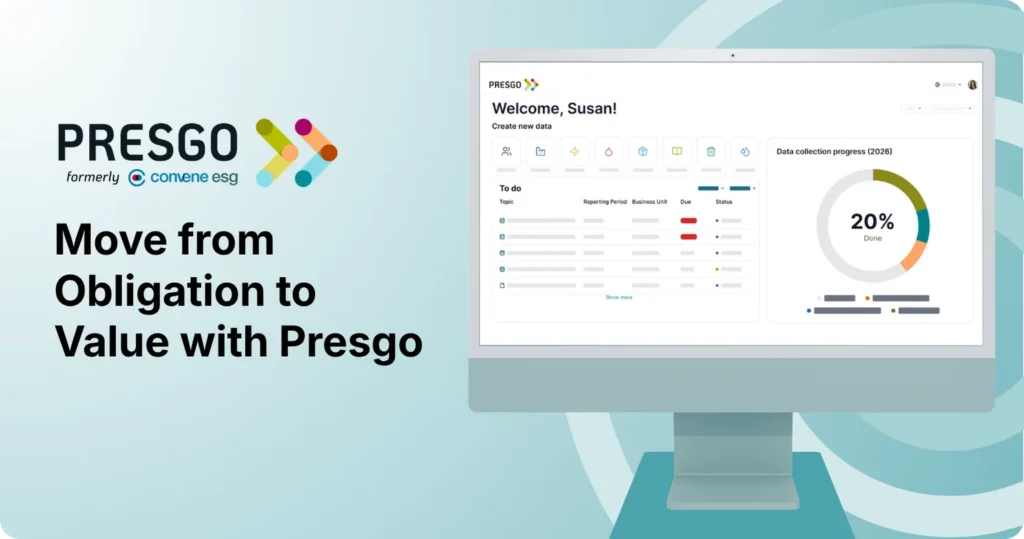
As Moroccan organisations face rising ESG reporting expectations, the challenge is no longer whether to report, but how to build the systems needed to report accurately, consistently, and efficiently.
Platforms built specifically for this purpose are already emerging in the market. Presgo, for example, is an AI-first platform designed to help teams centralise ESG data, streamline reporting workflows, and prepare disclosures with greater confidence. In that sense, it helps Moroccan companies move from treating ESG as a reporting obligation to managing it as a repeated business process.