Talk to an ESG Expert about how Presgo can help you!
Our ESG Experts are on-hand to understand your ESG Reporting needs and cater our solution to you. Get in touch to discuss how we can help.
Talk to an ESG ExpertContents
- What is ESG in manufacturing and why does it matter?
- What is green manufacturing?
- How to integrate ESG in the supply chain of manufacturing companies?
- Key ESG Metrics for the Manufacturing Industry
- Emerging ESG Trends in Manufacturing
- Leading Global ESG Performers in the Manufacturing Sector
- Start Responsible Manufacturing with Presgo
People are learning more about sustainability and want proof of what they are consuming and paying for. It is not even so much about what exactly companies produce, but by how responsibly they operate. Stakeholders expect practices and results that can be measured with real sustainability data and progress.
In manufacturing, resource use, labour conditions, and ethical governance structures are tightly linked to effective global supply chains. These demands fall under environmental, social, and governance (ESG) priorities. For ESG officers and regulators, the conversation has now shifted from why to how. How do we integrate ESG into operations, supply chains, reporting, and in ways that go beyond compliance?
In this article, we look at why ESG matters in manufacturing, how supply chains are part of the equation, key metrics to track, new trends, and lessons from leading companies.
What is ESG in manufacturing and why does it matter?
ESG in manufacturing refers to the adoption of practices that balance production with sustainability. Manufacturing is a critical global sector that powers economies and technological advancements, but its impact on key ESG issues requires a high level of accountability to address the challenges.
Understanding the ESG issues below addresses the challenges of long-term sustainability.
Social and Governance Dimensions
While environmental concerns dominate many sustainability discussions, ESG governance and social issues carry equal weight in the bigger impact and expectations of stakeholders. Worker health and safety, equitable wages, diversity, and local community impacts are part of stakeholder priorities. This is reflected in the EU’s Corporate Sustainability Due Diligence Directive (CSDDD), which requires companies to address human rights alongside environmental impacts.
On governance, there is the G20/OECD Principles of Corporate Governance, developed by the Organisation for Economic Co-operation and Development (OECD) and the Group of Twenty (G20), that call for transparent and accountable governance systems. These principles are also echoed in the Corporate Sustainability Reporting Directive (CSRD) for standardised and reliable disclosures on ESG.
Environmental and Operational Pressures
Among the most resource-intensive sectors, it consumes huge amounts of energy, water, and raw materials while producing significant waste and emissions. With tighter rules in Europe, such as the EU’s Carbon Border Adjustment Mechanism, and in the U.S., like the EPA Regulations for Vehicles and Engines, the stakes for compliance are getting higher. Delaying sustainability and the integration of ESG in the manufacturing industry means higher costs, disruption risks in the supply chain, and restricted market access.
According to research, embedding sustainability into operations results in better efficiency. It also causes effective risk management and stronger customer loyalty. Moreover, the pressure to decarbonise can be traced to the global climate goals such as the Paris Agreement, which calls for net zero emissions by 2050. This means actualising commitments and what many leaders recognise as green manufacturing.
What is green manufacturing?
Green manufacturing, also known as sustainable manufacturing, refers to innovative practices that reduce negative overall environmental impact. It involves adopting cleaner technologies and renewable energy and designing processes that use materials and natural resources more responsibly. This is practised by manufacturing companies like the United Microelectronics Corporation (UMC). Its Green Foundry applies sustainable principles to its overall production of integrated circuits for other companies.
Based on recent research, green manufacturing proves to improve ESG performance significantly. It does so by strengthening the capacity of innovation and easing the financing constraints of companies, adding to the competitive advantage among industries.
While initiatives for ESG in manufacturing begin at company facilities, their biggest impacts lie upstream in the supply chain.
How to integrate ESG in the supply chain of manufacturing companies?

Supply chains often account for the largest share of emissions, labour exposure, and governance risks. Many of these are hidden upstream, but improving transparency and collaboration for ESG integration creates opportunities that benefit both companies and society at large. So, how do we do this?
1. Map risks and set standards
Supply chains often carry the largest share of a manufacturer’s ESG footprint. Scope 3 emissions, labour risks, and governance frequently originate upstream, where oversight can be weak and difficult to manage. Companies start by mapping their suppliers to identify high-risk regions and industries, building a baseline for intervention. This process uncovers hotspots such as areas with high water stress, weak labour protections, or carbon-intensive production.
As supply chains evolve, ESG risks also shift, affecting operations and company processes. Manufacturers now align with international standards, including the Global Reporting Initiative (GRI) and the Science Based Targets Initiative (SBTi), fusing these compliance expectations into contracts and supplier codes of conduct. Those who update their assessments regularly with established standards can spot vulnerabilities early and have enough preparation to adjust strategies.
2. Engage suppliers and build capacity
While audits and compliance checks are necessary, they are still not enough to drive sustainable change. Many manufacturers now invest in training and shared resources for suppliers to help them meet ESG expectations. Supplier engagement is emerging as a market advantage, with companies co-investing in cleaner technologies and safer workplaces upstream.
This is the case for Samsung’s initiative to run training programs for suppliers covering ESG, involving due diligence, labour and human rights, and environmental impacts. These programs also cascade to lower-tier suppliers.
3. Monitor and report efforts and performance
Investors expect reports to align with the GRI and the CSRD standards and frameworks. This is why companies integrate ESG clauses into contracts and rely on third-party audits. This maintains accountability and transparency in disclosures and traceability in data portals. And with the stringency of regulations, companies utilise advanced technology and expert support to automate and assist with collecting, tracking, and analysing data for ESG reporting.
Key ESG Metrics for the Manufacturing Industry
ESG metrics provide the backbone for ESG management, especially in manufacturing. This allows companies to measure progress, benchmark peers, and demonstrate accountability.
Environmental Metrics
Manufacturers track and calculate scopes 1, 2, and 3 greenhouse gas emissions, including resource consumption and wastewater, as part of making decarbonisation a priority. Factory-level metrics include scope 1 and 2 emissions, energy consumption, water use and discharge, hazardous waste, recycling, and material efficiency.
Since most impacts sit in the value chain, supply chain metrics are equally important. These cover:
- Scope 3 Emissions: Impacts tied to purchased goods, transport, product use, and end-of-life.
- Supplier Energy Profile: Share of renewables versus fossil fuels in upstream production.
- Water Use: Volumes withdrawn, recycled, or discharged by suppliers, especially in water-stressed areas.
- Raw Material Sourcing: Share of recycled, renewable, or third-party certified materials.
- Waste Management Practices: Supplier policies on waste generation, recycling, and reuse.
- Transport Footprint: Emissions linked to fuel efficiency, transport modes, and logistics.
- Land and Forests: Exposure to deforestation or land conversion through sourcing activities.
- Chemicals and Substances: Use of hazardous inputs, replacement with safer alternatives, and compliance with chemical laws.
Social Metrics
Social performance is increasingly visible to stakeholders. Apart from employment impacts and community relations, there are also the work health and safety indicators that include incident rates, lost-time injuries, and compliance with occupational standards. Adherence to wage fairness, hours, labour rights, DEI, and avoidance of forced or child labour are also critical. Weak and unethical social practices can negatively affect operational stability and reputation.
Governance Metrics
Governance builds the structure that ensures accountability and alignment with stakeholder expectations. Independent directors, ESG expertise, and diverse leadership strengthen decision-making. Linking executive pay and incentives to ESG outcomes aligns leadership priorities with long-term corporate sustainability. And then adding compliance audits to address risks and combining them with ESG reporting for transparency adds weight to these ESG metrics.
Emerging ESG Trends in Manufacturing
After mapping emissions, resource use, and supply chain ESG metrics, manufacturers are now turning those insights into broader strategies. The focus is moving from simply tracking impact to rethinking design, technology adoption, and responsible practices. These ESG trends show how sustainability is also evolving from compliance reporting into a long-term structure for competitive and resilient manufacturing.
Circular Economy and Lifecycle Design
Manufacturers are designing for reuse, remanufacture, and recyclability. Data from the World Bank Group shows that the sourcing of natural materials causes more than 90% damage to biodiversity, all the more reason for companies to redesign their processes. This is to stay current with resources and address the consequences of the damage that has already been done.
This is also why the World Bank reported and proposed circular economy practices for possible policy development. With closed-loop systems and product take-back schemes, there can be reduced waste, dependence on raw materials, and overall carbon footprint. Economically as well, this system lowers material costs while opening new revenue streams.
Decarbonisation Beyond Direct Emissions
Efforts now extend beyond factory activities. Scope 3 emissions, including raw material extraction, logistics, and overall product use, represent the largest share of manufacturers’ footprints. In fact, scope 3 makes up roughly 90% of overall company emissions. Because it’s also the most challenging to collect quality data from and manage all that, companies have to go above and beyond. Alongside adopting renewable energy and sustainable technology and processes, companies can positively contribute to scope 3 emissions reduction by engaging with their supply chain.
ESG Technology for Improved Performance and Transparency
Blockchain, AI, and the Internet of Things (IoT) sensors are being applied to verify the origins of raw materials and monitor emissions data for lifecycle assessments (LCAs). It is also used for ESG data collection and analysis. These tools, such as ESG reporting software, improve traceability, reduce the risk of greenwashing, and help meet regulatory disclosure standards. Data shows that advanced intelligence and technology are levelling up both the compliance and competitive advantage of companies, especially in the global landscape.
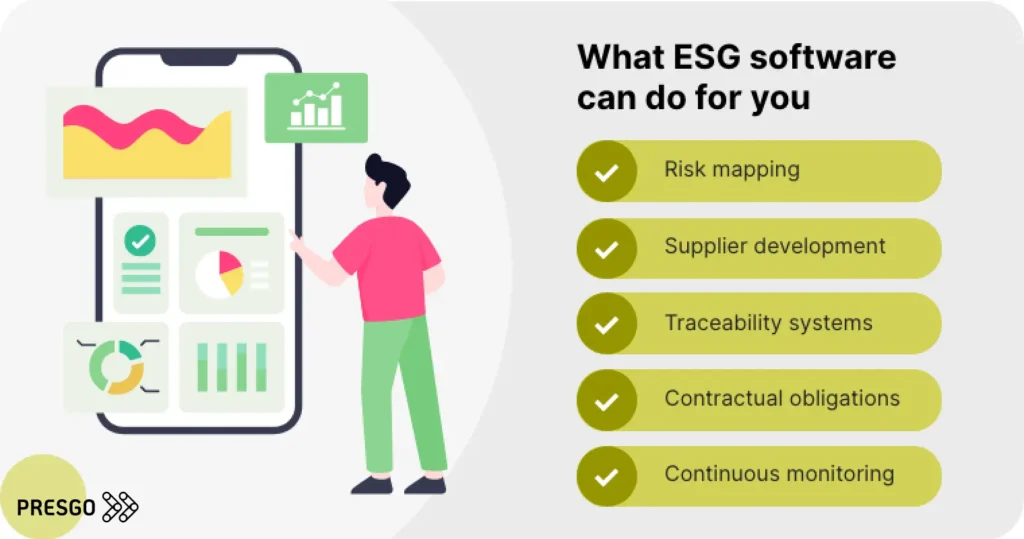
Technology in ESG software has features that work out all these:
- Risk mapping: Identifies environmental pollution, labour violations, and governance lapses.
- Supplier development: Provides training, funding, and shared resources to raise ESG capacity.
- Traceability systems: Tracks material origins, labour practices, and emissions data.
- Contractual obligations: Incorporates ESG standards into supplier agreements.
- Continuous monitoring: Uses audits and data platforms to track compliance and progress.
Expanding Social Responsibility
Social dimensions are gaining ground in the manufacturing industry and beyond. DEI, skill development, and fair workplace policies are more incorporated into ESG strategies, with more than half of U.S. respondents reporting this change, according to the Pew Research Center.
A study in China also shows that workplace systems and companies that practice transparent ESG overall at the executive and employee level have a positive effect on corporate ESG behaviour and employee satisfaction. Global supply chain laws also demand heightened scrutiny in lower tiers, especially in manufacturing, which relies on large workforces across suppliers and partners. This development broadens ESG beyond environment and safety into workforce well-being and community initiatives.
Growing Regulatory Demands
Regulatory alignment with the Sustainable Development Goals (SDGs) is central to global ESG progress. While ESG regulations have long been in place, the demand and push for them across regions and in local compliance are giving them even greater importance at scale. From Europe’s CSRD to mandatory developments in Asia, manufacturers are facing stricter legal obligations that cost them fines and market restrictions.
At the regional level, there have been recent releases of sustainability guidelines:
- EU’s Ecodesign for Sustainable Products Regulation (ESPR) requires sustainable innovation and circular economy adoption for production and consumption.
- The ASEAN Simplified ESG Disclosure Guide for SMEs in Supply Chains (ASEDG) is shaping up as a benchmark for SME participation in sustainability initiatives. Although voluntary, it is a stepping stone toward de facto compliance with global standards.
At the country level, specifically the Philippines, it develops and continues to implement laws that are especially focused on manufacturers:
- The Clean Air Act and Clean Water Act protect natural resources.
- The Ecological Solid Waste Management Act and the more recent Extended Producer Responsibility Law mandate a circular economy and responsible waste management and product packaging systems.
- The Philippine Green Jobs Act financially backs companies that push for sustainable manufacturing and innovation.
Leading Global ESG Performers in the Manufacturing Sector
Performing companies are already transforming and refining their operations to meet tougher global standards on climate action, resource efficiency, and social responsibility. Highlighted here are their initiatives and ESG reporting best practices, demonstrating how decarbonisation, supplier engagement, transparency, and technology are becoming standard practice in the industry.
Siemens
Siemens targets net zero operations for scope 1 and 2 emissions by 2030. This is done through renewable energy, internal carbon pricing, and collaboration in global clean energy programs, including their Robust Eco Design (RED) approach. The company reinforces its ESG commitment through workforce human rights policies that align with global due diligence guidelines. With its supplier code of conduct, the company also proves its higher objective toward decarbonisatoon beyond emissions. In this case, they reported completing their risk-driven supplier engagement toward an ESG-aligned supply chain before 2025.
Apple
Apple, with most of its factories in Asia, is driving renewable energy adoption across its supply base with the Supplier Clean Energy Program and targets 100% renewable energy by 2030. They have already achieved a 60% reduction in emissions. By applying lifecycle design principles and advancing clean energy trading, Apple is linking circular economy practices with large-scale emission reduction.
3M
In 2024, the company has cut almost 60% of its scope 1 and 2 emissions and more than 30% of its scope 3 emissions with its guiding principles in circularity, climate, and community. Its logistics strategy involves moving freight from air to ocean, tracking vendor performance, and restructuring global supply chains. This is how the company addresses the largest share of its carbon footprint, rethinking global supply chains and complying with SBTi for emission target evaluation.
Samsung
The South Korean global company promotes circularity by using recycled materials in its products and packaging while enhancing efficiency and extending product lifespans. Before the start of 2025, its division handling smartphones, tablets, and everyday gadgets already gets 93.4% of its energy from renewable sources. The company invests in training, including that in AI, software, and even human rights. It has its own AI Ethics Council, AI Principles of fairness, transparency, and accountability, and supply chain partners to prevent labour issues, including forced and child labour.
Toyota
The Japanese automotive company has developed electrified options for 77% of its Toyota and Lexus models. The company combines environmental performance with social programs, from carbon tracking and water management to technical training initiatives. It has advanced its workplace equity and human rights training for all employees, also engaging suppliers and dealers through its sustainability guidelines.
Start Responsible Manufacturing with Presgo
Manufacturing companies know strong ESG practices have their benefits, especially in strengthening their brand reputation. The question is how deeply and effectively they can do them. Managing data, tracking supply chain performance, and meeting global reporting requirements are already challenging for regular disclosures and monitoring.
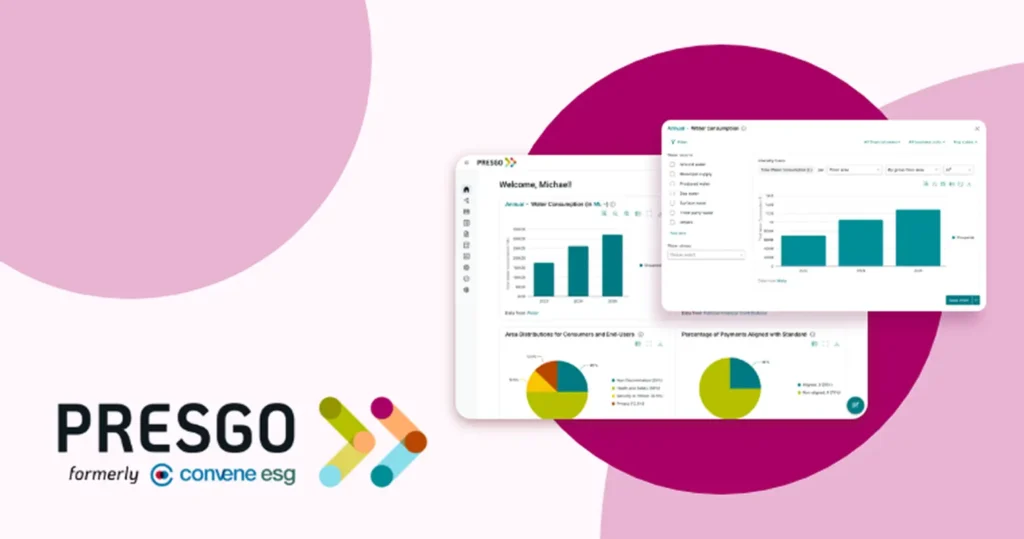
ESG reporting software can be just the answer for this. Platforms like Presgo (formerly Convene ESG) can centralise ESG data, streamline supplier engagement and reporting, and align disclosures with international standards such as the GRI and other global frameworks. It understands how manufacturing is resource-intensive and needs ESG reporting software to handle high volumes of data, supply chain ESG metrics, and advanced AI capabilities. Presgo’s audit-ready carbon accounting and data governance portal guarantee compliance and data traceability in ESG for manufacturing companies. These tools secure the overall transparency across suppliers, stakeholders, and reporting portals.
By investing in structured ESG reporting tools and best practices, manufacturers can move from compliance-driven strategies to leadership positions in sustainability.
Try a demo today and equip yourself with Presgo’s ESG technology.