Talk to an ESG Expert about how Presgo can help you!
Our ESG Experts are on-hand to understand your ESG Reporting needs and cater our solution to you. Get in touch to discuss how we can help.
Talk to an ESG ExpertContents
The world is constantly changing, and the reality is it’s not all for the better. Climate change, dwindling natural resources, and widening social inequalities are pressing issues that affect every corner of the planet. Our ecosystems have long been harmed by insufficient policies, misuse of environmental resources, and the alarming pollution levels of big companies and institutions. Many communities lack access to basic needs like clean water and education. These global challenges emphasise the need to rethink our ways — how we live, work, consume, and interact with the world.
This is where sustainability offers a path forward.
What is sustainability?
Sustainability is about creating a balance between the economy, society, and the environment to ensure resources are used responsibly and preserved for the future. For companies, sustainability simply means operating in ways that minimise harm, if not avoid it completely, to people and the planet while continuously supporting growth. This keeps operations and progress moving while resources and the environment are responsibly safeguarded for years ahead. By prioritising sustainability, companies level up their reputation, attract top talent, and secure their long-term success, beyond protecting limited resources.
How important is sustainability?
Sustainability is a significant concern as it balances environmental protection, social equity, and economic growth by encouraging the responsible use of resources and accountability of stakeholders. This addresses critical challenges while securing resources and opportunities for future generations. Sustainability is essential in:
- Protecting the environment: Sustainable practices address climate change, reduce pollution, and preserve our biodiversity. It pushes the move for renewable energy and cutting our dependence on finite resources, especially those that produce greenhouse gas emissions. These efforts preserve our essential ecosystems and keep our air and water clean, while encouraging cooperation to tackle environmental issues through community engagement and awareness.
- Advancing social responsibility: This benefit deals with the reduction of inequality by improving people’s access to healthcare, education, and housing while also promoting diversity, equity, and inclusion. Companies that adopt these ethical practices strengthen relationships with their stakeholders and align business decisions with the broader needs of society. An example is Microsoft’s social empowerment mission, community partnerships, mentorship, and inclusivity for talents with disabilities and neurodivergence.
- Ensuring economic sustainability: A sustainable economy prioritises growth that avoids harming the environment or society, emphasising solutions that are highly innovative. Policies encouraging green technologies and sustainable investments contribute to adaptable and financially stable systems supporting opportunities and overall development. When emissions come from technology itself, companies are called to resolve this with green technology alternatives. This is the case for the rise of hydrogen fuel cell electric vehicles (FCEVs), such as Toyota FCEVs, which are part of the company’s Beyond Zero commitment.
- Preparing for the future: Businesses that integrate sustainability into their strategies are better prepared for the evolving demands of stakeholders and regulations. By innovating to meet modern expectations and highlighting present and future contributions, companies increase their relevance, trustworthiness, and ability to thrive in a competitive landscape.
What are the 6 Rs of sustainability?
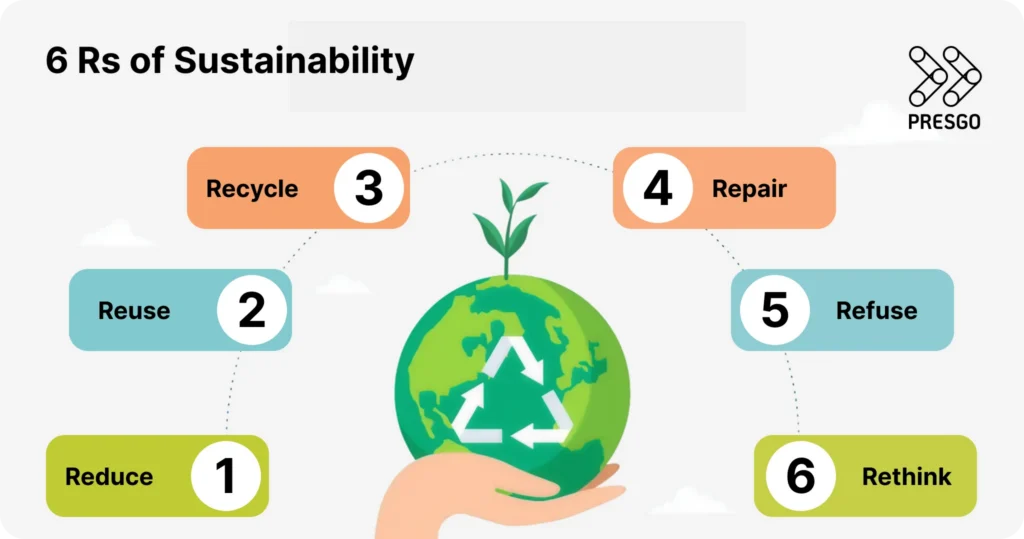
Sustainability is not simply about preserving the environment but can be viewed as an approach that can transform how producers and consumers interact with the planet. Originally, there were only the 3 Rs — Reduce, Reuse, and Recycle — as part of a growing environmental movement in the 1960s and 70s. Over time, many industries have adopted these principles to cut down on waste, save energy, and encourage sustainable practices.
It then evolved into the 6 Rs of sustainability — Refuse, Reduce, Reuse, Recycle, Rethink, and Repair — that offer more actionable steps to minimising environmental harm while maximising our resources. Adopting these 6 principles of sustainability can provide companies and communities with meaningful changes that protect our planet, create economic opportunities, and improve the quality of life.
Reduce
Reducing waste and energy consumption is the foundation of sustainability. By cutting down on unnecessary materials and processes, businesses can lower their environmental footprint and save costs. For example, going paperless and efficiently lowering energy use can give significant long-term benefits like conserving resources, which is being done by the Bank of America’s digital-first products and services.
By minimising waste, consumers are learning to buy only what they need. For instance, people now prefer products with minimal packaging or brands that support eco-friendly practices. This shift discourages overconsumption and encourages a culture of simplicity.
Reuse
Reusing materials prevents waste from being discarded prematurely and extends their lifecycle. The idea of reusing has inspired consumers to repurpose items instead of discarding them. From using reusable bags and containers, people are finding creative ways to extend product lifespans. The green soju bottle is an example, where major producers in South Korea voluntarily agreed to standardise soju bottles and support bottle deposit systems to collect them for reuse.
Recycle
Recycling involves transforming waste into new, usable products. Implementing effective recycling or upcycling programs, such as separating materials at the source, reduces landfill contributions. This also provides an opportunity to recover valuable materials and reintegrate them into production cycles, promoting a circular economy.
Awareness campaigns about proper disposal methods have empowered individuals to contribute to circular economies, where waste is transformed into new resources.
Repair
Repairing items instead of discarding them encourages efficient overall use of resources and reduces waste. Encouraging a culture of maintenance and restoration can extend the life of products and lower the demand for new purchases. Repair programs, whether for electronics or clothing, are great examples of this principle in action. This includes Microsoft working with iFixit to offer tool kits designed for its self-repair initiative for its devices.
The repair mindset motivates consumers to fix items rather than replace them straight away. Whether it is mending clothes, repairing electronics, or restoring furniture, there is a growing trend for resource conservation.
Refuse
Refusing unnecessary or harmful materials, such as single-use plastics, helps reduce environmental damage at the source. Businesses can choose more sustainable alternatives and encourage customers to adopt similar habits. This proactive approach tackles waste before it becomes an issue.
Many consumers and a growing number of businesses now reject plastic straws, disposable cutlery, or excessive packaging. This mindful refusal not only reduces landfill waste but also pushes companies to adopt sustainable alternatives.
A global movement called Plastic Free July calls for the behaviour change of refusing single-use plastic consumption, resulting in its effective reduction. Participants in 2021 were able to reduce 1.2 billion kg of waste sent to landfills, 900 million kg of recyclable materials, and 0.3 million tons of plastic, a movement that started with just 40 people and now involves millions around the world. This was supported by different institutions, governments, and companies and influenced the global plastic treaty at the UN’s environment assembly.
Rethink
The last R — Rethinking — challenges businesses and individuals to adopt innovative approaches to sustainability. This means reassessing processes, products, and goals to align with environmental priorities.
For instance, supply chains can be upgraded or transformed to prioritise eco-friendly practices and integrate sustainable materials and processes into their operations. One such case is Tesla’s sustainable global energy economy plan through a renewable-powered grid, electrified transportation, and minimising the extraction of resources.
Rethinking consumption encourages consumers to question their buying habits. People increasingly consider a product’s lifecycle, ethical sourcing, and environmental impact, driving demand for sustainable and responsibly made goods and services.
How do you apply the 6 Rs for your company?
The 6 Rs of sustainability serve as a comprehensive guide for companies seeking to create meaningful changes in operations that resonate beyond corporate social responsibility. Here’s how your company can strategically apply these principles:
Assess opportunities and plan strategically
Start with a detailed evaluation of your operations to identify areas where sustainability practices can be introduced or improved. Use this assessment to design a clear and actionable plan that prioritises high-impact areas while making sure the company’s mission and goals are aligned. A well-thought-out ESG strategy guarantees efforts are meaningful, measurable, and scalable.
Reduce waste and optimise resources
Implement resource-saving measures, such as transitioning to paperless systems or minimising packaging materials. Reducing waste not only lessens the environmental footprint but also improves operational efficiency and cost management.
Reuse and repurpose creatively
Find innovative ways to extend the life cycle of materials by reusing or repurposing them. This could involve rethinking production waste or utilising refurbished equipment, demonstrating a commitment to sustainability and resourcefulness. Such is the case with Samsung’s upcycling programme, which repurposes old smartphones into smart home devices, contributing to a circular economy by reducing e-waste, extending product life cycles, and encouraging the reuse of resources.
Recycle responsibly and build systems
Establish and promote robust recycling programs across the organisation. Proper waste segregation and adherence to recycling standards help ensure compliance while visibly reinforcing the company’s environmental responsibility. For example, Coca-Cola established a “World Without Waste” initiative that aims for packaging that is 100% recyclable and uses 50% recycled material.
Rethink processes and innovate for sustainability
Reevaluate traditional processes to identify eco-friendly alternatives and opportunities for innovation. An example is how Walmart committed to rethinking its global operations and transitioning to renewable energy sources like wind and solar installations. Encouraging teams to develop new products or workflows that align sustainability goals with business objectives also encourages creativity and long-term value for the company.
Engage stakeholders and advocate for action
Cultivate a culture of sustainability by actively involving employees, clients, and partners in the mission of climate change and social responsibility. Communicate goals transparently through sustainability reporting and provide opportunities for everyone to contribute to the cause. Strong stakeholder engagement reinforces the company’s leadership in sustainability and fosters collective ownership of company goals.
What are the three pillars of sustainability?
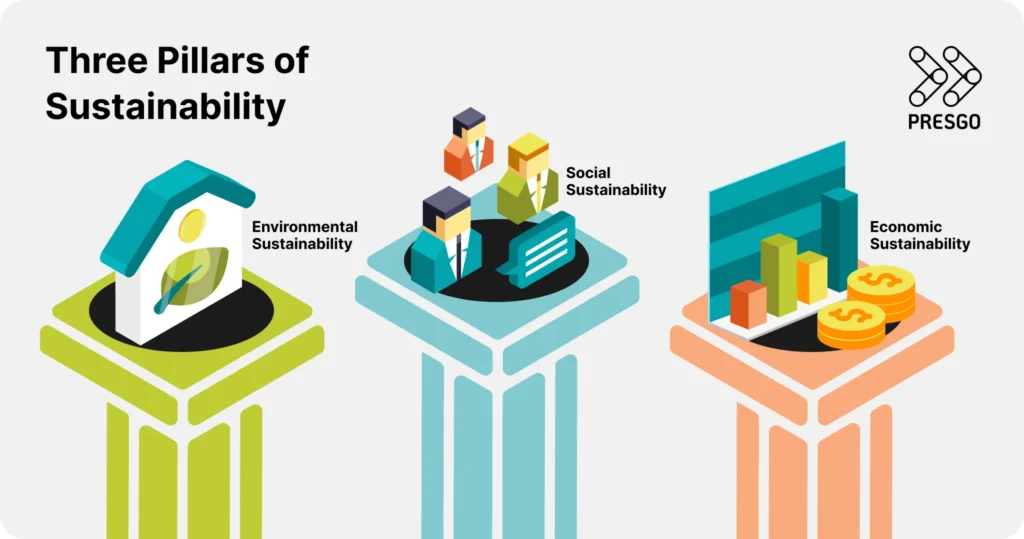
Sustainability revolves around three interconnected pillars: environmental, social, and economic sustainability. Together, these dimensions create a framework for balancing the needs of the present with those of future generations. These pillars provide actionable guidelines for addressing pressing global issues, such as climate change, inequality, and resource depletion. Below is an overview of each pillar and its importance.
Environmental Sustainability
Environmental sustainability is about protecting and managing our natural resources responsibly. It includes practices, such as reducing greenhouse gas emissions, improving biodiversity, minimising pollution, and conserving energy and water resources.
This pillar ensures the health of ecosystems, which directly affects human well-being and the survival of countless species. For example, adopting sustainable agricultural practices and a circular economy helps preserve resources for future generations.
Social Sustainability
Social sustainability focuses on equity, well-being, and inclusion, addressing needs such as health care, education, housing, and safety for all members of society. It fosters connected and resilient communities by reducing inequalities and supporting diversity. For instance, fair access to resources and opportunities promotes social harmony and justice. By affirming a good quality of life, this pillar reduces societal vulnerabilities, improves social cohesion, and creates a foundation for sustainable economic and environmental strategies.
Economic Sustainability
Economic sustainability is making sure businesses and society thrive without depleting resources or causing harm to the environment. It prioritises responsible resource management, innovation, and financial stability to create long-term prosperity. Practices such as aligning investments with sustainability goals and adopting circular economic models reduce waste and maximise resources. This benefits economies while safeguarding the planet.
What role does ESG play in sustainability?
Environmental, social, and governance (ESG) criteria are essential tools for integrating sustainability into business and investment decisions. They align closely with the pillars of sustainability by providing measurable standards for assessing and improving a company’s sustainable practices.
- Environmental: This examines how organisations manage their impact on the environment, such as reducing emissions, conserving energy, and adopting eco-friendly technology.
- Social: This aligns companies with their social sustainability goals. It evaluates workplace diversity, labour practices, and contributions to societal well-being.
- Governance: Governance focuses on transparency, accountability, and ethical business practices. Strong ESG governance supports environmental and social efforts by building trust with stakeholders.
Why does ESG reporting matter?
ESG bridges the gap between sustainable development goals and real-world action. By integrating ESG factors into decision-making, businesses can align their operations with sustainability goals, build trust with investors, and contribute to global challenges like climate change and social inequality. Companies adopting ESG principles often observe enhanced financial performance and risk management. For example, reducing energy consumption not only benefits the environment but also cuts costs, providing a dual advantage.
ESG provides a structured framework to measure and manage these efforts, helping companies align their operations with global standards and stakeholder expectations. ESG reporting takes this a step further by offering a transparent account of an organisation’s performance, allowing stakeholders to assess its impact and commitment to sustainable development. By fostering accountability and showcasing progress, ESG reporting ensures businesses not only meet compliance requirements but also contribute meaningfully to a more sustainable future.
Drive Sustainability Forward with Presgo

Achieving balance across environmental, social, and economic factors requires thoughtful strategies and transparent reporting. Sustainability reporting pushes for organisations to not only implement sustainable practices but also share their impact on stakeholders and the environment. Whether it’s reducing emissions or improving social responsibility, organisations require a solution to manage the complex tasks of data collection, analysis, and compliance. The key lies in streamlining this process with sustainability software to make it efficient and impactful.
Presgo steps in as the ESG reporting software with the ESG solutions to address every company’s reporting needs. This sustainability software is designed to measure, manage, and elevate sustainability efforts, centralising data collection, reporting, and collaboration with advanced AI technology and expert guidance. With features like pre-built templates aligned with global sustainability frameworks and local standards, dashboards for tracking progress, and seamless team integration, Presgo makes sustainability reporting manageable and effective.
Take the first step to simplify your sustainability efforts. Schedule a demo today!