Talk to an ESG Expert about how Presgo can help you!
Our ESG Experts are on-hand to understand your ESG Reporting needs and cater our solution to you. Get in touch to discuss how we can help.
Talk to an ESG ExpertContents
- What is an ESG reporting tool?
- Most Frequently Used ESG Reporting Tools
- Why do ESG reporting tools exist?
- Key Capabilities of Modern ESG Reporting Tools
- Who needs an ESG reporting tool?
- Emerging Trend: The Merits of AI tools for ESG Reporting
- How to Evaluate ESG Reporting Tools (Without Getting Overwhelmed)
- Make Future-Ready Reports with Presgo
Sustainability or ESG reporting is crucial for companies and organisations to better track how business activities impact society and the environment. Over the years, governments and organisations shifted from voluntary, narrative-driven ESG reporting to regulated, data-heavy, and assurance-ready reporting. This is driven primarily by the evolving reporting regulations, such as the IFRS Foundation’s ISSB standards and the EU’s CSRD framework. These updates include requirements for scopes 1 and 2 emissions reporting, as well as a shift in focus towards auditability and climate-related risks.
Not all organisations need an ESG reporting tool immediately. Companies that started their reporting journey with more traditional tools, such as spreadsheets, may eventually struggle with accuracy, auditability, and scale. As complexity grows, companies may opt to adopt ESG reporting tools to help manage multiple frameworks, audit requirements, or fragmented data. In this article, discover the range of modern ESG reporting tools available today and how to determine what your organisation needs.
What is an ESG reporting tool?
An ESG reporting tool is technical software designed to simplify the process of collecting, analysing, and reporting on ESG data for organisations. These software programs typically consolidate information from multiple internal and external sources into centralised systems, where it can be validated, analysed, and visualised through dashboards or reports. This makes it easier for sustainability teams to track performance over time and communicate results to stakeholders such as regulators, investors, and customers via sustainability disclosures.
RELATED READING: ESG Reporting Best Practices: Top 6 Examples for Leading Industries
Most Frequently Used ESG Reporting Tools
While general business intelligence (BI) tools such as Microsoft’s Power BI offer data visualisation and flexibility, ESG reporting tools are built specifically around the sustainability use case. They often include features for complex data collection workflows, emissions, calculations, framework-specific disclosures, and audit readiness. This reduces the need for manual consolidation and custom modelling when reporting against requirements such as double materiality or greenhouse gas (GHG) accounting.
| Feature | Spreadsheets | BI Tools | Modern ESG Reporting Tools |
| Data integration | Require manual entry from multiple sources | Connect to databases for visualisation | Use AI-automated data integration from ERP, CRM, surveys, etc |
| AI and automation | No AI with a low automation level; prone to errors | Dashboards are available, but require manual modelling. May have predictive AI integration via add-ons | AI report gap analysis and report generation, with more opportunities for automation |
| Compliance support | No built-in support; requires manual alignment | Custom visualisation options only | Multi-framework support (GRI, CSRD, ISSB) with auto-mapping features |
| Real-time monitoring | None | Applicable, if the tool has dashboard features | Applicable, using live dashboards and real-time alerts |
| Scalability/Cost | Low cost, but not scalable | Medium to high scalability with licensing costs | Highly scalable for small businesses and enterprises, with customisable packages depending on ESG report needs |
Why do ESG reporting tools exist?
The standardisation of ESG reporting in the 2010s saw the establishment of globally recognised standards and frameworks, such as the Sustainability Accounting Standards Board (SASB), the UN’s 17 Sustainable Development Goals (SDGs), the Global Reporting Initiative (GRI), and the Task Force on Climate-related Disclosures (TCFD). During this period, transparency became a primary focus for sustainability and ESG reporting as organisations are expected to communicate their reporting processes better and set clear goals and targets.
Today, ESG is no longer a peripheral practice. Sustainability has become a crucial aspect of corporate governance and business strategy, driven by regulatory requirements and investor scrutiny.
Frameworks and standards such as the Corporate Sustainability Reporting Directive (CSRD), GRI, and the International Sustainability Standards Board (ISSB) standards require structured, comparable, and auditable data across reporting periods. Static reports and manually maintained spreadsheets struggle to meet these expectations, particularly when disclosures must be updated regularly or reviewed by external auditors.
The best ESG reporting tools are designed to address this gap. They enable organisations to manage complex datasets, maintain consistency across reporting cycles, and meet regulatory timelines without relying entirely on manual processes.
Key Capabilities of Modern ESG Reporting Tools
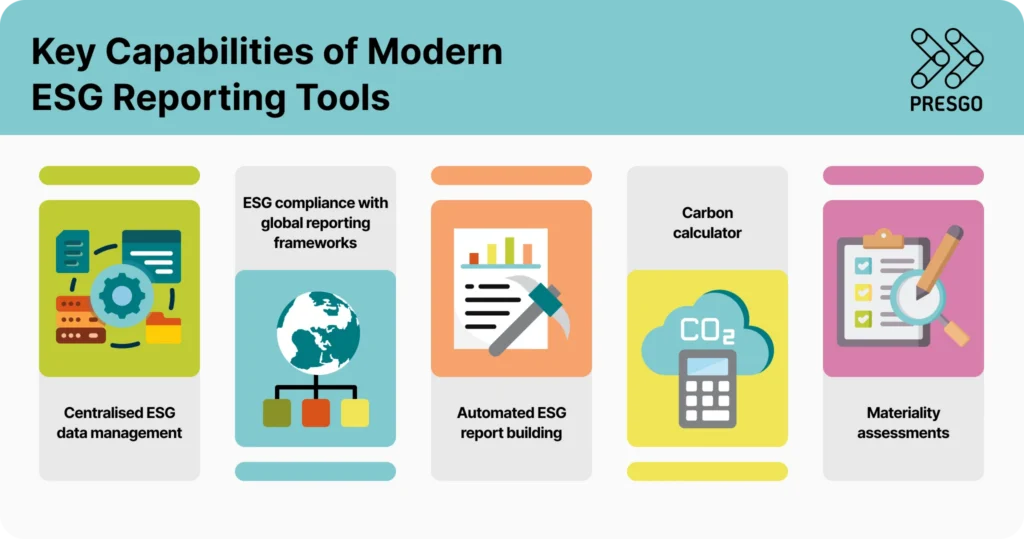
In line with the standardisation of sustainability reporting worldwide, ESG reporting tools have evolved to accommodate features to better adhere to shifting regulatory requirements and guidelines. Some key features of modern ESG reporting tools include:
Centralised ESG data management
Modern sustainability & ESG reporting tools offer data management features to automate the collection, validation, and management of ESG data across various teams and departments to streamline collaboration. ESG reporting platforms today offer integrated Optical Character Recognition (OCR) to auto-fill and scan invoices, bills, and other documents, such as hand-filled forms.
ESG compliance with global reporting frameworks
Some modern ESG reporting tools also have compliance software capabilities to help ESG teams keep up with changing disclosure requirements across various frameworks and standards. This includes AI-driven features for gap analysis to identify potentially missing disclosures. Modern tools also offer a host of customisable templates to align with specific reporting requirements and guidelines. Depending on the framework and guidelines being followed, ESG reports can also be exported to various formats, including Word, PDF, XLSX, or XBRL.
Automated ESG report building
At their core, modern ESG reporting tools are packed with features to make ESG reporting easier. This means increased production, but also improved efficiency and accuracy. Teams can make use of pre-assembled ESG reports and templates with narrative placeholders available to maintain consistency across reporting periods and ensure reports remain stakeholder-ready. There are also version management features to track edits and access archives of older versions for accountability.
Carbon calculator
One of the most common portions of an ESG report is carbon measurement. Nowadays, modern ESG reporting tools offer carbon calculator features that automatically calculate carbon emissions, including Scopes 1 to 3 emissions, and deliver outputs aligned with globally recognised frameworks to ensure consistent compliance. Some ESG tools also offer features for supplier data management, allowing teams to gather Scope 3 emissions data and monitor risks such as value chain impact or governance issues.
Materiality assessments
Some sustainability reporting frameworks, such as CSRD, require organisations to evaluate both financial and material impact. Modern ESG reporting tools offer double materiality assessment features, allowing ESG teams to conduct independent materiality assessments without relying on consultants.
Who needs an ESG reporting tool?
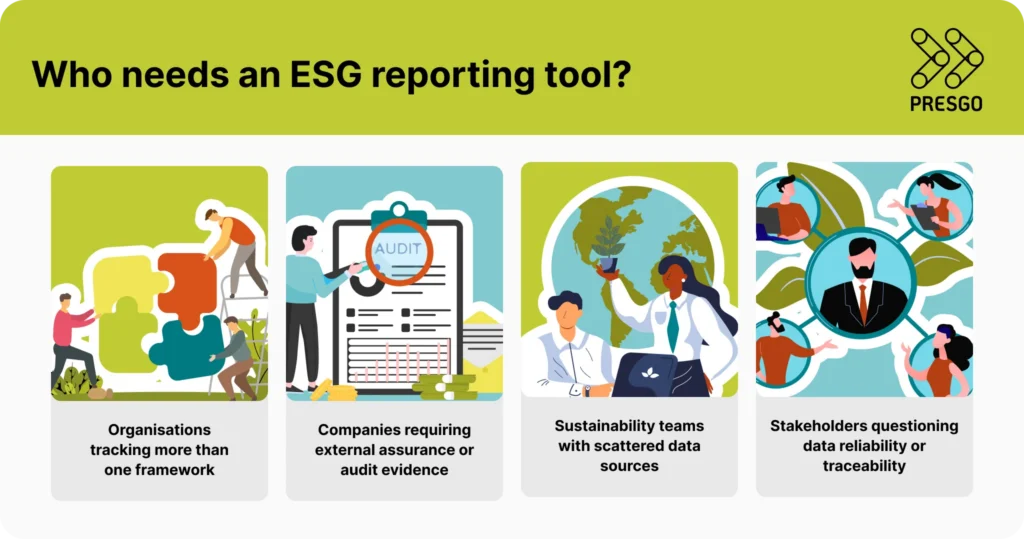
As regulatory requirements tighten and audit expectations become more stringent, ESG reporting processes often become too complex to manage manually. Growing disclosure obligations, increased demand for verifiable data, and more rigorous assurance standards create clear pressure points that signal the need for a dedicated ESG reporting tool. Below are common indicators that an organisation may be reaching this transition stage:
1. Organisations tracking more than one framework
Some regions, such as the European Union (EU), require organisations to align with multiple reporting frameworks and standards, including the CSRD and the European Sustainability Reporting Standards (ESRS). Meanwhile, in the Asia-Pacific region, several countries combine mandatory reporting requirements with various global frameworks, such as the GRI, SASB, and recently, the IFRS S1 and S2 standards, which may require previously undisclosed advanced metrics such as management measures and capital allocation to climate solutions. An ESG reporting tool can help consolidate relevant data and insights to meet varying framework requirements without duplicates and inconsistencies. Examples of organisations in this criterion include:
Listed and multinational companies
These organisations are required to track more than one reporting framework due to investor and stakeholder demands as well as mandatory regulations. Typically, smaller companies aren’t required to do the same unless their supply chains rely on larger buyers.
Organisations in heavily regulated sectors
Key industries subject to disclosure regulations, such as finance, energy, manufacturing, and real estate, track multiple ESG frameworks simultaneously. For example, companies in finance typically follow the ISSB and GRI, while real estate and construction entities may be reporting under the Global Real Estate Sustainability Benchmark (GRESB), ISSB, and GRI. Using modern ESG reporting tools helps manage potential gaps and overlaps.
2. Companies requiring external assurance or audit evidence
For both financial and non-financial reporting, external assurance helps enhance trust and confidence between the organisation and its stakeholders. Organisations in the EU, for example, are required to provide external assurance as part of the compliance with CSRD and ESRS. ESG reporting tools can provide assurance and audit-ready solutions to assist with the process. Some industries that can benefit from ESG tools are:
Energy and utilities
Energy and utilities companies in the EU require external assurance due to regulations like ESRS E1 standards and the EU Taxonomy, which require reporting on Scope 1 and 2 emissions, energy efficiency, and renewable energy transitions. Similarly, the U.S.’s Federal Energy Regulatory Commission (FERC) demands audited emissions data for utilities to ensure compliance with decarbonisation targets.
Manufacturing and mining
For manufacturing and mining organisations, external audits are required due to frameworks like the CSRD and ISSB standards, as well as laws focused on carbon and Scope 3 emission impacts.
Chemicals and materials
Similar to the energy and utilities sector, companies in the chemicals and materials industries practice mandatory assurance under CSRD and ESRS. Specifically for Europe, sector-specific benchmarks like the Registration, Evaluation, Authorisation and Restriction of Chemicals (REACH) compliance also require third-party assurance.
3. Sustainability teams with scattered data sources
Handling large volumes of ESG or sustainability-related data across various teams and departments can lead to inefficiencies and loss of accountability and completeness. The right ESG reporting tool can help enhance data tagging and categorisation for compliance with various frameworks and standards, as well as provide gap analysis solutions in case of missing ESG data.
Depending on the frameworks and standards your organisation is required to comply with, it can often be overwhelming to keep up with compliance deadlines. ESG reporting tools with AI features and integration help reporting teams gather and format data from multiple departments and formats at a faster rate than traditional ESG reporting processes. With AI-first ESG reporting solutions, features such as document parsing, data management, and validation can be helpful.
4. Stakeholders are questioning data reliability or traceability
Scattered data formats and sources can lead to confusion and concerns among stakeholders. Modern ESG reporting tools can help efficiently aggregate data and ensure reliability by offering features such as audit trails, real-time validation, and stakeholder collaboration. In the long run, this helps improve data quality and accuracy, as well as retain accountability in case of missing data or necessary modifications in the report.
Emerging Trend: The Merits of AI tools for ESG Reporting
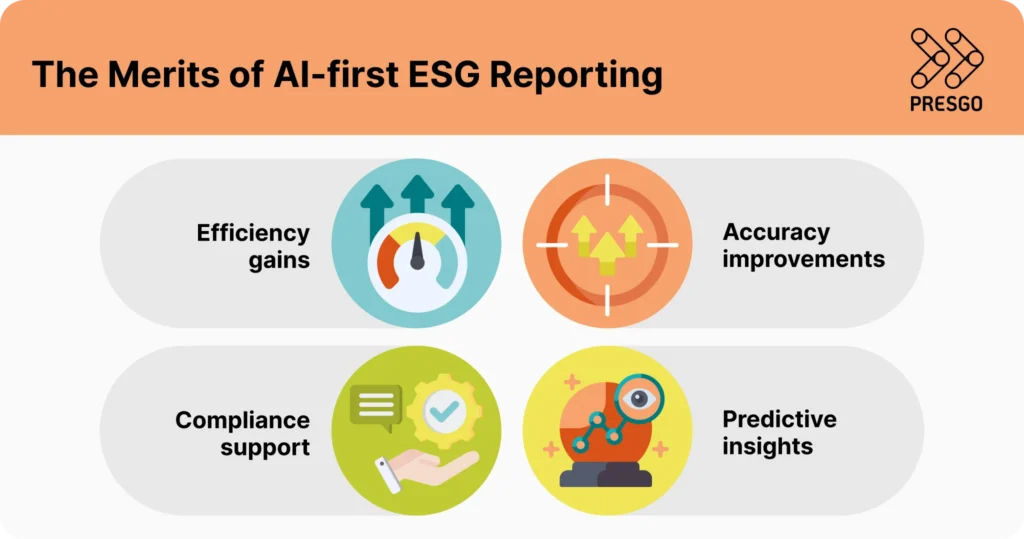
Many newer platforms today incorporate AI-first features to support data extraction, validation, and reporting workflows. Below are some key advantages of AI-first ESG reporting:
Efficiency gains
AI can automatically collect and validate data from diverse sources, significantly reducing manual effort. Automated report generation also speeds up ESG reporting cycles. In the long term, this can help cut costs and free time and resources for teams to do other tasks, such as strategic analyses, shifting the organisational focus toward stakeholder engagement and sustainability strategy.
Accuracy improvements
AI can help detect anomalies, inconsistencies, and potentially missing information, minimising human errors in the reporting process. AI features can also standardise data across global frameworks like the CSRD and GRI, ensuring that reports remain audit-ready.
Compliance support
As sustainability regulations continue to shift and evolve, AI can help teams stay aligned with disclosures across global standards while flagging non-compliance risks. Modern ESG reporting tools can automate categorisation and traceability while simplifying multi-framework adherence. This improves transparency for investors and regulators.
Predictive insights
As AI helps handle data across departments, it can forecast and model scenarios based on identified trends. This includes the ability to detect common ESG risks such as emissions and supply chain issues. AI-first tools also typically feature real-time dashboards that track indicators to help businesses proactively manage sustainability outcomes.
How to Evaluate ESG Reporting Tools (Without Getting Overwhelmed)
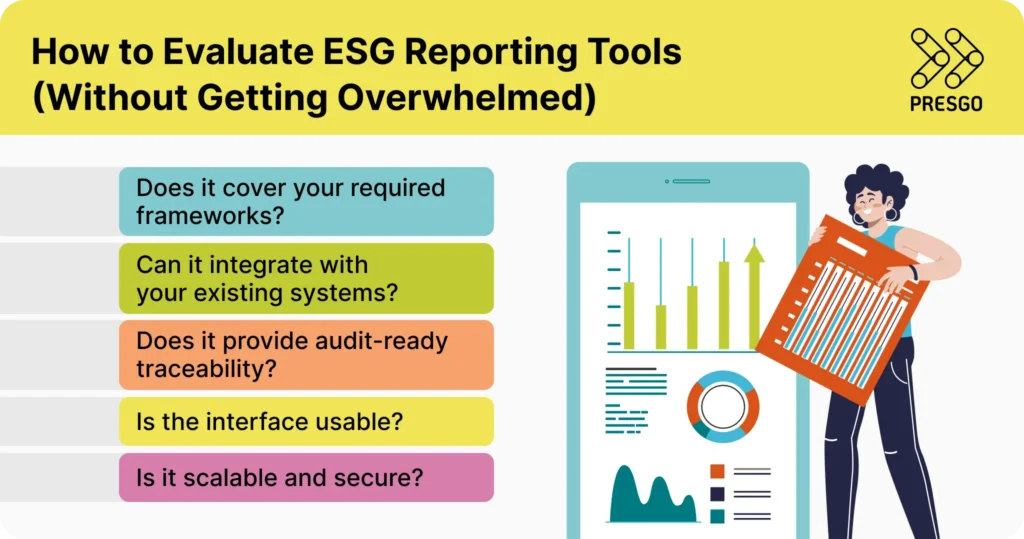
When evaluating ESG reporting tools, organisations should focus on how the tool can solve common reporting challenges without adding complexity. Tools should reduce manual work, improve traceability, and align with your requirements.
Key questions to ask:
- Does it cover your required frameworks?
Ensure the tool supports all relevant reporting standards (e.g., CSRD, GRI, SASB, TCFD, ISSB) and updates as regulations evolve, rather than needing manual adjustments.
- Can it integrate with your existing systems?
Good tools automatically pull data from existing systems (ERP, HRIS, finance) without manual re-entry, reducing errors and saving time.
- Does it provide audit-ready traceability?
Organisations should be able to track where data comes from, how it was calculated, and who approved it. These are essential to ensuring external assurance and compliance reviews.
- Is the interface usable?
Intuitive dashboards, clear visuals, and straightforward workflows help teams adopt the tool without heavy training.
- Is it scalable and secure?
Your ESG reporting tool should handle growing data volumes and evolving requirements while upholding data protection through features such as encryption and access controls.
Make Future-Ready Reports with Presgo
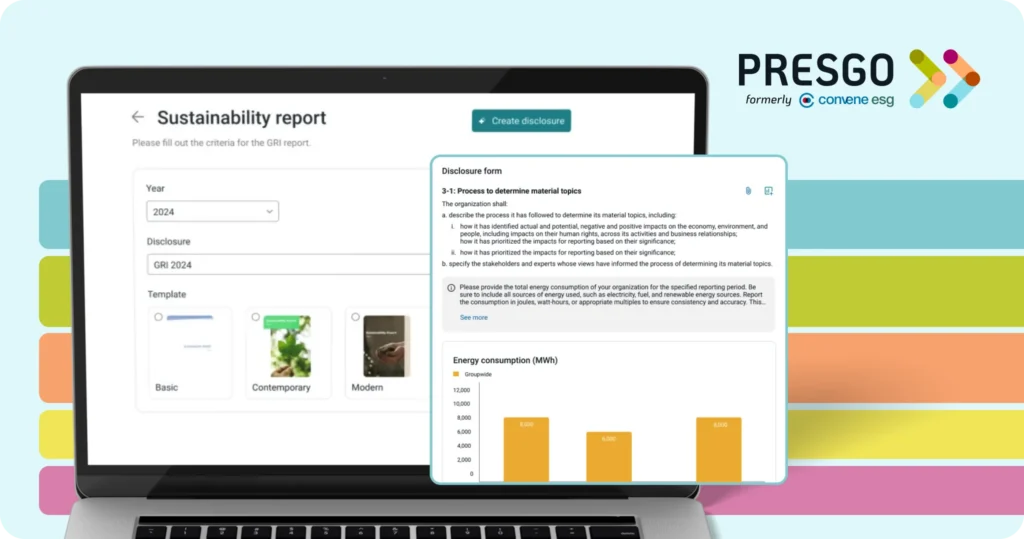
Comprehensive ESG reporting tools like Presgo enable organisations to manage complex, multi-framework disclosures efficiently and consistently. With regulatory expectations rising worldwide, particularly around mandatory disclosures and assurance, manual methods like isolated spreadsheets are increasingly inadequate.
Presgo helps organisations:
- Stay compliant with multiple evolving reporting standards.
- Reduce manual errors and time spent on reporting tasks.
- Produce more credible, audit-ready data for stakeholders.
- Track performance more strategically instead of just compiling numbers.
- Automate processes such as drafting disclosures and narratives, as well as supplier surveys and stakeholder input analyses.
- Scale according to your organisation’s ESG journey using modular features and built-in tools.
Organisations that adopt ESG reporting tools early build reliable reporting workflows and improve transparency across environmental, social, and governance dimensions. Accurate, traceable reporting becomes not just a compliance task but a foundation for better decision-making.
Book a demo to learn how Presgo’s AI-first features can support your organisation’s ESG reporting journey.