Talk to an ESG Expert about how Presgo can help you!
Our ESG Experts are on-hand to understand your ESG Reporting needs and cater our solution to you. Get in touch to discuss how we can help.
Talk to an ESG ExpertContents
Sustainability reporting, now extended to ESG reporting, is central to how companies disclose their impact on the environment, society, and the economy. These reports provide stakeholders with a clear view of a company’s ESG performance, reflecting the company’s priorities, measured outcomes, and alignment with broader sustainability goals.
Every sustainability report is built by teams based on a set of principles. These principles shape the report’s content, test the company’s practices, and ensure the disclosures are grounded in real data and meaningful insights. Behind each metric and narrative lies a group of people focused on accuracy, clarity, and accountability.
To help streamline this process, digital tools such as ESG reporting software are often used to simplify the workflows of ESG reporting teams.
The Rise of Sustainability Reporting and New Compliance Demands
Structured sustainability reporting frameworks emerged in the late 1990s. One early example is the Global Reporting Initiative (GRI), which launched its first guidelines in 2000. Soon after, companies across various industries formalised their reporting practices, owing to increased investor expectations, global initiatives, and public scrutiny. Today, sustainability reporting has evolved from a voluntary initiative to a regulated requirement in many regions, becoming a fast-paced, dynamic process for companies worldwide.
Due to varying regulatory landscapes, sustainability reporting requirements differ across regions. In the European Union, the Corporate Sustainability Reporting Directive (CSRD) mandates ESG disclosures to be aligned with the European Sustainability Reporting Standards (ESRS). In Asia, including the Philippines, regulatory bodies and stock exchanges have introduced their own sustainability reporting requirements for publicly listed companies.
As sustainability reporting becomes standardised, businesses are faced with new operational demands. This involves departments that may not have contributed to prior corporate disclosures or are unfamiliar with sustainability concepts. To address this, companies must build systems to track environmental, social, and governance metrics accurately. Today, ESG compliance requires clear processes, cross-departmental coordination, and a high standard of data integrity to ensure accuracy.
What is an ESG reporting team?
Sustainability reporting relies on both operational collaboration and strategic oversight.
At the centre of the process are dedicated sustainability or ESG teams. These teams lead coordination efforts across departments, gather and analyse data, manage reporting frameworks, and ensure the final disclosures are complete and accurate.
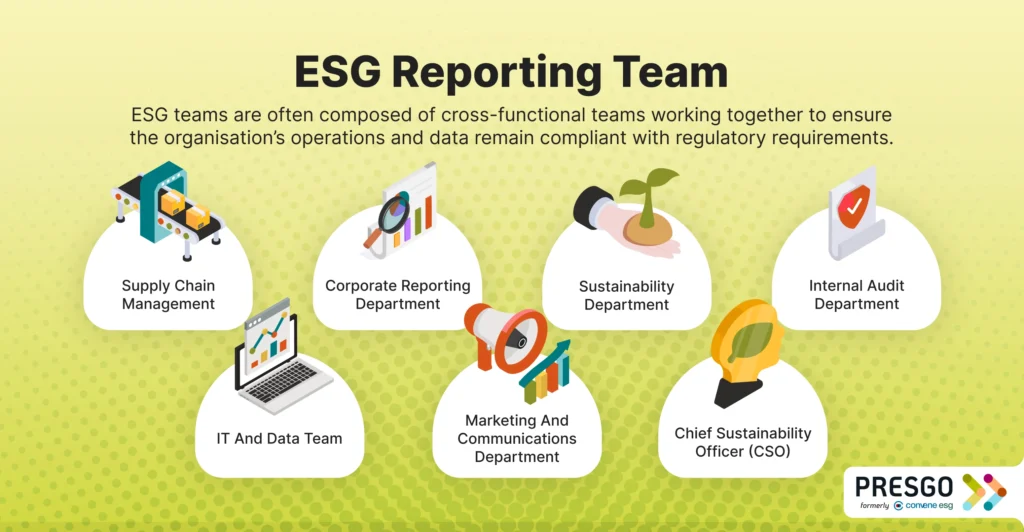
Due to the varied aspects of sustainability reporting, ESG teams are often composed of cross-functional teams working together to ensure the organisation’s operations and data remain compliant with regulatory requirements.
Aside from creating and publishing corporate sustainability reports, the key responsibilities of an ESG reporting team include:
- Managing sustainability initiatives and developing ESG strategies
- Guiding resource allocation for ESG strategies
- Ensuring compliance with regulatory, legal, and environmental standards
- Overseeing corporate sustainability reports
- Guarding against greenwashing
Some key roles and departments typically included in an ESG reporting team are:
- Supply chain management: Oversees the company’s entire production flow, from sourcing of raw materials to delivery. This department ensures the organisation’s supply chain complies with the latest ESG regulations.
- Corporate reporting department: Responsible for collecting, analysing, and publishing the organisation’s financial and non-financial ESG performance. The department also aligns ESG metrics with financial statements to ensure credibility and auditability across reporting cycles.
- Sustainability department: Collects and analyses ESG-related data throughout the company’s operations. Using this data, the department develops strategies for climate change mitigation, environmental impact reduction, and ways to uphold corporate social responsibility (CSR). It is also responsible for overseeing corporate sustainability initiatives and ensuring these are reported accurately.
- Internal audit department: In charge of assessing the company’s ESG maturity, performing risk assessments, and providing assurance by verifying the accuracy of the organisation’s sustainability data. Internal auditors collaborate with legal and compliance departments to ensure ESG reporting complies with regulations.
- IT and data team: Aggregates diverse data sources and ensures they meet requirements such as sustainability metrics. IT teams also streamline the reporting process by introducing and implementing the latest technologies to help with data accuracy.
- Marketing and communications department: Communicates the organisation’s sustainability initiatives to stakeholders. The department is also responsible for internal communications to uphold sustainability initiatives within the organisation and its suppliers, as well as public relations and community management.
- Chief Sustainability Officer (CSO): For enterprises, a CSO collaborates with internal and external stakeholders to manage sustainability strategies and ESG reporting. Chief sustainability officers ensure that initiatives and strategies help further the company’s ESG goals. The CSO also monitors the latest changes to ESG regulations in areas where the organisation operates.
What is the role of the board in ESG reporting?
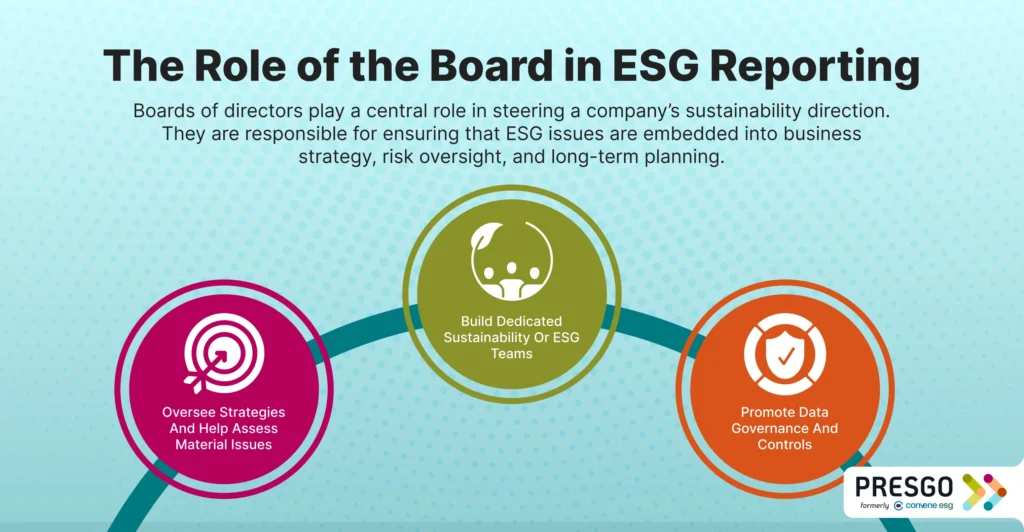
Before immediate team members and officers, sustainability efforts and consequent reporting begin with the boards. Boards of directors play a central role in steering a company’s sustainability direction. They are responsible for ensuring that ESG issues are embedded into business strategy, risk oversight, and long-term planning. Specific responsibilities include:
1. Oversee strategies and help assess material issues
Modern boards go beyond passive review. They set expectations for transparency and monitor how sustainability priorities influence business performance. This includes reviewing how the company identifies its most significant risks and opportunities across its operations and value chain.
Additionally, boards ensure that the business impact on the environment and the environment’s impact on business are evaluated clearly and consistently. This approach helps align sustainability reporting with business strategy, ensuring meaningful action beyond mere compliance.
2. Build dedicated sustainability or ESG teams
To strengthen oversight, many boards establish dedicated sustainability or ESG teams. These teams help define responsibilities and monitor the progress of sustainability performance. In some cases, boards may also rely on the help of external experts or training to improve their understanding of new and complex sustainability topics.
3. Promote data governance and controls
Boards influence the quality of sustainability disclosures by promoting strong internal controls and data governance. They require reliable, decision-useful information and encourage clear communication with investors, regulators, and other stakeholders.
Ultimately, boards that treat sustainability as a core governance issue set the tone for responsible leadership. Their active role in overseeing ESG reporting teams supports long-term value creation and strengthens trust in the company’s commitments.
Who needs an ESG team?
The success of a sustainability report depends on the people involved. Companies take different approaches depending on their size, stage of reporting maturity, and available resources. While team structures may vary according to need and resources, ESG reporting teams rely on coordination, accountability, and technical understanding to ensure accuracy and compliance. Below are some of the common team structures for sustainability reporting.
1. Companies that are just starting
In companies new to sustainability reporting, a single representative from an existing department, such as finance, corporate affairs, legal, or operations, is tasked with leading the effort. This person serves as the central coordinator, gathering inputs from various departments and compiling them into a report.
They may not have prior ESG experience, and reporting is often treated as an additional responsibility alongside their core role. These individuals rely heavily on cross-departmental support and external consultants to interpret reporting requirements, conduct the materiality assessment, and prepare disclosures.
Key roles in this stage may include:
- Finance or Accounting: For data consolidation and linkages with financial reporting
- Legal or Compliance: For interpreting regulations and reviewing final disclosures
- HR: For social indicators such as diversity, training, and working conditions
- Operations or EHS: For environmental metrics, resource use, and emissions data
2. Companies with a dedicated team
As companies become more well-versed in sustainability requirements, the need for a more comprehensive reporting process arises. More advanced organisations form a dedicated sustainability or ESG team. This internal team owns the reporting process, manages timelines, engages with stakeholders, and ensures compliance with relevant frameworks.
This team typically includes:
- Sustainability Managers or ESG Officers: Lead reporting strategy and framework alignment
- Data Analysts: Manage data collection and ensure accuracy
- Stakeholder Engagement Leads: Conduct materiality assessments and consultations
The dedicated team still works closely with other departments, but is fully accountable for the reporting process.
3. Companies with integrated ESG functions
In large or sustainability-focused organisations, ESG responsibilities are embedded across multiple business units with clearly defined roles. These companies may have:
- Board-level ESG Committees
- Chief Sustainability Officers (CSOs) reporting to the CEO or CFO
- Cross-functional working groups that meet regularly to review targets and coordinate updates
4. External contributors
Across all company types, external partners support reporting efforts:
- Sustainability consultants: Provide expertise on reporting standards and frameworks
- Auditors: Conduct limited assurance or verification
- Software providers: Offer ESG data management platforms
- Design or content firms: Help communicate the report effectively
How to Build an ESG Reporting Team
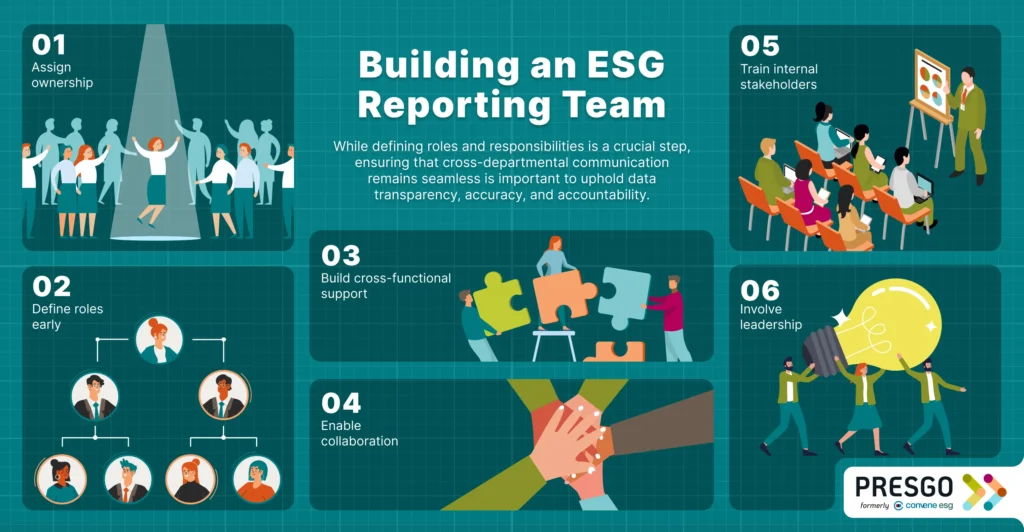
Strong reporting depends on clear teamwork, communication, and accountability. Companies must establish a clear and structured approach to the process. While defining roles and responsibilities is a crucial step, ensuring that cross-departmental communication remains seamless is important to uphold data transparency, accuracy, and accountability. Below are the steps to building a solid ESG reporting team:
- Assign ownership: Identify a core sustainability or ESG lead who coordinates the reporting process across departments. For larger companies and entities, the CSO typically handles this.
- Define roles early: Clarify responsibilities for data provision, review, narrative input, and compliance to avoid overlaps or gaps. For example, risk managers for risk assessments and sustainability managers for data analysis.
- Build cross-functional support: Involve finance, HR, legal, risk, operations, and communications teams to ensure broad coverage and accurate data.
- Enable collaboration: Hold regular check-ins, align on definitions, and maintain shared working documents to improve coordination. The IT team can streamline this process by introducing software or integrated platforms where cross-functional teams and managers can access dashboards to get a quick view of the ESG reporting progress.
- Train internal stakeholders: Equip team members with a basic understanding of ESG standards and materiality to help them contribute effectively. Today, professional and industry associations and advisory firms provide sustainability courses, webinars, and training for employees and team members. This includes the GRI Academy from the Global Reporting Initiative, as well as department-specific ESG training from professional services firms.
- Involve leadership: Keep executives and board members informed so they can provide guidance and approve final disclosures.
Regardless of the size or maturity of your ESG reporting team, sustainability reporting is a complex, multi-step process that demands clarity, coordination, and discipline. After a materiality assessment to identify the topics that matter most based on stakeholder expectations and business strategy, teams must collect data from across the organisation.
This is followed by the difficult work of validating and consolidating the data, and then narrative development. This is the crucial part of the process where data and numbers become meaningful insights aligned with the company’s ESG frameworks. Finally, the report goes through internal review involving legal, finance, and senior leadership.
Boost ESG Team Collaboration with the Right Reporting Software

Ultimately, sustainability reporting is a collaborative process. Leaders, teams, and advisors work together to produce accurate and comprehensive reports that reflect more than just performance. A good sustainability report reflects a company’s understanding of its responsibilities and communicates them with integrity.
Every report begins with questions. What are we measuring? How are we performing? Where are we falling short? Teams face and answer these questions throughout the process. Their willingness to ask and answer them drives the quality of the outcome.
Alongside people and processes, the right tools also make a difference. As reporting requirements become increasingly complex and data-heavy, companies need systems that help reduce manual work and improve accuracy. Digital tools like ESG software are designed for sustainability reporting and can help centralise ESG data, track carbon emissions, set goals, and generate reports that meet global standards. These tools support real-time collaboration, reduce error-prone spreadsheets, and provide a reliable foundation for assurance and stakeholder confidence. This empowers teams to focus less on formatting and more on strategy.
Behind every sustainability report is a team asking hard questions, supported by tools that help them find clear answers, fast.
Presgo helps facilitate the sustainability reporting process with its suite of built-in tools and automated workflows. Depending on the size and maturity of your ESG team, the all-in-one platform provides greater data security and accountability to ensure future-proof reporting.
Organisations can empower ESG teams using the software. Corporate reporting teams, for example, can benefit from the platform’s auto-report generation feature. Meanwhile, supply chain management teams can utilise the supplier module to monitor ESG performance across the chain. Automated data collection workflows also ensure teams can consolidate years of ESG data to ensure accuracy, working alongside AI-first features to draft insightful reports and detect anomalies as they come.
Businesses and teams using Presgo also have access to a dedicated team of ESG Experts and Partners for consultations, assurance, and integrations to guarantee full compliance with mandatory requirements. Book a demo today to learn more about how Presgo can support your team.