Talk to an ESG Expert about how Presgo can help you!
Our ESG Experts are on-hand to understand your ESG Reporting needs and cater our solution to you. Get in touch to discuss how we can help.
Talk to an ESG ExpertContents
In today’s rapidly changing business landscape, environmental, social, and governance (ESG) goals are no longer just an option. They are becoming central to corporate strategy, investor expectations, and regulatory requirements, such as the CSRD and ESG reporting.
One of the most powerful ways to make progress on ESG initiatives is through ESG training. As excellent ESG performance relies on a deep understanding of what ESG truly is, it is essential to instil a common language and shared understanding to integrate sustainability into every aspect of an organisation’s functions. Companies can turn strategy into action through employee sustainability training, embedding ESG principles into everyday decision-making.
What are ESG goals?
ESG goals, encompassing environmental, social, and governance objectives, guide organisations in aligning their operations with sustainable and ethical performance. These goals can encompass a wide range of commitments, such as reducing emissions, enhancing employee well-being, and strengthening corporate ethics and transparency.
The key dimensions of ESG goals are the following:
- Environmental goals include efforts such as lowering carbon emissions, improving energy efficiency, and promoting climate literacy throughout the company.
- Social objectives aim to improve how a company interacts with its employees, customers, and the wider community. They often contribute to fostering employee engagement, workplace health, and inclusive cultures. Substantial ESG training and programmes can significantly enhance retention and job satisfaction.
- Governance initiatives aim to institute transparent leadership, ethical conduct, and stakeholder accountability in line with corporate sustainability expectations.
Well-implemented ESG goals not only fulfil compliance but also enrich employee experience, drive innovation, and build long-term business resilience. Moreover, engaging employees through targeted corporate sustainability training empowers them to contribute meaningfully to ESG performance, transforming sustainability from policy into culture.
Why are ESG goals important for employees?
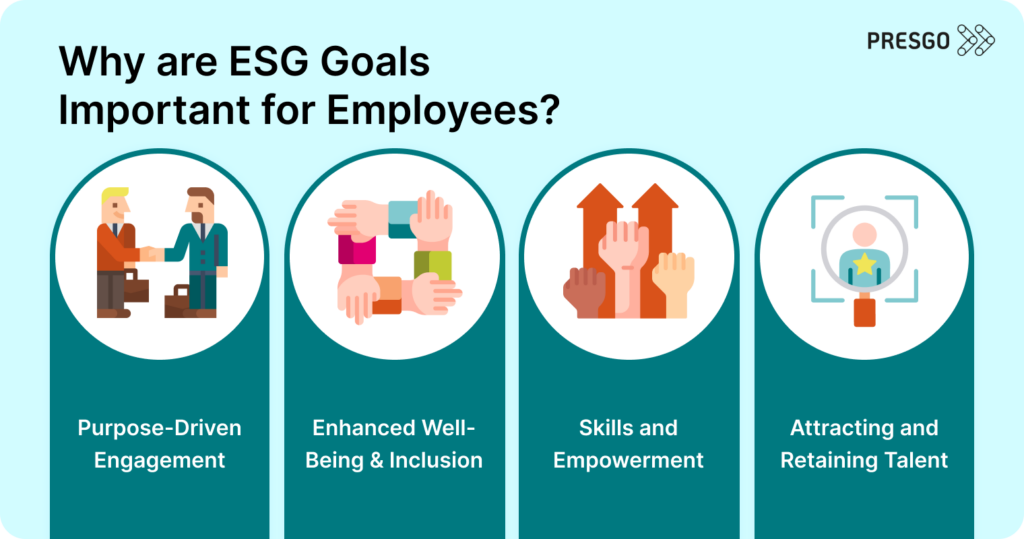
ESG goals transcend compliance. They shape employee experience, workplace culture, and long-term strategic advantage. Today’s workforce increasingly seeks purpose-aligned employers, making ESG initiatives a central lever for engagement and retention.
- Purpose-Driven Engagement: Employees, especially from younger generations, want employers whose values align with their own. ESG goals provide meaning beyond profit, fuelling motivation and loyalty.
- Enhanced Well-Being & Inclusion: Social dimensions of ESG, such as mental health, diversity, equity, and inclusion, build a supportive and thriving work environment. Employees who feel seen and supported demonstrate higher engagement and loyalty.
- Skills and Empowerment: ESG-focused training, like climate literacy, empowers team members to act with purpose. Equipped with the right knowledge, employees can integrate sustainability into daily tasks and decisions.
- Attracting and Retaining Talent: Companies serious about ESG outperform peers in attracting talent. Many individuals choose employers based on sustainability credentials, not just salary.
How to Set ESG Goals and Measure Impact
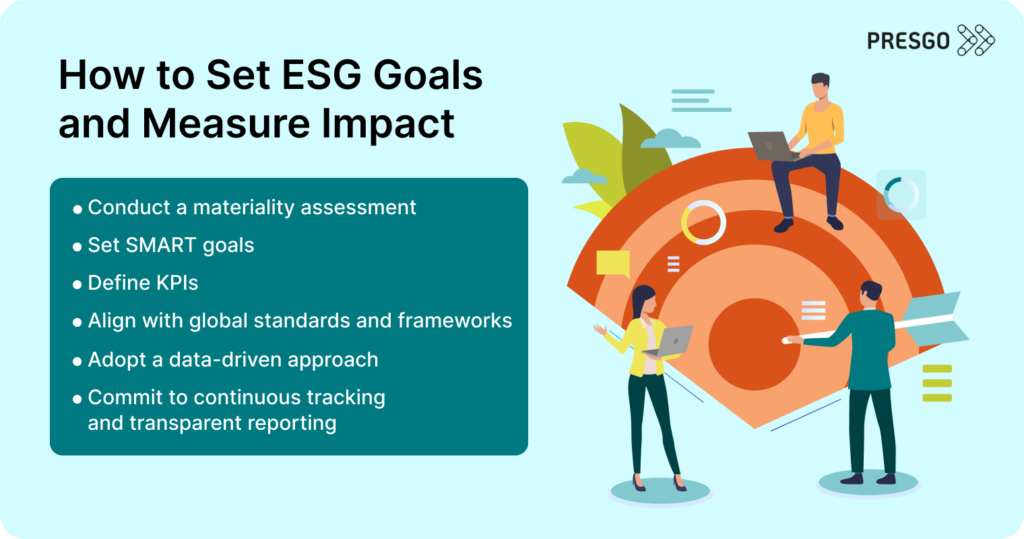
When setting ESG goals, organisations should follow a structured, transparent process:
- Conduct a materiality assessment to identify the ESG issues most relevant to your business and stakeholders. This ensures that goals target areas where the company can make the most meaningful impact.
- Set SMART goals, which are specific, measurable, attainable, relevant, and time-bound objectives, to show clarity and accountability. For example, a company declares its commitment to reduce 20% of carbon emissions by 2030 compared to its 2020 levels.
- Define key performance indicators (KPIs) that align with these goals, such as emissions data, workforce diversity ratios, or governance compliance metrics, to enable consistent measurement.
- Align with global standards and frameworks like the Global Reporting Initiative (GRI), Sustainability Accounting Standards Board (SASB), or science-based targets to ensure comparability and strengthen credibility.
- Adopt a data-driven approach by integrating ESG KPIs into business strategy and tracking progress systematically. Integrating ESG into the strategy and operations involves understanding ESG principles, assessing current ESG status, setting clear ESG goals, developing an ESG action plan, and implementing the plan effectively.
- Commit to continuous tracking and transparent reporting, providing regular updates internally and externally so that progress can be monitored, adjustments made, and stakeholder trust maintained.
While strong ESG goals and measurement frameworks provide the foundation, their success ultimately depends on how effectively they are integrated across the organisation. This is where employee engagement comes in, translating strategic ESG commitments into everyday practices and measurable impact.
How does employee engagement affect ESG?
Employee engagement is a critical driver of successful ESG initiatives. It goes beyond saving bees and white rhinos, as it drives tangible benefits for corporate culture and business performance. Involving employees across all departments creates a multiplier effect, going from participants to active contributors and achieving faster and more meaningful organisational sustainability goals. The combined impact can be transformative in these ways.
Driving ESG goal achievement
Engaged employees help organisations achieve ESG objectives by actively participating in initiatives and understanding the rationale behind each goal. Setting clear and backed ESG targets and providing regular updates motivates employees and fosters accountability. Frequent communication of ESG progress guarantees alignment between individual actions and corporate objectives.
Promoting sustainable workplace practices
Employees who understand and participate in ESG initiatives are more likely to adopt environmentally and socially responsible behaviours. For instance, reducing office carbon footprint depends not only on policies but also on employee actions and buy-in. Also, climate literacy is reported to be a key factor in empowering employees to make meaningful sustainability decisions in the workplace.
Enhancing employee retention and corporate culture
Engaged employees are more motivated, productive, and loyal. Research shows that organisations integrating ESG meaningfully into workplace culture see higher retention rates, particularly among younger talent who prioritise purpose-driven work. Similarly, ESG-focused programmes improve employee satisfaction and engagement by giving staff a clear connection between their work and the company’s sustainability impacts.
Employee engagement ensures that ESG initiatives align with broader societal goals, including social responsibility and ethical conduct. Employees who understand ESG principles are better equipped to support initiatives that go beyond compliance, integrating sustainability into everyday operations. Also, the growing regulatory landscape, including the CSRD, pushes the importance of preparing employees for future ESG reporting requirements.
Improving ESG reporting quality
Employee involvement in ESG data collection enhances the reliability and comprehensiveness of sustainability reporting. This engagement ensures that ESG disclosures reflect actual practices and not just compliance. In fact, HR’s role in ESG is evolving to include mobilising employees around corporate social impact and integrating ESG into workplace routines.
The Role of HR in Conducting ESG Training for Employees
Human resources sits at the center of ESG training. It owns the systems that turn intentions into repeatable behaviours: defining competencies, building curricula, and embedding expectations into onboarding, leadership development, and performance management.
These are HR responsibilities in conducting ESG training for employees:
Integrate ESG in onboarding
Onboarding sets the tone for an employee’s journey, and it’s a powerful moment to integrate ESG into the company culture from day one. By introducing sustainability goals, ethical standards, and governance expectations alongside compliance and role-based training, HR can ensure employees see ESG as a core responsibility. Deloitte highlights that organisations often fall short on sustainability because they fail to embed the “human element.” HR leaders can bridge this by aligning onboarding and people practices with ESG priorities, making sustainability part of everyday work rather than an external addition. Similarly, HR can integrate ESG principles from recruitment to workplace environment, immediately connecting new hires to their roles and the organisation’s sustainability commitment.
Create sustainability training tailored to job functions
Generic ESG training rarely resonates with employees unless it connects directly to their roles. HR can collaborate with managers to design function-specific modules. For example, supply chain teams may focus on ethical sourcing, while finance teams learn ESG disclosure standards. HR management tools must be used to integrate sustainability into the company’s systems, including tailored training and development programmes. Also, continuous ESG education is critical to operationalise the social pillar of ESG, ensuring employees have role-relevant knowledge of their impact and translating strategy into practice.
Use ESG reporting software to measure training impact
ESG training matters if its impact can be measured and reported. HR leaders play a pivotal role in tracking participation, training hours, and skills gained, which directly support ESG reporting frameworks. HR manages data, such as the GRI’s training and education standard, requiring the disclosure of employee upskilling training and programs. This highlights the advantage of technology such as AI-powered ESG reporting software that helps monitor workforce indicators like engagement and diversity in real time, improving both ESG measurement and external accountability.
Reward participation in employee sustainability projects
Incentivising hands-on involvement reinforces learning and builds culture. Whether through bonuses, performance recognition, or public acknowledgement, the HR department can tie sustainability engagement to career development. A 2025 academic research reinforces that ESG-driven HR practices significantly boost employee performance and well-being, suggesting that rewarded ESG participation yields tangible benefits.
Therefore, by aligning HR strategy with ESG goals, companies are guaranteed sustainability that is woven into the ESG workplace.
7 Strategies for Leveraging Employees’ Potential in Achieving ESG Goals
To effectively harness employees’ potential in achieving ESG goals, organisations can implement the following strategies:

Foster transparent communication
Regularly communicate the importance of ESG goals and how they align with the company’s mission. Provide education and resources to help employees understand ESG principles and their impact on the business and society.
Empower grassroots movements
Encourage and support the formation of Employee Resource Groups (ERGs) and committees that are passionate about various ESG aspects. For instance, Pernod Ricard has established ERGs open to all employees to foster a sense of belonging and inclusivity, aligning with their commitment to diversity and inclusion.
Provide training and education
Offer training programs to enhance employees’ understanding of ESG principles and practices, equipping them with the knowledge and skills to contribute effectively. Pernod Ricard also provides resources and support to help employees understand ESG principles and their impact on the business and society.
Provide meaningful opportunities
Create opportunities for employees to participate in ESG activities that have a tangible impact, whether it is community service, environmental projects, or diversity and inclusion programmes. Technip Energies, a French engineering and technology company, offers a We Volunteer program, which provides employees with two paid hours annually to engage in meaningful causes. This initiative aligns with the company’s commitment to encourage employees to contribute to social and environmental causes.
Enable autonomy and leadership
Give employees the autonomy to lead initiatives and make decisions relevant to ESG. When employees feel their actions can lead to real change, engagement increases significantly. Such is the case for Technip Energies, which empowers employees through its D&I Champions Network, promoting leadership in diversity and inclusion efforts.
Recognise and reward ESG contributions
One of the most effective ways to engage employees in ESG initiatives is by linking their efforts to tangible rewards and recognition. Companies can integrate ESG criteria into their performance evaluations, aligning with sustainability objectives and contributions to ESG initiatives. They can then acknowledge and reward the efforts of employees and teams, taking many forms, from company-wide shout-outs to financial incentives.
Transform Employee Engagement into ESG Performance with Presgo

Engaging employees in every aspect of ESG is a strategic necessity. With the right ESG tools and technology, companies can empower their workforce, strategies, and operations to level up performance and report impactful results. Given how fast-paced the ESG landscape is evolving today, engaged employees and well-designed initiatives can deeply benefit from modern technology like ESG software.
At Presgo, we simplify this process by transforming complex ESG data into clear, actionable insights and measurable impact. The ESG reporting software allows organisations to design, monitor, and measure employee-focused ESG programmes, ensuring alignment with corporate goals while tracking participation and impact. With Presgo, businesses can streamline ESG training initiatives, measure engagement outcomes in real time, and provide employees with the tools and visibility needed to contribute effectively toward sustainability and social responsibility objectives.
Transform your employee engagement with Presgo. Book a demo today.