


Contents
- What do UK companies benefit from ESG reporting?
- What are the ESG reporting requirements in the UK?
- ESG Reporting Process: Step-by-Step for UK Companies
- Key Challenges in ESG Reporting in the UK and How to Address Them
- How Can ESG Reporting Software Help
- Build a Future-Ready UK ESG Reporting System with Presgo
Financial markets have seen the evolution of environmental, social, and governance (ESG) reporting over recent years from a niche practice into a mainstream business requirement for companies. The growing number of ESG reporting requirements introduced by governments and stock exchanges means companies need to integrate ESG reporting into their regular operations. Consequently, companies should be preparing to integrate ESG compliance into their processes, if they haven’t already.
Driven by regulatory updates, global sustainability alignment, and climate efforts, the ESG reporting landscape in the UK is set to see a significant shift in 2026. This guide will provide an overview of new UK ESG reporting requirements, identifying required companies, relevant frameworks, and best practices to streamline ESG reporting.
What do UK companies benefit from ESG reporting?
In a nutshell, ESG reporting refers to the structured disclosure of a company’s sustainability performance across the three pillars of ESG. It involves collecting, analysing, and publishing data that reflects how a company is managing its material impacts on people and the planet, and also its internal governance structures.
For UK companies operating in global financial markets, ESG reporting should be considered as a strategic necessity and not just a compliance exercise. Investors are now including ESG performance in their investment decisions, consumers are demanding transparency on sustainable business practices, and regulators are increasingly including ESG reporting requirements in their guidelines. Companies that fail to meet ESG expectations risk reputational damage, losing access to new sources of capital, and falling behind competitors who have already incorporated sustainability and ESG reporting into their business strategies.
What are the ESG reporting requirements in the UK?
ESG reporting requirements in the UK are shaped by a combination of global, regional, and national frameworks that aim to standardise ESG disclosures and improve transparency for investors and stakeholders. As sustainability becomes a strategic priority, UK companies must navigate both international expectations and domestic mandates.
At the global level, we have international ESG reporting frameworks, such as the GRI Universal Standards and the SASB Industry-specific Standards. These are voluntary initiatives that are widely used internationally, facilitating the disclosure of comparable ESG performance data across the board.
In the European region, the Corporate Sustainability Reporting Directive (CSRD) significantly expands ESG reporting requirements with the European Sustainability Reporting Standards (ESRS). UK companies with substantial operations in the European Union are expected to comply with CSRD and report using the ESRS, which mandates double materiality assessments, value chain disclosures, and third-party assurance.
To align with international best practices, the UK is also developing its own Sustainability Reporting Standards (UK SRS). These will be based on IFRS S1 and S2 standards that were published by the International Sustainability Standards Board (ISSB) in 2023. The UK government aims to create its UK SRS to reflect UK-specific policy priorities while ensuring minimal divergence from the IFRS S1 and S2. It is currently consulting on its exposure drafts for UK SRS S1 and S2, with finalised versions and voluntary adoption expected later in 2025. Moreover, the government is considering the potential mandatory implementation of the UK SRS S1 and S2.
Other ESG reporting requirements in the UK include:
- Streamlined Energy and Carbon Reporting (SECR) Regulations: Requires UK-incorporated companies, large unquoted companies incorporated in the UK, and large LLPs to report on their company’s energy use, greenhouse gas emissions, and energy efficiency actions.
- Climate-related Financial Disclosure Regulations 2022: Mandates climate-related disclosures aligned with the Task Force on Climate-related Financial Disclosures (TCFD) recommendations for large companies and LLPs. These must be included in companies’ and LLPs’ annual reports and accounts.
- Financial Conduct Authority (FCA) Listing Rule on TCFD Disclosures: Requires a commercial company with a UK premium listing to make disclosures against the TCFD recommendations and recommended disclosures on a ‘comply or explain’ basis.
- Gender Pay Gap Reporting: Employers in the UK with over 250 employees are required to publish their gender pay gap data annually.
- Modern Slavery Act 2015: Requires companies operating in the UK to publish an annual modern slavery statement that includes steps taken to address modern slavery risks in operations and supply chains.
Together, these frameworks and regulations form a comprehensive ESG reporting landscape that UK companies must navigate. The shift towards the new UK SRS that’s aligned with the ISSB’s IFRS S1 and S2 standards signals a move toward greater consistency and comparability in ESG reporting requirements.
ESG Reporting Process: Step-by-Step for UK Companies
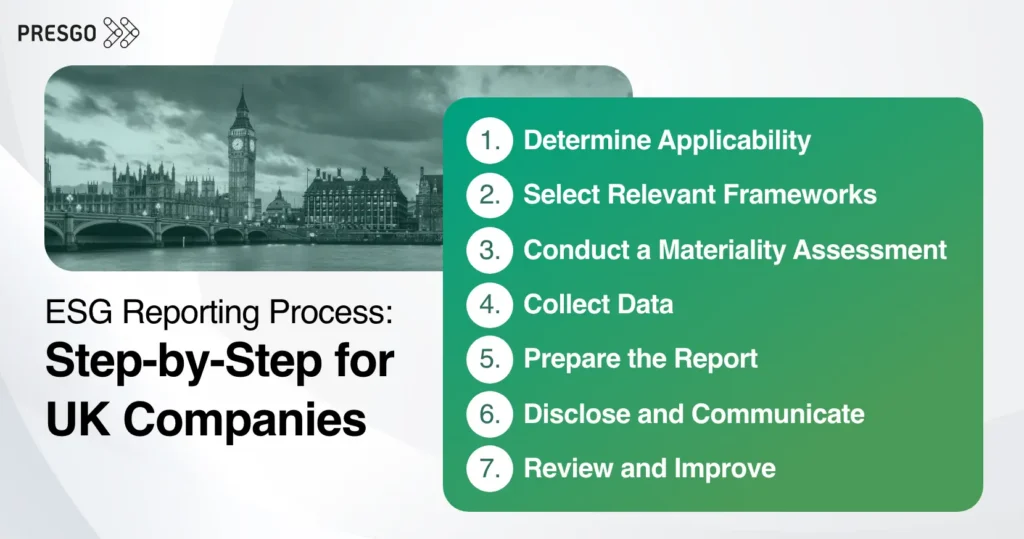
Navigating ESG reporting can be complex, but a structured approach can ease the process. Here’s a quick step-by-step guide for UK companies to follow:
- Determine applicability: Assess whether your company is subject to any mandatory ESG reporting regulations and whether there are any requirement thresholds based on size, sector, or listing status.
- Select relevant frameworks: Choose the appropriate ESG reporting standards (e.g., GRI, TCFD, IFRS S1 and S2) based on regulatory requirements and usability.
- Conduct a materiality assessment: Identify which ESG topics are most relevant to your specific business context, based on actual and potential impacts and stakeholder input.
- Collect data: Gather quantitative and qualitative data across the business, covering all significant locations and operations. Ensure that your data is accurate and consistent. Use internal audits or third-party verification to validate your data where necessary.
- Prepare the report: Write and structure the report according to the chosen standard/s, focusing on your identified material ESG topics
- Disclose and communicate: Publish your report through annual filings, sustainability reports, or digital platforms.
- Review and improve: Use insights from the reporting process to enhance ESG strategies and prepare for future disclosures.
Key Challenges in ESG Reporting in the UK and How to Address Them
First, data collection is often fragmented across departments, making it difficult to ensure consistency and accuracy. Without integrated systems and processes, companies may struggle to consolidate and validate ESG metrics effectively.
Second, the regulatory landscape is complex and constantly evolving. For companies operating internationally, there may be a need to align with both local and international standards, resulting in added complexity. These companies must be able to navigate multiple frameworks simultaneously, each with its own set of requirements and guidelines.
Third, many organisations lack the internal expertise and resources to manage ESG reporting effectively. Smaller companies may not have dedicated sustainability teams, while larger ones often face coordination issues across departments and locations. As ESG disclosures increasingly require external assurance, companies must also prepare for audit-level scrutiny, which demands robust internal controls and documentation.
Finally, the pace of regulatory changes regarding ESG reporting requirements can result in uncertainty. New requirements require companies to stay agile and continuously adapt their reporting strategies and processes, which can put a strain on already limited resources.
How Can ESG Reporting Software Help
ESG reporting software can help companies overcome these key challenges by centralising and automating data collection across departments to ensure consistency and accuracy. These platforms support multiple frameworks, easing the burden of navigating evolving regulations. They also enhance audit readiness through features like traceable data audit trails and built-in validation tools. For organisations with limited ESG expertise, the software simplifies compliance through guided workflows and templates. Additionally, real-time dashboards and analytics support better decision-making and continuous improvement in sustainability performance.
Making use of an ESG reporting platform helps companies reduce the burden of manual reporting and improve the quality of ESG disclosures. In short, modern ESG reporting solutions offer the following advantages:
- Automation: Streamline data collection and report writing processes.
- Alignment: Ensure compliance with multiple ESG reporting standards simultaneously.
- Collaboration: Data owners can submit and review data as needed.
- Audit-Readiness: Ensure collected ESG data is traceable and evidence-based.
- Data-driven Decision-making: Simplified data presentation facilitates strategic decision-making.
Build a Future-Ready UK ESG Reporting System with Presgo

This guide has outlined the importance of ESG disclosures, the entities that must comply, the key international and UK-specific frameworks, and the step-by-step process for effective reporting. It also looked at how ESG software can make it easier to gather data, meet different standards, work together, and be ready for audits.
Presgo is a purpose-built platform that helps companies centralise ESG data, align disclosures across multiple frameworks, and maintain consistency as regulations evolve. For UK organisations navigating the transition to more rigorous ESG reporting, Presgo provides a practical and scalable solution.
Designed to support UK ESG reporting needs, Presgo aligns with IFRS S1 and S2, UK SRS, GRI, TCFD, and other global standards. It streamlines data collection across teams and operations, improves audit readiness through traceable and verifiable data, and supports year-on-year comparability. By reducing manual effort and increasing data reliability, Presgo enables companies to focus beyond compliance. It facilitates data-driven decision-making for future-ready sustainability practices and disclosures.
With 2026 marking a pivotal year for ESG reporting requirements in the UK, companies that act now to strengthen their ESG will be better positioned to meet evolving ESG developments.
Get future-ready with us at Presgo. Book a demo today.
