

Contents
- What is greenwashing?
- What are the examples of greenwashing?
- Why is greenwashing a serious risk in the UK?
- How to Avoid Greenwashing for UK Companies
- What is the role of ESG reporting software in preventing greenwashing?
- Greenwashing Case Studies in the UK
- FAQs about Greenwashing in the UK
- Build Credibility Through Transparent ESG Reporting with Presgo
We’ve heard terms like eco-friendly, net-zero ready, or sustainable used so easily for marketing. A well-thought-out sustainability initiative benefits the overall goal of a greener economy and a better future for society and the environment. However, many claims of sustainability progress can be misleading or unsupported by actual science and research. It not only harms the company’s reputation, but also the promise these claims project and the global advocacy for sustainability.
In this article, explore what is greenwashing, what damage it can do (especially for UK companies), and how to avoid crossing that territory.
What is greenwashing?
Greenwashing refers to the practice of making misleading, exaggerated, or false claims about a company’s environmental performance or the sustainability of its products and services. The United Nations (UN) defines it as the act of “misleading the public to believe that a company or entity is doing more to protect the environment than it is.”
While there is no single definition of greenwashing in the UK, regulators like the Competition and Markets Authority (CMA) treat it as the use of false or unsubstantial environmental claims. This is reflected in a report showing 62% of UK products failing multiple checks under the Green Claims Code, which protects consumers from unsupported environmental claims.
What are the examples of greenwashing?
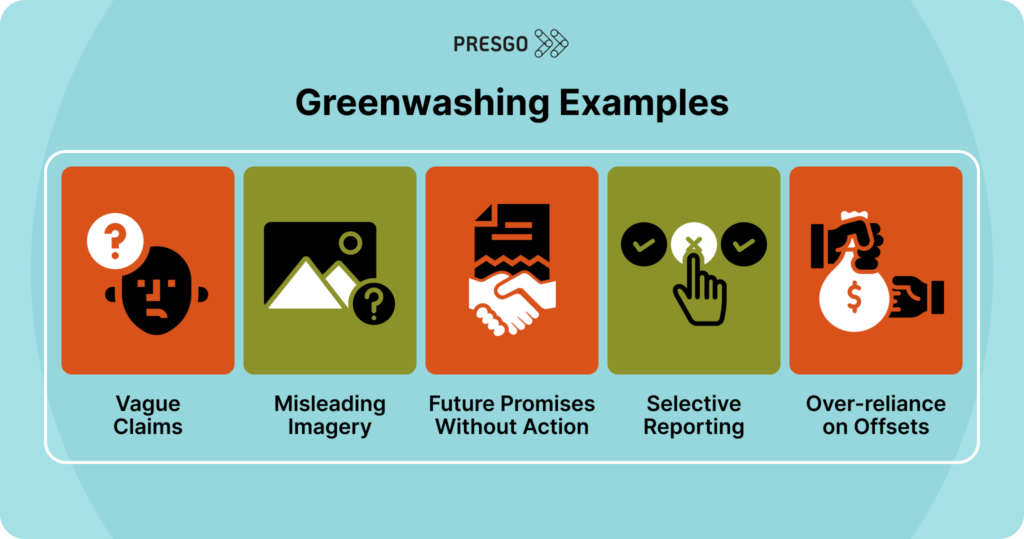
Greenwashing can take many forms, but these are some of the greenwashing examples that businesses in the UK should avoid.
Vague Claims
Using terms like eco-friendly, green, or sustainable without clearly defining what these terms mean or offering evidence to back them up is one of the most common types of greenwashing. One case involved ASOS, a British fashion retailer, which faced criticism for greenwashing after promoting its “Responsible Edit.” It was intended to be a hub for sustainable fashion. But with not much clarity on what made their products environmentally responsible, a regulatory investigation led to ASOS committing to address and improve these greenwashing issues.
Misleading Imagery
This is commonly executed by using nature-related imagery to suggest a product or company is more sustainable than it is. Among the different types of greenwashing, misleading imagery is less about terms and more about its translation to visuals.
In 2021, HSBC ran two posters showing ocean waves and tree signs. It claimed to combat climate change by funding green projects and planting two million trees. The UK Advertising Standards Authority ruled the ads were misleading because they ignored the bank’s heavy involvement in funding major polluting industries, including fossil fuels and coal.
Future Promises Without Action
Companies that have done this were setting ambitious sustainability goals without presenting a clear and feasible strategy to meet these targets. Several FTSE 100 companies that have pledged to reach net zero by 2050 were revealed as greenwashing examples. As of 2023, 95% of these companies failed to set short-term carbon reduction targets or publish detailed transition plans. This gap between long-term promises and real action makes their commitments appear more like marketing than actual progress.
Selective Reporting
This deals with focusing on one positive environmental metric while ignoring the larger negative impact. One instance is Nestlé’s switching from plastic to paper straws. It sounds eco-friendly, but it can also be considered more of a distraction. By highlighting a minor change, Nestlé shifted its attention away from the massive waste created by its single-use packaging. This kind of selective reporting dressed up small actions as big progress, while the real waste problem was not addressed.
Over-reliance on Carbon Offsets
Heavily relying on carbon offsetting, such as through tree planting or purchasing carbon credits, undermines and sets aside the goal of reducing direct emissions. It lets major UK companies claim progress on climate goals while continuing to do business in the exact same way.
Is carbon offsetting greenwashing? By default, the answer is no. But it becomes greenwashing when offsets are unverified and used to overshadow the larger emissions a company avoids addressing.
This is the case for EasyJet’s carbon offsetting program. Analysis showed that about 72% of the airline’s 11 million purchased carbon credits were likely “junk” and failed to deliver real emission cuts. This kind of offset dependence shows a false picture of climate action and delays their accountability to shift away from fossil fuels.
Why is greenwashing a serious risk in the UK?
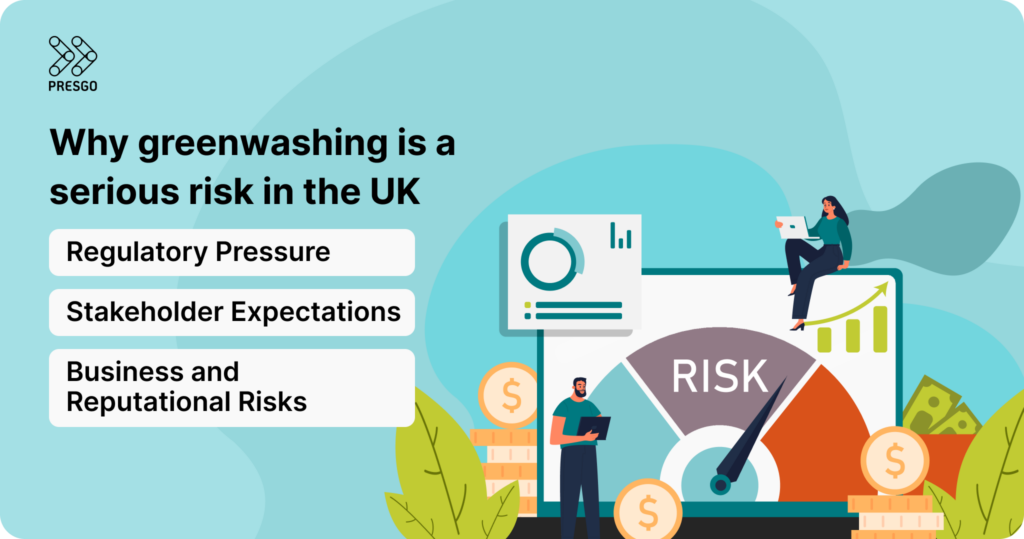
The United Nations’ secretary-general pushed for “zero tolerance for net zero greenwashing” in a speech on net zero commitments at the COP27. This is because the risks linked to greenwashing are serious. It has already touched on regulations, stakeholders, and business strategy.
Here are the reasons why greenwashing poses major risks for UK companies:
Regulatory Pressure
In 2020, the European Union reported that 53% of green claims lacked solid backing and appeared vague and misleading. Almost half of the claims came with no proof at all. This left consumers with no way to verify the allegations, and they were slowly losing their trust.
In the UK, the regulatory environment surrounding greenwashing is tightening, with multiple authorities now empowered to enforce strict rules around sustainability claims. These are two of the key changes in regulations:
- Anti-Greenwashing Rule (AGR) by the Financial Conduct Authority (FCA): This rule came into effect in 2024 and mandates that all sustainability-related claims must be correct, clear, comparable, and complete. Companies found violating the guidelines can face fines and reputational damage.
- Competition and Consumers Act (DMCCA) by the Competition and Markets Authority (CMA): This will have the power to impose fines of up to 10% of turnover value. This new legal framework significantly increases the risk for businesses engaging in greenwashing by eliminating the need for court proceedings to implement penalties.
Apart from these, the UK regulatory agency, Advertising Standards Authority (ASA), also continues to monitor and ban misleading green advertisements. The tightening of regulations means greenwashing is already beyond a reputational issue, but a compliance and financial risk. Companies can face fines and long-term damage to their credibility and trust from their stakeholders.
Stakeholder Expectations
Stakeholders, particularly investors, customers, and employees, have expectations for companies to deliver their sustainability promises.
- 71% of investors in a 2024 global investor survey believe that ESG should be deeply embedded in corporate strategy. But the performance and progress should be backed by actual data and results, as 89% of UK investors believe the majority of sustainability reporting has unsupported claims. This affects investors’ decision-making.
- In the same way, 44% of the globally surveyed public expressed their scepticism about the authenticity of companies’ ESG statements. When UK consumers identify greenwashing in products, KPMG reported 54% would opt out of purchasing them, damaging the brand and the company’s reputation overall.
- Employees also go for and stay with companies that are genuinely committed to sustainability. A company’s values and ethical and sustainable practices greatly impact workplace experience and workforce fulfilment.
Business and Reputational Risks
The risks of greenwashing also extend to misalignment with business strategies and cause operational setbacks. Businesses that focus on superficial claims instead of actual and measurable sustainability efforts will lag behind as market expectations and regulatory pressures continue to evolve. In many cases, companies that engage in greenwashing fail to adapt their operations to meet new standards or invest in the necessary transformation to become more sustainable in reality. It exposes them to risks in transitions like stranded assets and supply chain disruptions.
Greenwashing can also damage relationships with suppliers and business partners. Companies linked to misleading claims may experience contract withdrawals, supply chain reviews, or the need for costly audits to restore credibility. One recent case was the misleading advertisement by Unilever for its brand, Persil. There was not enough proof for their claims that the ad had to be banned. This negatively affected its marketing efforts, costing them in the process, and created bad publicity after being used as a case study on greenwashing environmental impact.
How to Avoid Greenwashing for UK Companies
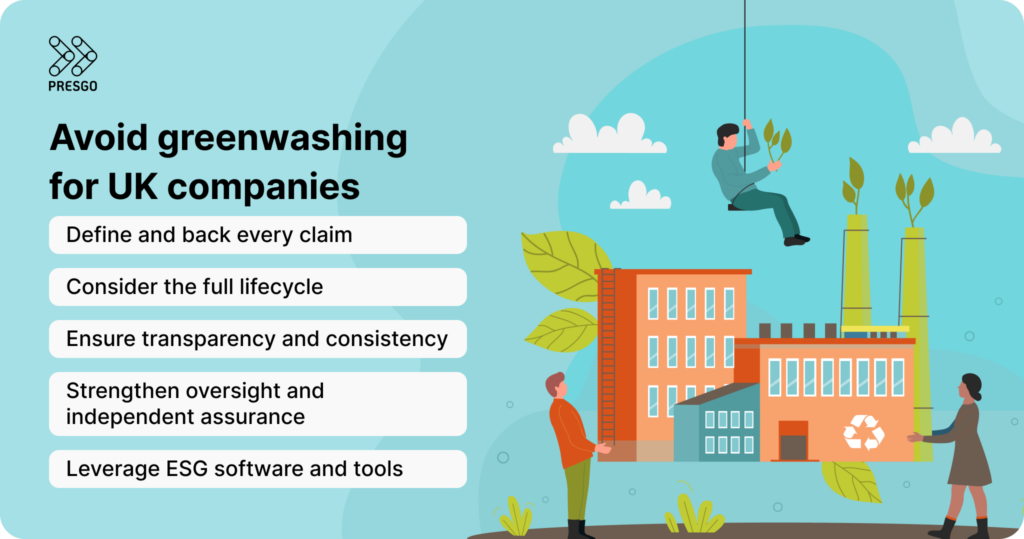
To avoid the risks of greenwashing, UK companies must align their environmental claims with genuine, verifiable actions. When a company implements effective ESG governance, it can make sure that its claims are backed by data, certified methodologies, and independent verification.
These are key steps for businesses on how to avoid greenwashing.
Define and back every claim
Companies should clearly define what terms like “carbon neutral” or “sustainable” mean for them and guarantee that their claims are supported by data, third-party certifications, or measurement methodologies. For example, Savills UK reports a 17 % year-on-year reduction in scope 1 and 2 emissions and an 11 % reduction in scope 3 emissions, with their emissions verified by an independent third party.
Consider the full lifecycle
Simply picking out positive environmental attributes while ignoring larger impacts connects a lot to selective reporting. It’s essential to assess the entire lifecycle of a product or service, from sourcing materials to its end-of-life stage, and report its sustainability performance completely. Transparent disclosures of both progress and remaining challenges help build credibility and insights for improvement.
Ensure transparency and consistency
Environmental claims have to be consistent across all business communications, including marketing, sustainability ESG reports, and investor relations materials. A recent case is with Aqua Pura, which continued promoting “environmentally friendly” bottle caps in 2025 on its website even after the ASA ruled the claim unsupported in 2022. This makes the company look unreliable and questionable in its internal oversight. The case also shows how inconsistencies across marketing and past regulatory rulings can trigger closer scrutiny from UK regulators.
Strengthen oversight and independent assurance
Companies need to implement governance structures to guarantee environmental claims are reviewed at the senior level and also subject to critical internal controls. Independent ESG audits and third-party verifications add another layer of reliability to verify the authenticity of a company’s sustainability claims.
Leverage ESG software and tools
With the bulk and complexity of ESG data for transparent reporting, companies can strengthen credibility by using ESG reporting software. This technology can help companies track, analyse, verify, and communicate progress transparently. Many modern tools now also use AI to spot inconsistencies or gaps that could lead to unverified environmental claims.
What is the role of ESG reporting software in preventing greenwashing?
Effective ESG reporting software plays a pivotal role in preventing greenwashing by helping companies collect, track, and communicate sustainability data in a consistent and verifiable manner. These platforms streamline data collection, improve transparency, and provide a clear audit trail that supports the accuracy of environmental claims.
ESG software centralises the tracking of key metrics like emissions, energy use, waste management, and supply chain sustainability. It also guarantees that data is aligned with local UK standards such as the TCFD, SDR, and AGR. Additionally, it helps companies comply with UK-recognised global frameworks, such as the GRI, SASB, and SBTi, increasing comparability across sectors and industries.
Most tools also offer dashboards that give teams oversight of progress across each reporting area to check whether information is accurate, complete, and grounded in data. By using ESG reporting software, companies can monitor their progress toward sustainability goals and create credible, regulator-ready disclosures that withstand scrutiny from both regulators and stakeholders.
For example, Lloyd Banking Group implemented ESG reporting software to track and consolidate sustainability metrics across 30 divisions, resulting in more accurate, transparent reporting of their environmental impact. These platforms also facilitate the generation of investor-ready ESG reports that meet stakeholder expectations for transparency, accuracy, and substantiation.
Greenwashing Case Studies in the UK
Greenwashing has become one of the most common forms of corporate misconduct in the UK’s transition toward a low-carbon economy. Companies have learned that the green approach of marketing sells. But when environmental claims don’t measure up to reality, it is also counterproductive to the overall sustainability plans and progress.
Below are two recent high-profile examples that show how regulators are tightening the rules and how companies are being held accountable.
Lloyds Banking Group
In December 2024, ASA ruled that one of Lloyds Bank’s LinkedIn advertisements misled the public about its environmental commitments. The post claimed the bank was “putting the weight of our finance into clean and renewable energy” and was using “100% renewable energy to power our buildings.” It failed to mention that Lloyds still finances carbon-intensive industries, contributing to greenhouse gas (GHG) emissions.
The ad gave the impression that renewable energy made up a significant part of the bank’s investments, which was not the case. With that misinformation, Lloyd pulled the ad and responded that it would take the feedback on board when creating future sustainability campaigns. This has placed the bank under tighter monitoring and under questionable accuracy of its wider sustainability reporting.
ASOS, Boohoo, and Georde at Asda
In 2024, the Competition and Markets Authority (CMA) found that the fashion retailers, ASOS, Boohoo, and George at Asda misled shoppers with eco ranges like “Responsible Edit”, “Ready for the Future,” and “George for Good.” It included items labelled as recycled even though the recycled content was only about 20%, which is not enough to meet the criteria. Unclear terms and imagery without supported evidence were also used. The companies signed agreements to clarify their marketing, label products accurately, and report their progress to regulators. This case sent a strong message to the fashion industry that claims must be backed by facts. That, or face possible legal action and risk misleading consumers and investors.
FAQs about Greenwashing in the UK

1. What is the difference between greenwashing and aspirational sustainability claims?
Aspirational claims like “net-zero by 2050” are not inherently greenwashing as long as they are transparent and backed by a credible roadmap. Greenwashing occurs when a company implies more has been achieved than the data evidence they can present.
2. Are there UK-specific penalties for greenwashing?
Yes. From April 2025, the CMA can impose fines of up to 10% of global turnover under the DMCCA for misleading green claims. Additionally, the FCA’s anti-greenwashing rule requires firms to substantiate sustainability-related claims.
3. How can ESG reporting software help my company avoid greenwashing?
ESG reporting software provides a centralised platform for tracking and verifying sustainability metrics, guaranteeing claims are accurate, transparent, and substantiated. This reduces the risk of making misleading or unverified claims.
4. What steps should my company take right now to reduce greenwashing risk?
Audit all existing green claims, implement robust governance processes for verifying sustainability claims, and invest in ESG reporting systems to improve data accuracy and transparency.
Build Credibility Through Transparent ESG Reporting with Presgo
Greenwashing is a costly risk for UK companies. With regulators tightening their oversight, investors are also expecting even greater transparency in ESG reporting and sustainability communications.
Since transparency relies on accurate data and measurable results, using technology in this process is a clear advantage. ESG software like Presgo helps bridge the gap between the intention to be transparent and the ability to show real progress to back statements.
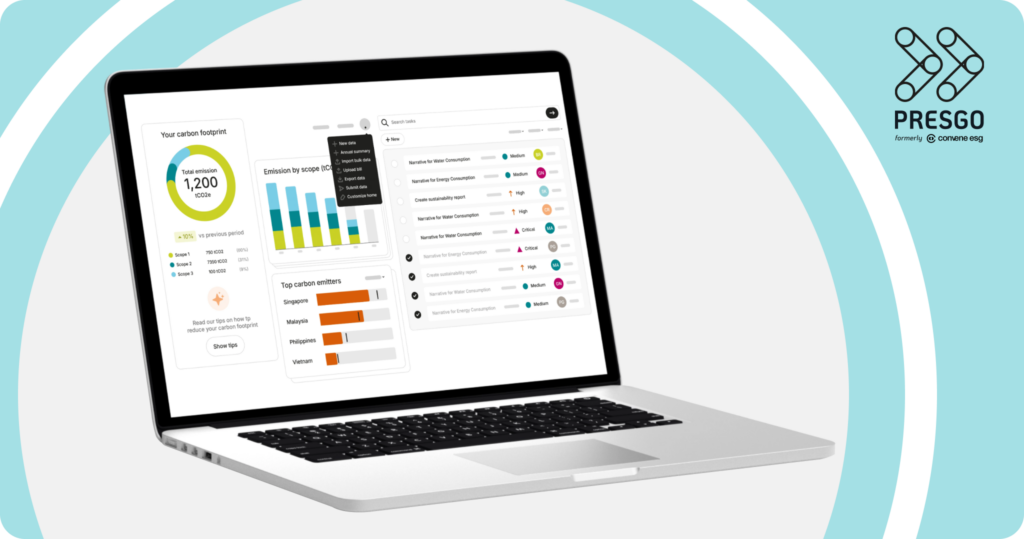
Presgo is an AI-native ESG reporting software and technology designed to support ESG reporting and sustainability communication. The software simplifies collaboration across departments and stakeholders. It also connects directly with your company’s systems to create a single source of verified information. Its automated data collection and built-in audit trails make it easier to present honest and consistent disclosures aligned with local and global frameworks like CSRD (ESRS), GRI, and TCFD.
With Presgo, teams can track progress, review updates, and share dashboards that show measurable results and real-time data. This makes it easier for companies to communicate their sustainability performance confidently and avoid greenwashing. Communicate your ESG progress and redefine your sustainability marketing with compliant and accurate information. Book a demo and build credibility with Presgo today.
