
Contents
Sustainability has become increasingly relevant for organizations across industries worldwide. In an ever-evolving landscape, organisations should identify and understand the environmental, social, and governance (ESG) issues that require the most action and resources. This is where a materiality assessment comes in.
Explore in this article why materiality assessments are essential for ESG reporting and how to conduct one to align with global reporting frameworks.
What is a materiality assessment?
A materiality assessment is a tool that helps an organization identify and understand the ESG issues that carry the greatest impact for the business and its stakeholders. This helps organizations focus their resources on the matters that impact financial performance and sustainability commitments.
The Global Reporting Initiative (GRI) defines the materiality concept as one used to “filter” information that is or should be useful to users. In ESG reporting, the term materiality refers to matters that have direct or indirect impacts on a company’s ESG goals, economic opportunities, stakeholder engagement, or overall business value.
Today, organizations around the world are reporting on sustainability and ESG matters. Data from the World Business Council for Sustainable Development (WBCSD) indicates that 83% of organizations’ reports disclosed double materiality assessments in 2025, an increase from 77% in 2024. This aligns with the rising demand for ESG transparency by governments and stakeholders worldwide, as well as the increased adoption of reporting frameworks such as the EU’s CSRD.
Why is a materiality assessment important?
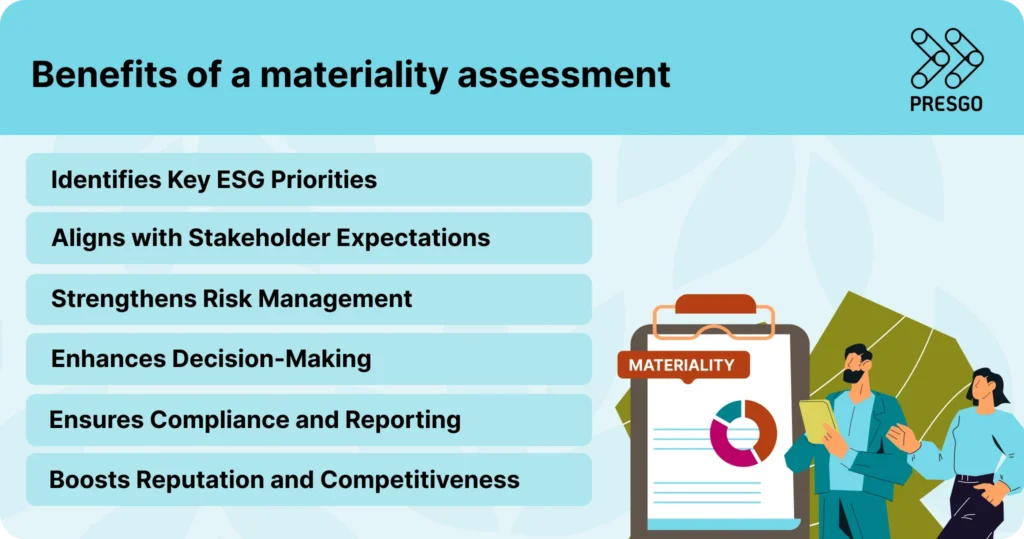
While materiality assessments are not universally required for every company, it is mandatory under specific regulations, such as the EU’s Corporate Sustainability Reporting Directive (CSRD). Upon establishment, the CSRD demands double materiality assessments for covered organizations to determine reporting scope under the ESRS standards. Here are the reasons why materiality assessments are needed for companies:
Identifies key ESG priorities
By pinpointing the most critical environmental, social, and governance topics, a materiality assessment directs resources to high-impact areas, preventing oversight of emerging issues and maximizing ESG initiative effectiveness.
Aligns with stakeholder expectations
A materiality assessment reveals what matters most to investors, employees, customers, and others. In the long term, this fosters stronger relationships, boosts engagement, and builds support for company strategies through targeted communication.
Strengthens risk management
It uncovers long-term risks like regulatory shifts or climate effects early, enabling proactive mitigation, trend spotting, and resilience against threats to value creation.
Enhances decision-making
Companies gain data-driven clarity for resource allocation, strategy alignment, and opportunity identification, reducing waste on low-priority issues and integrating sustainability into core business planning.
Ensures compliance and reporting
It streamlines adherence to specific standards, such as CSRD and GRI, by scoping disclosures to material topics, improving transparency, and preparing for evolving regulations while elevating ESG ratings.
Boosts reputation and competitiveness
Prioritizing material issues enhances transparency, stakeholder loyalty, and market positioning, often leading to higher sustainability scores, investor appeal, and competitive edges like better customer retention.
How to conduct a materiality assessment?
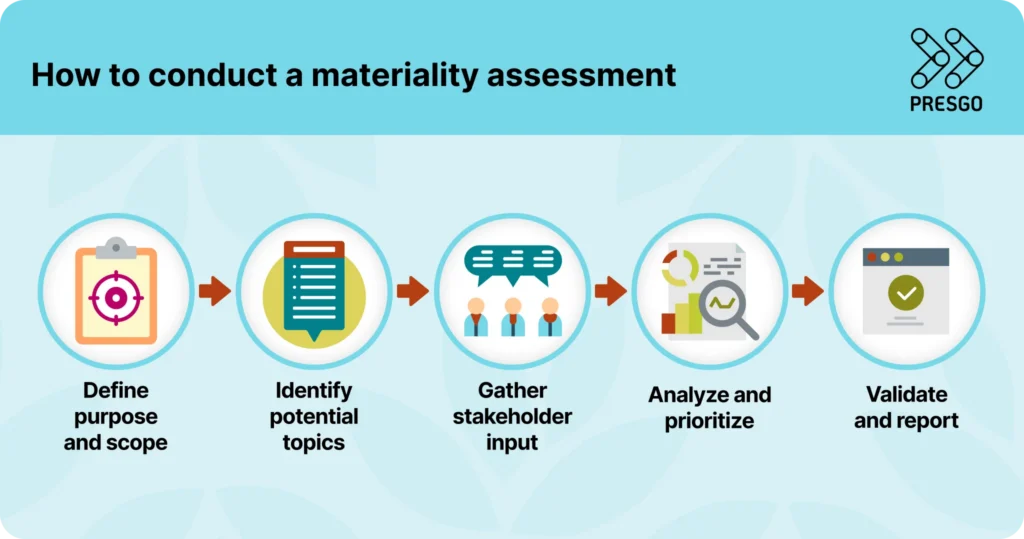
A materiality assessment is conducted through a structured, multi-phase process involving stakeholder input, data analysis, and prioritisation to identify key ESG issues.
- Define purpose and scope
Clarify the assessment’s objectives and define its boundaries across the value chain, business units, and stakeholders. Similarly, establish which “materiality” topics are to be covered, whether to identify risks, improve sustainability strategy, or inform corporate reporting. - Identify potential topics
Compile a list of relevant ESG topics based on industry standards (e.g., GRI, SASB), peer benchmarks, internal data, and regulations. Refine and cluster this list into categories, such as:
- Environmental
- Carbon emissions
- Biodiversity conservation
- Waste reduction
- Social
- Human rights
- Labor rights
- Employee health and safety
- Governance
- Data privacy
- Risk management
- Organizational diversity
- Gather stakeholder input
Engage internal experts and external stakeholders through interviews, surveys, or workshops to assess the topics’ importance and business impact. It’s also important to prioritize stakeholders based on their influence or the significance of their concerns to your business’s sustainability strategy. - Analyze and prioritize
Evaluate the ESG topics based on criteria such as strategic relevance, financial, social, or environmental effects, and stakeholder views. Plot the results on a materiality matrix to rank high-priority issues visually and align them with the organization’s strategic goals. - Validate and report
Test findings with management, seek final stakeholder feedback, and document the process. Afterwards, integrate into the ESG report to help leaders address the necessary priorities while ensuring compliance with sustainability frameworks.
What is a materiality matrix?
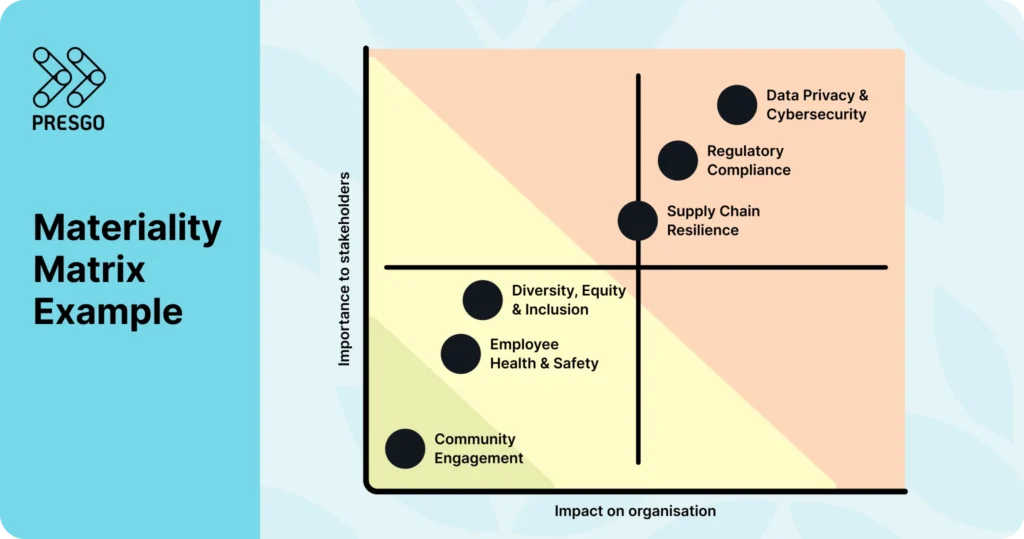
A materiality matrix is a two-axis visual tool organizations use to identify, prioritise, and communicate the most critical ESG issues. This graph plots issues based on their impact on the organization’s success (X) and their importance to stakeholders (Y).
How to understand a materiality matrix?
The materiality matrix is interpreted by examining the established quadrants. The upper-right corner typically signals urgent issues needing immediate resources and actions, while the upper-left corner prioritizes stakeholder concerns despite lower internal impact.
In the lower half, the lower-right corner addresses purely business risks, while the lower-left corner deprioritizes topics that may not be too relevant to stakeholders.
By focusing on quadrants, teams and stakeholders get a quick, visual view of trends, gaps, and strategic focus areas.
What comes after a materiality matrix?
After creating and validating the materiality matrix, organizations can translate these insights into actionable outcomes. This involves prioritizing high-impact issues from the upper-right quadrant and embedding them into core operations. The process builds on the matrix’s visual prioritization to drive strategic decisions.
- Validate with leadership: Share the matrix in executive reviews to confirm priorities and align on resource needs.
- Develop targeted strategies: Create specific plans for top issues, such as setting reduction targets for high-emission activities or diversity programs for stakeholder concerns.
- Set measurable KPIs: Define key performance indicators tied to matrix priorities, like carbon footprint goals or employee satisfaction scores, and link them to executive incentives.
- Integrate into organizational planning: Embed ESG priorities into annual budgets, risk assessments, and long-term roadmaps for sustained focus.
- Monitor and report progress: Track KPIs via dashboards or ESG reporting software. Update the matrix annually and disclose outcomes in reports to stakeholders.
Double Materiality vs Single Materiality
Single materiality focuses solely on financially relevant information for investors. On the other hand, double materiality, required in CSRD-aligned reporting, adds an outward-looking dimension that evaluates a company’s broader environmental and social impacts.
| Aspect | Single Materiality | Double Materiality |
|---|---|---|
| Core focus | Impact of sustainability issues on the organization’s financial position and performance. | Impact of sustainability issues on the organization, as well as how the organization’s activities affect the environment, people, and broader society. |
| Primary audience | Investors, lenders, and other users of financial statements. | Investors, regulators, communities, employees, and stakeholders whose interests go beyond financial value. |
| Scope of disclosure | Issues with a measurable financial impact on the company. | Issues that are financially material or have significant environmental or social impacts, even if financial effects are indirect or long-term. |
| Typical use | Traditional financial reporting frameworks such as the U.S.’s Generally Accepted Accounting Protocols (GAAP). | Required under the EU’s CSRD and implemented through the ESRS. |
| Sector specificity | Uniform across sectors, since financial reporting rules apply the same materiality threshold regardless of industry. | More sector-sensitive under the ESRS, as sustainability impacts differ. For example, emissions and resource use drive materiality in mining or energy sectors, while data privacy, digital inclusion, and governance issues are more material in finance or technology. |
Simplify Materiality Assessments with Presgo
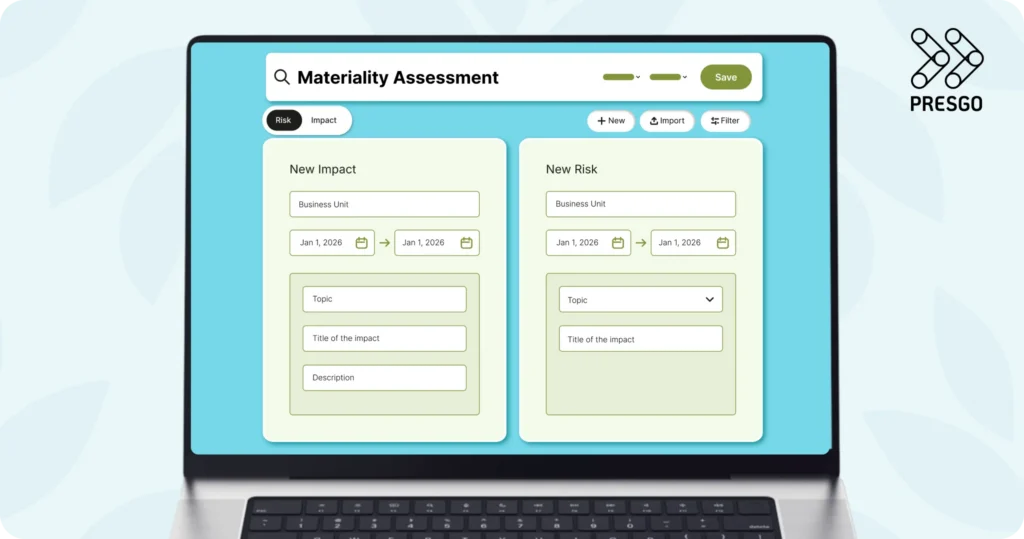
As regulatory landscapes shift and ESG transparency increases, materiality assessments become an essential part of sustainability reporting. Aside from ensuring compliance and improving stakeholder engagement, this tool allows teams and organizations to prioritize ESG topics that are most impactful to stakeholders.
Presgo is an AI-first ESG reporting platform helping organizations worldwide align with evolving corporate sustainability regulations and standards. Presgo’s modular design enables reporting teams to access features and modules at every reporting stage, from basic performance tracking to complex emissions calculations.
The platform is also equipped with a built-in double materiality assessment tool, helping organizations evaluate financial and impact materiality and turning data into actionable insights for reporting and strategy.
Book a demo today to learn about how Presgo can help turn materiality insights into action.