Contents
- What is the Singapore Green Plan?
- How prepared are Singapore companies for stricter ESG rules?
- EY Study Findings: Assessing Readiness for the Green Plan
- How will SGX’s new sustainability rules affect listed companies?
- The Readiness Gap: Why Companies Are Struggling
- What action should Singapore companies take now?
- Close the ESG Readiness Gap in Singapore with Presgo
A global movement has been on the rise, and countries are shifting to a more sustainable direction. Governments are slowly reshaping their mindsets on climate action, translating environmental commitments into national roadmaps. This influences businesses in funding, regulatory standing, and long-term commercial relevance.
In Asia, Singapore is moving at full speed with coordinated green policies and sustainability targets. At the centre of all these efforts is Singapore’s Green Plan 2030.
What is the Singapore Green Plan?
The Singapore Green Plan 2030 is a nationwide roadmap that sets ambitious climate and sustainability targets for the next decade. It is not a policy statement in isolation. It translates national climate goals into concrete expectations for the private sector with these core pillars:
- City in Nature
- Sustainable Living
- Energy Reset
- Green Economy
- Resilient Future
The plan calls for greening 80% of buildings, deploying cleaner-energy vehicles, and peaking national emissions before 2030. These targets are not only central to Singapore’s climate ambitions but also pivotal to how businesses will operate in a low-carbon economy in the coming years.
What does the Singapore Green Plan mean for businesses?
Companies are expected to play an active role in reducing emissions and transitioning to sustainable practices. For businesses, this means closer scrutiny of energy use, supply chains, and long-term climate exposure. Corporate decision-making now includes green financing, sustainability reporting, and transition planning as standard components, not as optional initiatives.
The Green Plan also includes sustainability and climate disclosures and alignment with global commitments such as the UN’s Sustainable Development Goals (SDGs) and the Paris Agreement. Corporate sustainability efforts are transitioning from high-level commitments, documented outcomes, and forward-looking analysis. This raises the question: Are Singapore companies ready for these changes?
How prepared are Singapore companies for stricter ESG rules?
A new EY study paints a concerning picture: despite improvements in disclosure, many companies in Singapore remain unprepared. The research shows that more than two-thirds of Singapore Exchange (SGX)-listed companies are not ready for the upcoming requirements in ESG reporting. The lack of readiness suggests that while awareness is rising, actual integration of sustainability into corporate strategies remains uneven.
This gap matters because FY 2025 will mark a turning point. From then on, SGX sustainability reporting will move away from the current “comply or explain” model. Instead, it will require all listed companies, regardless of industry, to align with the ISSB standards. For businesses, the question is no longer whether sustainability matters but how prepared they are to meet regulatory expectations while remaining competitive.
EY Study Findings: Assessing Readiness for the Green Plan
The third edition of EY’s State of Climate Reporting in Singapore examined 351 sustainability reports for FY 2024. On the surface, the numbers suggest improvement. A full 98% of issuers now publish climate-related disclosures, compared with 96% in 2023. However, when digging deeper, the study reveals that the quality of these disclosures often falls short of what will soon be required.
Only 32% of companies are fully aligned with all 11 recommendations under the Task Force on Climate-related Financial Disclosures (TCFD). While 62% performed scenario analysis to assess climate resilience, few described how those scenarios informed actual strategy. In other words, reports are becoming more common, but the link between disclosure and business action remains weak.
Another striking finding is that 47% of issuers disclosed a transition plan. This number might sound encouraging until we consider that 36% have already pledged net-zero targets. In the absence of robust transition planning, investors may view such commitments as aspirational rather than actionable.
Sectoral differences are also evident. Real estate and industrials are among the strongest performers, partly due to investor pressure and participation in global benchmarks such as the Global Real Estate Sustainability Benchmark (GRESB). By contrast, smaller issuers in consumer sectors often lack the expertise, resources, or governance structures to produce meaningful reports.
How will SGX’s new sustainability rules affect listed companies?
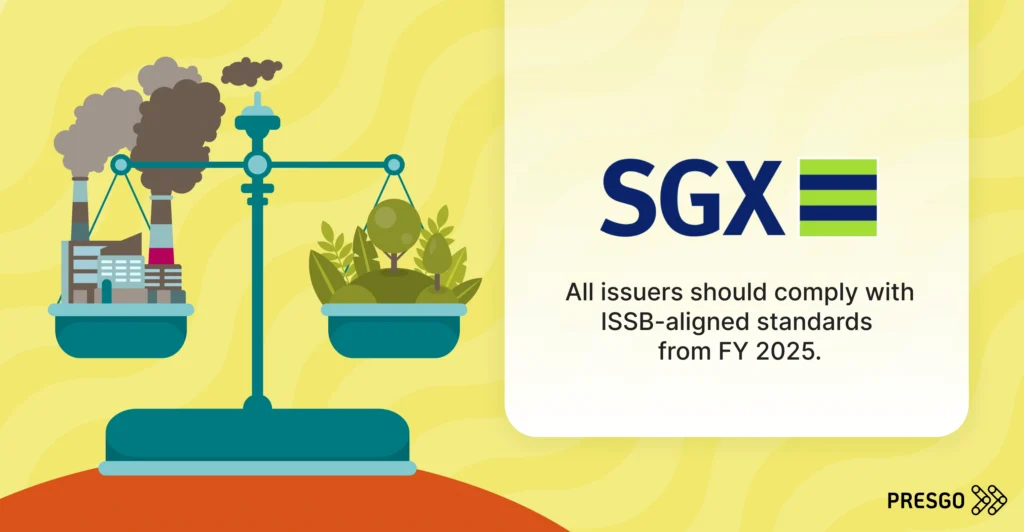
The regulatory environment is about to become much stricter. Starting with FY 2025, all issuers will need to comply with ISSB-aligned standards under the revised SGX sustainability reporting guidelines.
The changes include:
- Mandatory disclosure of scope 1 and scope 2 carbon emissions, with scope 3 under regulatory review.
- External assurance requirements for emissions data, which enhance credibility.
- Detailed reporting on resilience and transition plans to demonstrate long-term viability.
- Integrating sustainability outcomes with executive remuneration holds boards accountable for their performance in this area.
This shift means that sustainability reports will no longer be treated as side documents meant for public relations. Instead, they will form part of regulated disclosures with financial implications, requiring greater consistency, detail, and comparability. For companies, the change is not only a compliance issue but also a credibility test in the eyes of investors and regulators.
The Readiness Gap: Why Companies Are Struggling
Despite regulatory guidance and years of preparation, many issuers remain unprepared. The EY study identified several reasons:
- Complexity of Scope 3 emissions: Only 45% of companies disclosed them, and a mere 16% have set targets covering all three scopes. Tracking indirect emissions across supply chains remains a challenge.
- Limited expertise: Smaller companies often lack dedicated sustainability staff, relying instead on general managers who may not have the required technical knowledge.
- Financial constraints: Transition plans often require capital-intensive projects such as retrofitting buildings or upgrading manufacturing equipment. Not all companies, especially SMEs, have the resources to implement these changes.
- Governance weaknesses: Just over half of issuers explained how their boards ensure the right competencies to oversee climate strategy. Without governance clarity, even strong commitments can lack follow-through.
The Singapore Green Plan 2030 directly underpins these regulatory changes, and businesses are required to play their part in meeting national decarbonisation. Unless these challenges are addressed, the gap between leaders and laggards will widen, with reputational and financial consequences for those left behind.
What action should Singapore companies take now?
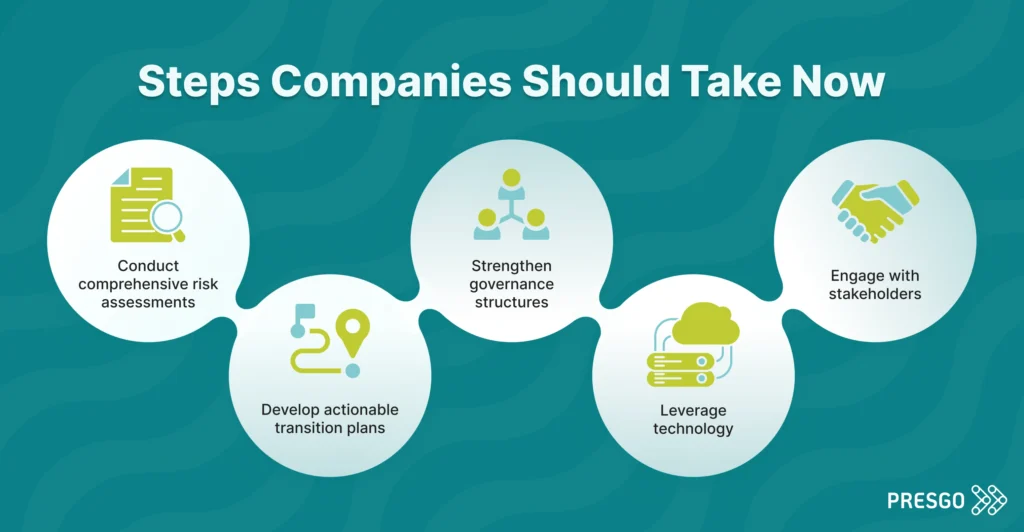
The path forward requires companies to act decisively. Practical steps include:
- Conduct comprehensive risk assessments: Move from qualitative statements to quantifying the financial impacts of climate risks and opportunities.
- Develop actionable transition plans: Tie decarbonisation commitments with detailed strategies, including timelines and resource allocations.
- Strengthen governance structures: Ensure boards and senior executives have the knowledge and accountability to oversee sustainability.
- Leverage technology: Adopt ESG reporting software to centralise data, streamline reporting, and align with global frameworks.
- Engage with stakeholders: Use reporting not only for compliance but also to build trust with investors, regulators, and customers.
By embedding these practices, companies can align with ESG reporting Singapore requirements while also future-proofing their operations.
Close the ESG Readiness Gap in Singapore with Presgo

The EY study serves as a wake-up call: Singaporean companies cannot afford to delay. With SGX sustainability reporting rules becoming mandatory in FY 2025, the preparation window is closing fast. Meeting new standards will be difficult without the right tools. The level of detail and assurance required under ISSB is not achievable with manual spreadsheets and fragmented systems.
For organisations facing the challenges of SGX sustainability reporting, ESG software, like Presgo, can simplify compliance, reduce costs, and improve accuracy.
What else can you do with Presgo?
- Automate the collection of sustainability data across subsidiaries and supply chains.
- Standardise disclosures across multiple frameworks, including ISSB, GRI, and SASB.
- Monitor real-time performance on emissions, energy, and resource use.
- Generate assurance-ready reports to satisfy both regulators and investors.
- Provide insights that help companies identify inefficiencies, cut emissions, and capture new opportunities in the green economy.
More importantly, Presgo is an AI-first modular platform that offers different ESG features that can be tailored to the needs of your company. At Presgo, we help organisations navigate this transition with Singapore’s national sustainability vision. Ready to strengthen your ESG strategy? Request a demo with Presgo today.