


Contents
- What is the Emissions Reduction Plan?
- What are emissions budgets, and how are they set in New Zealand?
- Why has the government set emissions budgets and an emission reduction plan?
- What is New Zealand’s net zero 2050 target?
- First Emissions Reduction Plan (ERP 1)
- Second Emissions Reduction Plan (ERP 2)
- Criticisms and Challenges to the ERPs
- What steps can be taken to help Maori adapt to the impacts of climate change?
- Manage Your Emissions Reporting and Performance with Presgo
Climate change has been a defining policy issue for New Zealand, shaping decisions across the economy, the environment, and society as far back as the early 1990s. As a country with a strong reliance on primary industries, extensive natural resources, and growing exposure to climate-related risks, it faces distinct challenges in reducing emissions while supporting economic activity and community wellbeing.
Understanding why the government introduced emissions budgets and an emissions reduction plan provides important context for how New Zealand intends to reach its net zero goal and how climate policy will continue to shape decision-making across the country.
This article lays the foundation to explore New Zealand’s Emissions Reduction Plan, emissions budgets, sector-specific policies, and the broader implications for climate action both locally and internationally.
What is the Emissions Reduction Plan?
New Zealand’s Emissions Reduction Plan (ERP) is a pivotal, legally binding strategic framework to reduce the country’s carbon emissions, achieving the net zero target by 2050. Built around emissions budgets, the plan places limits on national emissions over defined periods and translates long-term climate targets into practical policy action.
Central to New Zealand’s approach is the use of carbon credits and its emissions trading scheme (ETS), which is designed to incentivise emission reductions across sectors while enabling flexibility in meeting targets. However, the plan is not without controversy. It faces criticism for its handling of agricultural emissions, a major source linked to the country’s economic backbone, and the unique challenge of setting different targets for biogenic methane. Also, New Zealand’s climate policies intersect with ongoing debates about indigenous rights, with concerns raised over how Māori communities are impacted or involved in climate governance and land use decisions. These complex issues highlight the tensions between environmental goals and cultural and economic realities.
Globally, New Zealand’s ERP is part of a broader movement where countries legislate emissions budgets and develop carbon pricing mechanisms to hold themselves accountable.
What are emissions budgets, and how are they set in New Zealand?
Emissions budgets establish the maximum allowable amount of greenhouse gas (GHG) emissions that a country can produce over a specific period, typically five years. These budgets are based on independent scientific advice and are regularly reviewed and updated to reflect progress and changing circumstances. Several countries, including the UK, Ireland, Germany, and the European Union, have adopted legislated emissions budgets or binding reduction pathways, typically set in five-year cycles and linked to long-term net zero targets.
| Country / Region | Legislative Basis | Emissions Budget Approach | Net Zero Target |
| New Zealand | Climate Change Response (Zero Carbon) Amendment Act 2019 | Legally binding emissions budgets set in five-year periods | 2050 |
| European Union | European Climate Law | Economy-wide reduction targets rather than fixed budgets | 2050 |
| Germany | Federal Climate Change Act | Annual emissions limits with sector-level targets | 2045 |
| Ireland | Climate Action and Low Carbon Development (Amendment) Act 2021 | Five-year economy-wide carbon budgets | 2050 |
| United Kingdom | Climate Change Act 2008 | Five-year legally binding carbon budgets | 2050 |
In New Zealand, emissions budgets are legally mandated under the Climate Change Response (Zero Carbon) Amendment Act 2019. The country was among the early adopters of this structured, science-based budgeting approach. The independent Climate Change Commission provides expert recommendations on the budgets, which the government must then formally adopt. These budgets cover all greenhouse gases except biogenic methane, which has unique targets due to its significant role in New Zealand’s agricultural sector.
The development of New Zealand’s emissions budgets and Emissions Reduction Plans (ERPs) involved extensive engagement with a broad cross-section of society. Feedback and insights were gathered from diverse groups, including the Ministry for the Environment’s youth, climate business, and local government advisory panels. Key contributions also came from iwi (tribe) and Māori groups, sector representatives, environmental non-governmental organisations (ENGOs), climate scientists, and Aotearoa Circle’s Rangatahi Advisory Panel. This inclusive consultation process shaped the plans significantly — leading to the addition of new sections focused on technology, innovation, and the building and construction sectors.
Why has the government set emissions budgets and an emission reduction plan?
By establishing legally binding emissions budgets, New Zealand has created a robust accountability framework that compels the government to consistently plan, implement, and evaluate climate policies over time. These budgets set clear, enforceable limits on national emissions within defined periods, ensuring that climate action remains on a steady, evidence-based pathway beyond short-term political cycles. This legal obligation provides transparency and predictability for businesses, investors, and communities by signalling the government’s firm commitment and timelines for reducing emissions.
New Zealand’s approach transforms broad climate ambitions into actionable, measurable targets that drive investment in low-carbon technologies, support innovation, and encourage behavioural change across all sectors. This framework is especially crucial given New Zealand’s unique emissions profile, dominated by agriculture, and its commitment to incorporating indigenous perspectives and rights into climate action. Through these legally binding budgets, New Zealand positions itself as a leader in structured, accountable climate policy that balances environmental goals with social and economic realities.
What is New Zealand’s net zero 2050 target?
New Zealand has committed to achieving net zero greenhouse gas emissions by 2050 for all gases except biogenic methane, which has separate reduction targets. This “split gas” approach reflects the unique nature and warming impact of methane, which accounts for over 40% of the country’s emissions. The goal is to reduce biogenic methane emissions to 10% below 2017 levels by 2030 and further to 24–47% below 2017 levels by 2050, while all other greenhouse gases are to reach net zero or below by 2050.
Net zero means balancing the greenhouse gases emitted with the amount removed from the atmosphere through natural removals such as forestry or technological solutions like carbon capture. International aviation and shipping emissions are currently excluded but are under government review for future inclusion. The government also plans to use international carbon offset credits if necessary, particularly to help meet the 2030 emissions reduction target.
While ambitious, New Zealand’s current policies face challenges in fully delivering on these targets. The reliance on international offsets for the near-term targets has raised questions about the pace of domestic emissions reductions. Moreover, reducing emissions from agriculture and addressing indigenous perspectives remain complex issues. Nevertheless, the 2050 net zero target establishes a vital framework guiding New Zealand’s climate policies and emissions reduction plans moving forward.
First Emissions Reduction Plan (ERP 1)
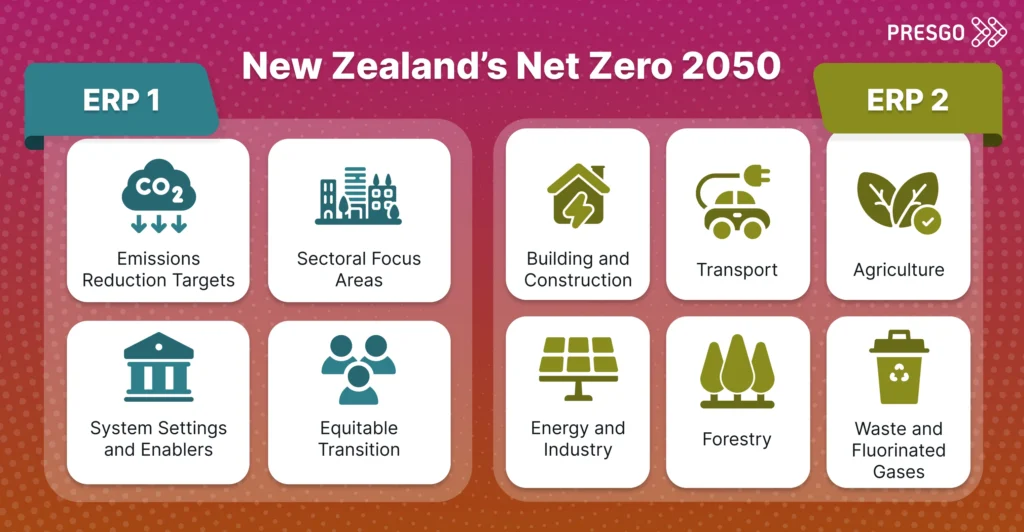
New Zealand’s first Emissions Reduction Plan (ERP 1), published in May 2022, sets out the government’s key actions and policies to reduce emissions during the first budget period. It provides a clear roadmap for cutting emissions across sectors and guiding the country’s initial climate efforts.
1. Emissions Reduction Targets
- Net zero long-lived greenhouse gases by 2050
- Biogenic methane reduction: 10% below 2017 levels by 2030, 24–47% below by 2050
2. Sectoral Focus Areas
- Transport: Reduce vehicle kilometres travelled, increase zero-emission vehicles, and build supportive infrastructure.
- Energy and Industry: Support renewable energy, ban new fossil baseload generation, promote industrial decarbonisation.
- Agriculture: Introduce emissions pricing, improve emissions reporting, and expand climate advisory services.
- Forestry: Increase carbon removals and support sustainable forestry practices.
- Waste and Fluorinated Gases: Implement emissions reduction measures.
3. System Settings and Enablers
- Reform New Zealand Emissions Trading Scheme (NZ ETS)
- Establish Climate Emergency Response Fund
- Enhance climate risk reporting transparency
- Support research, science, and innovation
- Promote circular economy and sustainable urban development
4. Equitable Transition
- Mitigate impacts on individuals and households
- Support businesses, industries, and Māori through a just transition
Second Emissions Reduction Plan (ERP 2)
New Zealand’s second Emissions Reduction Plan (ERP 2), which takes effect from January 1, 2026, builds on the foundation of the first plan with a sharper focus on innovation and expanded sectoral strategies. ERP 2 emphasises the role of new technologies to accelerate emissions reductions and introduces targeted actions in sectors that require additional attention.
Key sectoral focuses in ERP 2 include:
Building and Construction
New strategies aim to significantly improve energy efficiency in new and existing buildings, promote the use of sustainable materials, and reduce the carbon footprint embedded in construction processes. These measures will help lower emissions in a sector that accounts for a growing share of national carbon output.
Transport
The plan continues to push for reduced vehicle kilometres travelled while greatly accelerating the transition to zero-emission vehicles through incentives and infrastructure development, aiming to make clean transportation more accessible and affordable for all New Zealanders.
Agriculture
ERP 2 strengthens support for adopting lower-emission farming techniques and technology, combining this with ongoing emissions pricing and expanded advisory services to help farmers transition smoothly while maintaining productivity and economic viability.
Energy and Industry
The plan intensifies efforts to replace fossil fuels with renewable energy sources and supports the uptake of breakthrough industrial decarbonisation technologies, contributing to a cleaner, more resilient energy system.
Forestry
Building on previous efforts, ERP 2 focuses on enhancing carbon sequestration through sustainable forest management and encourages regeneration projects, recognising forestry’s pivotal role in offsetting emissions nationally.
Waste and Fluorinated Gases
Continued emphasis is placed on minimising emissions from waste through improved management practices and reducing the use and release of fluorinated gases with high global warming potential, which have a disproportionate climate impact despite smaller volumes.
ERP 2 strengthens monitoring and transparency mechanisms, deepens partnerships with iwi and Māori groups, and accelerates the rollout of initiatives already underway. This plan reflects a more integrated and urgent approach to keeping New Zealand on track toward its emissions reduction goals.
Criticisms and Challenges to the ERPs
Agricultural Emissions
Agriculture remains the largest source of New Zealand’s greenhouse gas emissions, contributing over half of the total, mainly through methane from livestock. The ERP has been criticised for its lack of clear, effective policies to reduce emissions in this sector. Farmers face high costs and have limited access to affordable mitigation technologies, while pricing mechanisms for agricultural emissions have been delayed, creating uncertainty and slowing action. These factors undermine the ability to meet national emissions targets and reflect a broader gap in addressing emissions at the source.
Overreliance on Forestry Offsets & Legal Challenges
A key criticism prompting legal action is the government’s heavy reliance on forestry offsets as a substitute for directly cutting emissions. Lawyers for Climate Action NZ and the Environmental Law Initiative filed a judicial review in June 2025, arguing that the ERP is “dangerously inadequate” and unlawfully depends on speculative tree planting to meet its climate targets. The government was also accused of cancelling around 35 crucial climate policies without proper consultation, leading to a fragmented and uncertain plan. This reliance on forestry is seen as risky, non-permanent, and inconsistent with scientific guidance and New Zealand’s obligations under the Paris Agreement.
Emissions Trading Scheme (ETS) Concerns
The NZ ETS exacerbates challenges by allowing companies to trade emissions and mostly rely on forestry credits rather than reducing actual emissions. This dynamic effectively transfers responsibility via offsets rather than achieving real sectoral reductions. The scheme’s design, particularly its inclusion of extensive forestry offsetting, risks lowering the carbon price signal needed to incentivise deep decarbonisation in sectors like agriculture and industry. The ETS has also led to controversial land-use changes, including farm-to-forest conversions, raising economic and environmental concerns.
What steps can be taken to help Maori adapt to the impacts of climate change?
New Zealand’s adaptation plan recognises that Māori are kaitiaki (guardians) of their whenua (land), leaders in their communities, landowners, business owners, and decision-makers regarding natural resources and infrastructure. The plan supports Māori to lead adaptation in all these roles by centring mātauranga Māori (indigenous knowledge) alongside Western science to better inform decision-making. With this, the government also lays out the impact of climate change on Maori with the following principles:
- Embedding Te Tiriti o Waitangi (Treaty of Waitangi) principles to ensure equitable partnership between the Crown and Māori, enabling Māori-led climate action and governance.
- Establishing a Māori climate action platform to facilitate Māori defining, measuring, and implementing a national climate strategy and action plan aligned with Māori values, including the Rauora framework, which integrates Māori worldviews into climate adaptation.
- Developing accessible risk and resilience information, tools, and guidance tailored to Māori socio-economic and cultural contexts to support vulnerability assessments and climate adaptation planning.
- Supporting climate-resilient development of Māori land, homes, marae, and cultural sites through partnerships and targeted funding to address climate hazards and promote community wellbeing.
- Providing resources for emergency management, building social cohesion, and strengthening community resilience in Māori communities, including proactive funding and workforce development.
Manage Your Emissions Reporting and Performance with Presgo
New Zealand’s Emissions Reduction Plan (ERP) highlights both the promise and the complexity of charting a path to net zero. By embedding emissions budgets into law, the country has built a robust framework that brings accountability and continuity to climate policy. Yet, the challenges are evident: agriculture remains difficult to decarbonise, reliance on forestry offsets and trading schemes raises concerns, and debates around indigenous rights and equity underscore that climate action is never just technical. It is also social, cultural, and economic. These tensions reflect a broader global reality: ambitious targets are necessary, but delivering them requires balancing environmental imperatives with livelihoods, justice, and innovation.
For businesses, this evolving landscape presents both risks and opportunities. Rising compliance demands under the Emissions Trading Scheme and sectoral regulations will reshape costs, but they also open avenues for innovation, efficiency, and long-term resilience. Companies that adapt early are best positioned to thrive in a low-carbon economy. This is where Presgo, an ESG reporting software, can help. Presgo equips organisations to track, measure, and act on sustainability goals with clarity. It’s the tool you need to turn complex frameworks like the ERP into actionable strategies.
As governments worldwide tighten climate commitments, Presgo empowers businesses to stay compliant, competitive, and ahead of the curve on the journey to net zero. Book a demo with Presgo.