


Talk to an ESG Expert about how Presgo can help you!
Our ESG Experts are on-hand to understand your ESG Reporting needs and cater our solution to you. Get in touch to discuss how we can help.
Talk to an ESG ExpertContents
- Climate Change in Malaysia: The Current Reality
- Malaysia’s Most Exposed Sectors
- Why ESG Is Your Next Line of Defence
- The Regulatory Push
- Opportunities in Malaysia’s Green Transition
- How ESG Software Helps
- Challenges for Malaysian Companies
- Steps to Get Started with ESG in Climate Risk Management
- Key Resources, Frameworks, and Standards
- Conclusion
Malaysian industries are beginning to feel the heat—literally and economically.
Global climate risks are accelerating at an unprecedented pace, creating ripple effects that reach from Wall Street trading floors to Malaysian palm oil plantations. As recent financial reports highlight mounting pressures from extreme weather events worldwide, Malaysia finds itself confronting an environmental reality that threatens the very foundation of its economic prosperity.
The nation’s key industries—agriculture, utilities, and finance—are already experiencing tangible impacts from Malaysia’s changing climate, from disrupted supply chains to infrastructure damage and mounting financial risks. What was once viewed as a distant threat has materialised into present-day operational challenges that demand immediate strategic action.
The urgency for climate adaptation has never been clearer, and Environmental, Social, and Governance (ESG) frameworks are emerging as the strategic defence mechanism Malaysian companies need to build resilience and maintain competitiveness. By proactively addressing climate-related risks through comprehensive ESG compliance, businesses can turn a potential crisis into a pathway for innovation and sustainable growth.
Climate Change in Malaysia: The Current Reality
Malaysia’s tropical climate is becoming increasingly volatile, with extreme weather events disrupting business operations across sectors. From 1970 to 2013, the country experienced a rise in average surface temperatures, with some regions seeing an increase of up to 0.25°C per decade—a clear manifestation of Malaysia’s changing climate.
This warming trend, coupled with unpredictable rainfall patterns, has exacerbated the frequency and intensity of extreme weather events. In 2022 alone, floods, landslides, and storms displaced over 156,000 people—a stark indication of Malaysia’s changing climate that directly impacts business continuity and economic stability.
Flooding presents a particularly potent threat, contributing to more damage than any other natural hazard in the country. The frequency and extremity of these events are projected to continue increasing, posing significant long-term risks to the Malaysian economy and society.
According to a recent Morgan Stanley report, a majority of companies globally are already feeling the financial impacts of climate change worldwide, including increased costs, worker disruption, and revenue losses (Morgan Stanley Global Climate Survey, 2024). For Malaysian businesses, these global findings serve as a clear signal that domestic operations are not immune to these financial and operational pressures.
Malaysia’s Most Exposed Sectors

While no industry remains immune, three key sectors stand out for their direct exposure to Malaysia’s changing climate:
Agriculture
As a cornerstone of the Malaysian economy, the agriculture sector faces heightened vulnerability to Malaysia’s changing climate. Key crops like palm oil and rice are directly affected by both prolonged droughts and severe flooding, which can reduce yields by as much as 60% in extreme cases. Unpredictable weather patterns also increase the risk of pest and disease outbreaks, further threatening food security and agricultural profits.
Utilities
The energy and water sectors face a double challenge from Malaysia’s changing climate. Heat waves increase electricity demand, straining power grids, whilst erratic precipitation patterns threaten the stability of water supplies and hydro-power generation. During extended dry seasons, reservoirs and rivers can reach critically low levels, impacting both public consumption and industrial operations.
Finance
The financial services industry is exposed to mounting climate-related credit risks from Malaysia’s changing climate. Regulators and central banks are increasingly concerned with “green swan” events—sudden, extreme, and disruptive financial shifts brought on by climate change. Banks and investors are under pressure to assess their exposure to climate-vulnerable sectors and re-evaluate their portfolios.
This has led to the development of new guidelines, such as the Task Force on Climate-related Financial Disclosures (TCFD), which helps institutions manage and disclose their climate-related financial risks through comprehensive ESG reporting frameworks.
Why ESG Is Your Next Line of Defence
For Malaysian companies, integrating ESG is no longer a choice but a necessity for long-term viability in the face of Malaysia’s changing climate. ESG provides a structured way to identify and manage both physical risks (such as flood damage) and transition risks (including new carbon taxes and shifting consumer preferences).
Companies with strong ESG performance have often demonstrated higher valuation multiples and improved access to capital, proving that sustainable practices can directly translate to financial benefits. Furthermore, ESG helps companies enhance their corporate governance, build stakeholder trust, and foster a more resilient and innovative culture, positioning them as leaders in a rapidly evolving market.
At its core, ESG provides a framework for businesses to examine their operations more holistically, embracing resource management procedures that prioritise sustainability and build defences against climate volatility.
The Regulatory Push
Malaysia stands at the forefront of climate change progress in Southeast Asia, with a robust regulatory environment that is pushing for greater transparency and accountability. The country has been a pioneer in sustainability disclosures since 2007 and continues to lead climate change progress regionally (RSM Global, 2024).
A significant milestone was the launch of the National Sustainability Reporting Framework (NSRF) in September 2024, which aligns local practices with international standards from the ISSB (RSM Global, 2024). This phased approach will require large listed companies to begin reporting in 2025, with requirements expanding to other firms by 2027.
This systematic implementation is designed to give companies time to adapt while strengthening the overall integrity and comparability of sustainability data through standardised ESG reporting. The Joint Committee on Climate Change (JC3), co-chaired by Bank Negara Malaysia and the Securities Commission, has been instrumental in this push, providing a clear roadmap for financial institutions and companies to integrate climate risk into their decision-making and advance overall climate change progress.
The government has also implemented other policies, such as the Companies Act 2016 and the Malaysian Code on Corporate Governance (MCCG), to enhance corporate governance and transparency, focusing on the governance aspect of ESG frameworks (RSM Global, 2024).
Opportunities in Malaysia’s Green Transition
Malaysia’s commitment to achieving net-zero carbon emissions by 2050 has opened up significant opportunities in the green economy. Malaysia’s renewable energy sector is poised for substantial growth, with the government setting an ambitious target to reach 70% renewable energy capacity by 2050.
The Malaysian Green Technology and Climate Change Corporation (MGTC) plays a crucial role by providing key financial incentives, such as the Green Investment Tax Allowance (GITA) and the Green Income Tax Exemption (GITE), which encourage investments in green technology and infrastructure (MGTC, 2023).
The renewable energy landscape in Malaysia is expanding rapidly, with new investments in solar, mini-hydro, and bioenergy projects. The biomass industry, particularly palm oil, has the potential to add up to RM17 billion to the country’s GDP, while the hydrogen economy could generate up to RM89 billion by 2050, positioning local renewable energy firms for substantial growth opportunities.
The voluntary carbon market, established by Bursa Malaysia, provides a new platform for companies to offset their emissions and engage in the global carbon economy, fostering new revenue streams and investment opportunities for local renewable energy firms and Malaysia’s renewable energy sector initiatives (RSM Global, 2024).
How ESG Software Helps
Adopting an ESG framework might seem daunting, but modern technology is simplifying the process. ESG software platforms serve as crucial climate change solutions that automate the collection and analysis of environmental data, making it easier to track emissions, manage resources, and monitor climate-related risks. These innovative climate change solutions represent the next generation of sustainability management tools.
These platforms provide real-time analytics, allowing companies to identify emerging risks before they impact operations. They also streamline ESG reporting, ensuring seamless compliance with new regulatory frameworks like the NSRF and international standards like the TCFD.
This technology transforms ESG from a manual, time-consuming task into a strategic advantage, providing the insights needed to make informed decisions and demonstrate a company’s commitment to sustainability.
Challenges for Malaysian Companies
Despite clear opportunities, Malaysian companies, particularly MSMEs, which constitute 39.1% of the country’s GDP, face challenges in addressing climate risks (MGTC, 2023). A primary hurdle is a lack of awareness and understanding of ESG urgency. Many businesses perceive it as a costly and complex compliance burden rather than a strategic tool for building resilience.
Additionally, access to green finance and technology can be limited, especially for smaller companies. A major challenge lies in supply chain transparency—many Malaysian companies are not fully aware of the ESG risks within their global supply chains, leaving them exposed to legal and reputational risks.
Resource constraints often prevent smaller companies from investing in comprehensive climate risk assessment tools, while skills gaps in sustainability expertise create barriers to effective implementation.
Steps to Get Started with ESG in Climate Risk Management

Companies can begin their ESG journey with these key steps:
Conduct a Materiality Assessment
Identify the most significant climate and ESG risks and opportunities for your specific business and industry. This process helps focus efforts on what truly matters to operations and stakeholders.
Establish Governance
Appoint a dedicated team or leader to oversee ESG initiatives and integrate them into corporate strategy from the top down. Board-level commitment is crucial for driving cultural shift.
Utilise Technology
Invest in an ESG software platform to automate data collection, analysis, and reporting. This is essential for accurate reporting and managing the complexity of new frameworks.
Engage Stakeholders
Communicate openly with employees, investors, and suppliers to build shared understanding and commitment to ESG goals. Transparency fosters trust and collaboration.
Set Measurable Targets
Establish clear, time-bound objectives for reducing climate risks and improving sustainability performance across operations.
Key Resources, Frameworks, and Standards
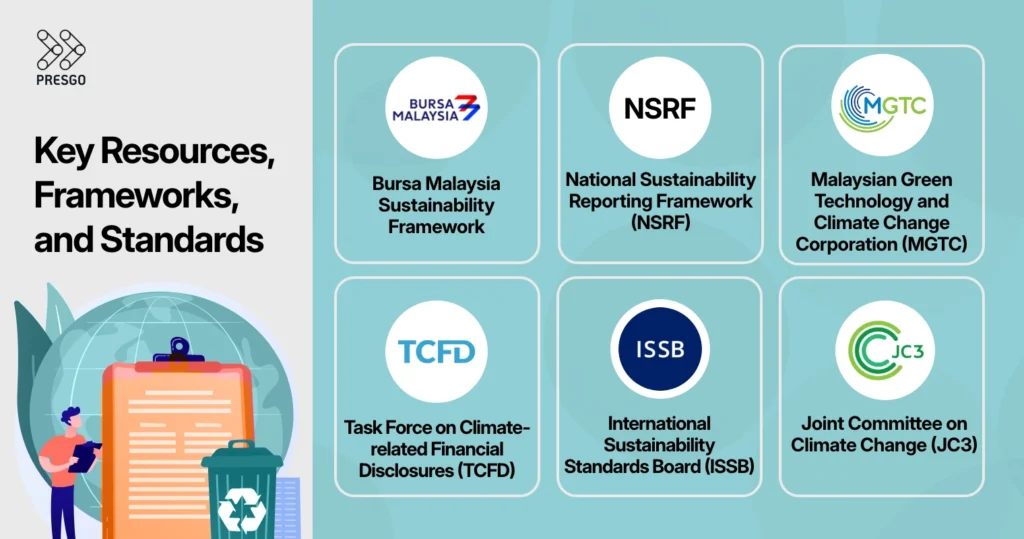
To guide your ESG journey, leverage these essential resources:
- Bursa Malaysia Sustainability Framework: Provides comprehensive guidance on sustainability reporting for public listed companies, offering structured approaches to disclosure requirements (Bursa Malaysia, 2024).
- National Sustainability Reporting Framework (NSRF): The new national standard for sustainability disclosures, aligning with international standards and providing clear reporting guidelines (RSM Global, 2024).
- Malaysian Green Technology and Climate Change Corporation (MGTC): Offers financial incentives and support for green initiatives, including grants and tax allowances for sustainable technology adoption (MGTC, 2023).
- Task Force on Climate-related Financial Disclosures (TCFD): An internationally recognised framework for disclosing climate-related financial risks and opportunities, essential for financial sector compliance.
- International Sustainability Standards Board (ISSB): The global standard-setter influencing Malaysia’s new reporting requirements, providing internationally aligned disclosure frameworks.
- Joint Committee on Climate Change (JC3): Offers regulatory guidance and policy direction for climate risk integration across financial services and corporate sectors (RSM Global, 2024).
Conclusion
The window for proactive climate adaptation is narrowing rapidly, and the impacts of Malaysia’s changing climate are already reshaping business landscapes across key industries. For Malaysian businesses, building long-term resilience and competitive advantage requires embracing ESG as a strategic imperative rather than a compliance burden.
The convergence of regulatory requirements, financial pressures, and climate realities means that companies can no longer afford to delay action. Those who act now will not only protect their operations from climate risks but also position themselves to capitalise on the significant opportunities emerging from Malaysia’s green transition.
Ready to transform climate risk into competitive advantage? Discover how Presgo ESG software can automate your climate risk tracking, streamline regulatory compliance, and provide the strategic insights needed to build climate-resilient operations. Our comprehensive platform helps Malaysian companies navigate the complexities of ESG frameworks while identifying opportunities for sustainable growth.
If you’re curious about how to get started, here’s a suggestion: Contact us today to explore tailored solutions that position your company at the forefront of Malaysia’s sustainable business transformation. Don’t wait for the next climate shock to reveal operational vulnerabilities—start building comprehensive climate defences now with proven ESG software solutions designed for Malaysian businesses.