

Contents
In Hong Kong, environmental, social, and governance (ESG) reporting has evolved into a strategic necessity. The Hong Kong Stock Exchange has developed one of Asia’s first reporting guides, driving corporate disclosure across ESG dimensions.
At the same time, global scrutiny on sustainability disclosure is intensifying. Investors and regulators demand more transparency, while Hong Kong’s role as a leading financial hub amplifies the importance of credible, comparable reporting.
This guide explores ESG reporting in Hong Kong practices, from HKEX requirements to global frameworks, tools, and best practices to help businesses navigate compliance and long-term value.
What is ESG reporting?
ESG reporting is how companies share their sustainability and governance performance beyond financial results. It highlights their impact on people and the planet while showing investors and stakeholders that they operate with transparency, accountability, and deep-rooted responsibility.
Globally, companies are turning to established ESG reporting frameworks, such as the Sustainability Accounting Standards Board (SASB), the Global Reporting Initiative (GRI), and the Task Force on Climate-related Financial Disclosures (TCFD) recommendations. In Hong Kong, compliance is anchored in the local HKEX’s ESG reporting guide, which ensures local alignment with global best practices while remaining sensitive to market-specific needs.
What is the HKEX ESG reporting guide?
The ESG reporting guidelines are embedded in the HKEX Listing Rules Appendix C2, which outlines disclosure obligations. The reporting guide was first launched in 2012 as a voluntary guide, offering companies a flexible framework to begin disclosing their ESG performance. Following a market consultation in 2015, the guide was amended to make annual ESG disclosure mandatory, requiring issuers to report on ESG matters for the same period covered in their annual reports. This marked a turning point, shifting ESG disclosure from voluntary adoption to a regulated requirement that continues to expand today.
New Climate-Related Disclosure Requirements
In April 2024, HKEX concluded another consultation, aligning Hong Kong’s ESG reporting requirements with the International Sustainability Standards Board (ISSB) climate disclosure standards. It then rebranded the framework as the ESG Code.
Part D of the ESG Code introduces mandatory climate-related disclosures. For financial years beginning on or after 1 January 2025, the updated reporting code requires all listed companies to disclose their scope 1 and scope 2 greenhouse gas (GHG) emissions. Listed companies will be required to disclose climate information in detail across four dimensions: governance, strategy, risk management, and metrics and targets. These requirements are to encourage companies to take concrete measures to reduce greenhouse gas emissions, improve energy efficiency, and explore new business models that adapt to the risks and opportunities of climate change.
Broader Sustainability Reporting Framework in Hong Kong
While HKEX oversees disclosure requirements for listed companies, it operates within a wider regulatory ecosystem. The Hong Kong Institute of Certified Public Accountants (HKICPA) issued the HKFRS Sustainability Disclosure Standards (HKFRS SDS), which are aligned with IFRS S1 and S2. The Accounting and Financial Reporting Council (AFRC) watches over the standards set by HKICPA, while other regulators like the Hong Kong Monetary Authority (HKMA), Securities and Futures Commission (SFC), and Insurance Authority decide how and when these standards will be used for financial institutions that are not listed.
Continuous development of local standards ensures Hong Kong remains at the forefront of global ESG practices.
What is Hong Kong’s step-by-step ESG reporting process?
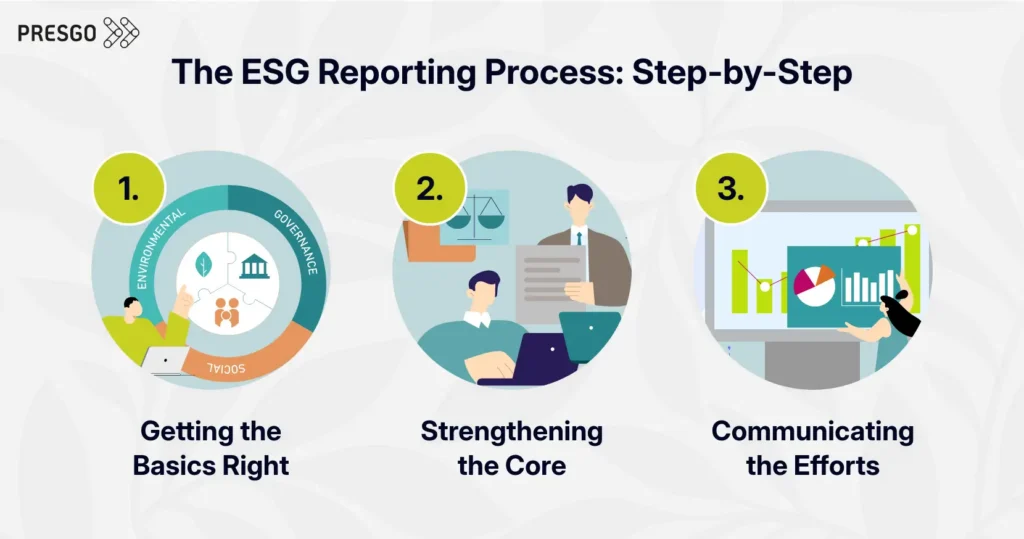
Successfully navigating ESG reporting in Hong Kong requires a structured approach that aligns with both global best practices and the HKEX ESG Reporting Guide. The process can be broken down into three main phases, according to KPMG’s ESG integration guide:
1. Getting the basics right
Companies begin by establishing a common understanding of ESG among their teams and supply chains. This includes defining the meaning of ESG for the business, setting a clear purpose, and ensuring that leadership establishes the appropriate tone at the top. A materiality assessment follows, helping firms identify, prioritise, and validate the ESG issues that are most relevant to their stakeholders and operations. This process ensures the effective allocation of resources to the most critical areas of impact.
2. Strengthening the core
With priorities defined, companies must build robust internal structures. This involves strengthening governance, where boards and senior executives oversee ESG strategy, foster proactive management, and engage in ongoing dialogue. Alongside governance, businesses must integrate risk management by adopting systematic approaches to identify, assess, and respond to ESG-related risks. A clear ESG strategy should also be developed, aligning with the company’s broader vision and mission while embedding sustainability into long-term planning.
Measurable outcomes are needed once governance and strategy are in place. Companies should define key performance indicators (KPIs) and set short, medium, and long-term targets. These metrics allow organisations to track ESG performance, assess progress, and drive continuous improvements.
3. Communicating the efforts
The final stage is disclosure and assurance. Companies must communicate their ESG vision, strategy, and performance transparently, whether through annual ESG reports, websites, or other stakeholder channels. To increase the credibility of their ESG data and HKEX reports, many organisations engage independent third parties. This practice strengthens trust and ensures alignment with evolving ESG reporting guidelines and international expectations.
What are the best practices for Hong Kong companies?
A 2024 study on Hong Kong’s listed companies highlights that, while companies have made progress in ESG disclosure, gaps remain in areas such as climate risk quantification and forward-looking scenario analysis. As ESG reporting in Hong Kong enters a new regulatory phase, best practices include:
- Embedding ESG considerations into business strategy beyond compliance
- Strengthening board oversight on ESG strategy
- Investing in ESG reporting software to enhance accuracy
Stay Ahead of Hong Kong ESG Reporting with Presgo

With the ESG Code, updated climate requirements, and the new HKFRS Sustainability Disclosure Standards, companies must meet higher expectations from investors and regulators. Manual processes and fragmented spreadsheets struggle to keep pace with this shift. This is where purpose-built ESG reporting software becomes a practical necessity.
The right platform brings structure to data collection, consistency to disclosures, and clarity across HKEX, ISSB, and climate-related requirements. For Hong Kong companies seeking a smarter way to manage ESG reporting, Presgo offers a focused solution. Designed for regulatory alignment and real-world reporting workflows, Presgo supports HKEX ESG Code compliance, IFRS S1 and S2, and other local and global frameworks. It centralises ESG data, streamlines reporting, and supports assurance, allowing teams to move beyond compliance and report with confidence. The ESG reporting software also helps with internal coordination, audit readiness, and year-on-year comparability for a streamlined disclosure of strategies, progress, and results.
Book a demo today and use the right ESG tools to meet your disclosure needs.