


Contents
- What is ESG reporting?
- What are the Australian Sustainability Reporting Standards?
- What are the ESG reporting requirements in Australia?
- Who is required to report and when?
- What are the challenges with the Australian government’s mandatory reporting?
- What are the benefits of mandatory ESG reporting for companies in Australia?
- Global standards alignment
- Stronger sustainability integration into governance and long-term strategy
- Better strategic decision-making
- Enhanced credibility with investors, regulators, and customers
- Improved access to capital and investment
- Stronger risk identification and management
- Greater operational efficiency and cost savings
- How to make an effective ESG report?
- Turn Australia’s Mandatory ESG Reporting into a Business Advantage with Presgo
Sustainability has rapidly moved from the periphery of corporate responsibility into the heart of business regulation and strategy. For years, Australian companies have voluntarily published sustainability and corporate social responsibility reports to demonstrate accountability and build goodwill with stakeholders. However, in 2025, Australia reached a turning point when the government mandated sustainability reporting to be included along with the companies’ financial reports. What was once seen as an optional exercise for reputation management has now become a legal requirement under the Corporations Act 2001.
The introduction of mandatory reporting may initially feel daunting for many organisations. Yet, beyond compliance lies the opportunity to strengthen transparency, build resilience, and embed sustainability at the core of their operations and business activities. This guide offers a detailed overview of ESG reporting in Australia, explaining the reporting standards, the criteria on who needs to report, and the specific reporting requirements. It also explores the benefits for businesses, the challenges they may face, and the practical steps needed to produce an effective ESG report that goes beyond legal obligations and becomes a driver of long-term value.
What is ESG reporting?
ESG reporting is the practice of measuring and disclosing how an organisation’s operations affect the environment and society, as well as its governance practices. It also discloses the risks and opportunities arising from them.
- The E in ESG refers to environmental considerations such as greenhouse gas emissions, energy consumption, waste generation, biodiversity impacts, and water use.
- The S represents social factors, which may include employee welfare, fair wages, diversity and inclusion, labour rights, health and safety, and community engagement.
- Finally, the G stands for governance, which covers the structures and processes by which organisations are managed, from board composition and executive remuneration to ethical conduct, transparency, and risk management practices.
ESG reporting acts as a bridge between an organisation’s internal practices and the expectations of its stakeholders. Investors, regulators, employees, customers, and communities increasingly expect credible, data-driven disclosures that reveal how businesses are addressing sustainability challenges and seizing opportunities. The aim is not only to show accountability but also to demonstrate readiness for a future where sustainability is integrated into financial performance and competitiveness.
What are the Australian Sustainability Reporting Standards?
Australia’s journey toward mandatory ESG reporting did not happen overnight. For many years, companies voluntarily released sustainability reports, often guided by frameworks such as the Global Reporting Initiative (GRI) or the Task Force on Climate-related Financial Disclosures (TCFD) recommendations. However, a lack of standardisation meant that reports varied significantly in scope, depth, and quality. Some companies provided comprehensive disclosures, while others only offered minimal statements. The mismatch makes it difficult for investors and stakeholders to compare performance across organisations.
Globally, momentum was building for more consistent reporting. The establishment of the International Sustainability Standards Board (ISSB) in 2021 and its release of the IFRS Sustainability Disclosure Standards provided a strong international benchmark. Investors worldwide also pushed for clearer and more comparable information to guide decision-making.
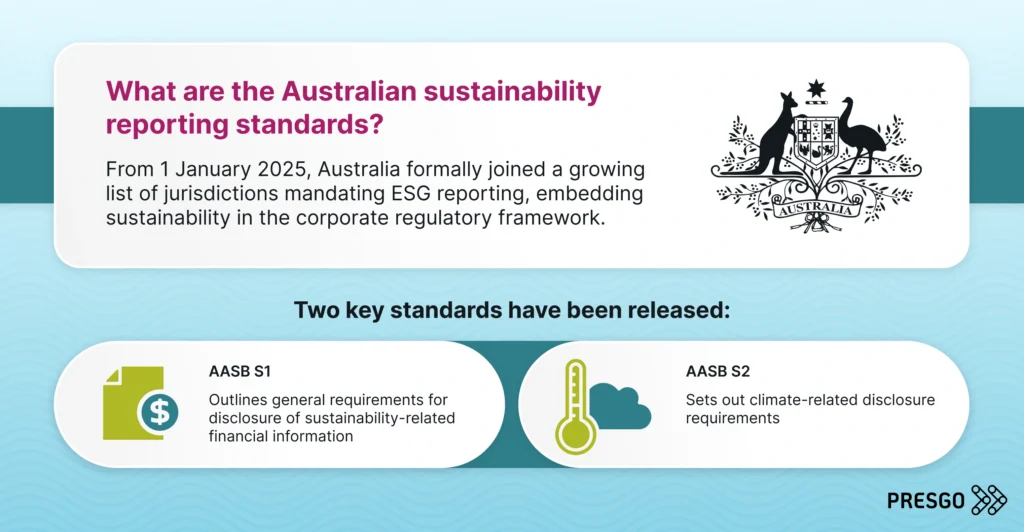
Against this backdrop, the Australian government recognised the need for a universal framework to make sure sustainability disclosures were reliable, transparent, and aligned with global expectations. This mandated reporting developments culminated in September 2024, when the Treasury Laws Amendment (Financial Market Infrastructure and Other Measures) Bill was passed by both houses of Parliament and received Royal Assent. From 1 January 2025, Australia formally joined a growing list of jurisdictions mandating ESG reporting, embedding sustainability in the corporate regulatory framework.
The introduction of mandatory reporting is underpinned by the Australian Sustainability Reporting Standards and developed by the Australian Accounting Standards Board. These standards are modelled closely on the ISSB’s IFRS Sustainability Disclosure Standards to ensure global alignment. Two key standards have been released: AASB S1, which outlines general requirements for disclosure of sustainability-related financial information, and AASB S2, which sets out climate-related disclosure requirements.
AASB S1
S1 sets out the general requirements for sustainability-related financial information. These could include issues such as resource scarcity, labour practices in the supply chain, or social risks related to community impact. The disclosures should cover how such factors may affect a company’s cash flows, cost of capital, or access to finance over the short, medium, or long term. While not mandatory, AASB S1 provides a valuable framework for companies that want to present a more holistic picture of their sustainability practices.
AASB S2
On the other hand, S2 is mandatory for entities that meet the reporting thresholds. It focuses exclusively on climate-related risks and opportunities. The standard requires disclosures on governance structures overseeing climate risks, strategies for managing these risks, processes for identifying and mitigating risks, and the metrics and targets used to track progress. In other words, companies must not only report emissions but also explain how climate change is shaping their strategy and financial outlook.
By incorporating international standards, the Australian approach ensures that its disclosures are consistent with global practices. This is particularly important for companies participating in international markets and supply chains.
What are the ESG reporting requirements in Australia?
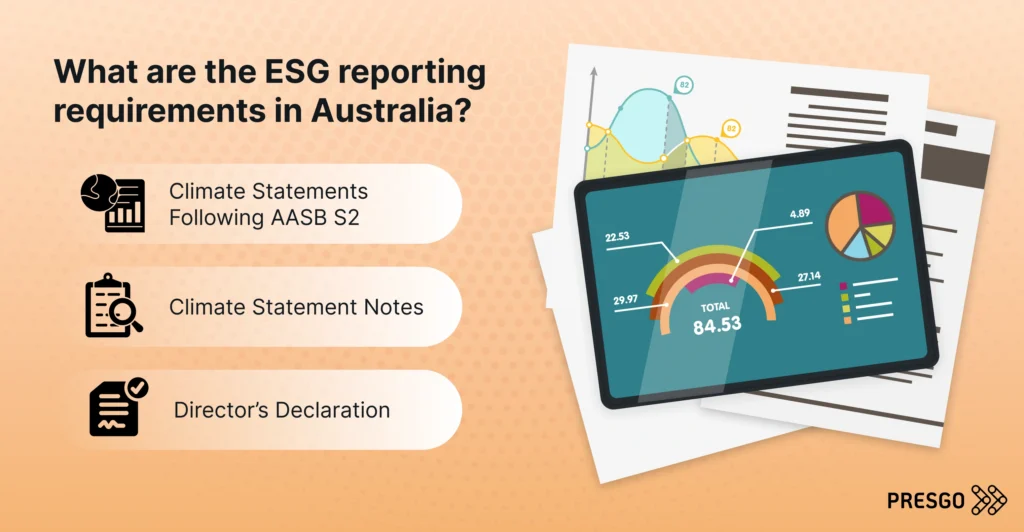
A sustainability report in Australia must include the following:
1. Climate Statements Following AASB S2
Climate statements form the core of the report and must comply with relevant standards unless modified by the Corporations Act. They disclose the company’s climate-related risks and opportunities in a manner that ties directly to financial performance.
2. Climate Statement Notes
The notes to the climate statements provide additional information, such as explanations of methodologies, assumptions, and any other details needed to meet legal requirements.
3. Director’s Declaration
The directors’ declaration is a formal statement by the company’s board confirming that, in their opinion, the sustainability report complies with the Corporations Act. The declaration must be approved by resolution, dated, and signed by a director, ensuring accountability at the highest level.
Who is required to report and when?
Not every organisation in Australia is subject to mandatory ESG reporting. The obligation applies to entities required to lodge financial reports with the Australian Securities and Investments Commission under Chapter 2M of the Corporations Act, provided they meet at least one of several thresholds.
First Threshold: What is the size of your company?
An entity and its controlled entities must prepare a sustainability report if they meet at least two of the following criteria:
- Consolidated revenue of at least 50 million Australian dollars,
- Consolidated gross assets of at least 25 million Australian dollars, or
- A workforce of 100 employees or more at the end of the financial year.
Second Threshold: Do you have NGER reporting obligations?
The second threshold relates to emissions impact. Entities that are registered corporations with reporting obligations under the National Greenhouse and Energy Reporting (NGER) Act 2007 automatically fall under the scope of mandatory ESG reporting.
Third Threshold: What is the value of your assets?
Registered schemes, registrable superannuation entities, and retail corporate collective investment vehicles with assets worth 5 billion Australian dollars or more must also prepare sustainability reports.
Phased mandatory reporting schedule
To allow companies time to adapt, the government introduced a phased rollout depending on the size of mandated entities.
- The largest entities are the first group required to comply for financial years beginning on or after 1 January 2025.
- The second group, including medium- to large-sized entities, follows for years beginning on or after 1 July 2026.
- Then, third, for the smaller entities, it is for years beginning on or after 1 July 2027.
Entities outside the scope of financial reporting obligations under Chapter 2M remain exempt.
What are the challenges with the Australian government’s mandatory reporting?
The transition to mandatory ESG reporting has significant implications for Australian businesses.
- High costs and resourcing requirements: For some, particularly smaller entities, the costs of establishing systems to collect and verify sustainability data may seem burdensome. Businesses may need to invest in new technology, hire specialists, or upskill existing staff to meet reporting requirements.
- Organisation adjustment to mandatory reporting: The shift to legally binding obligations requires changes in governance, operations, and strategy. This can be a laborious, deep overhaul and restructuring of internal operations and accountability.
What are the benefits of mandatory ESG reporting for companies in Australia?
The challenges with mandatory ESG reporting are balanced with clear opportunities, giving Australian companies several advantages.
Global standards alignment
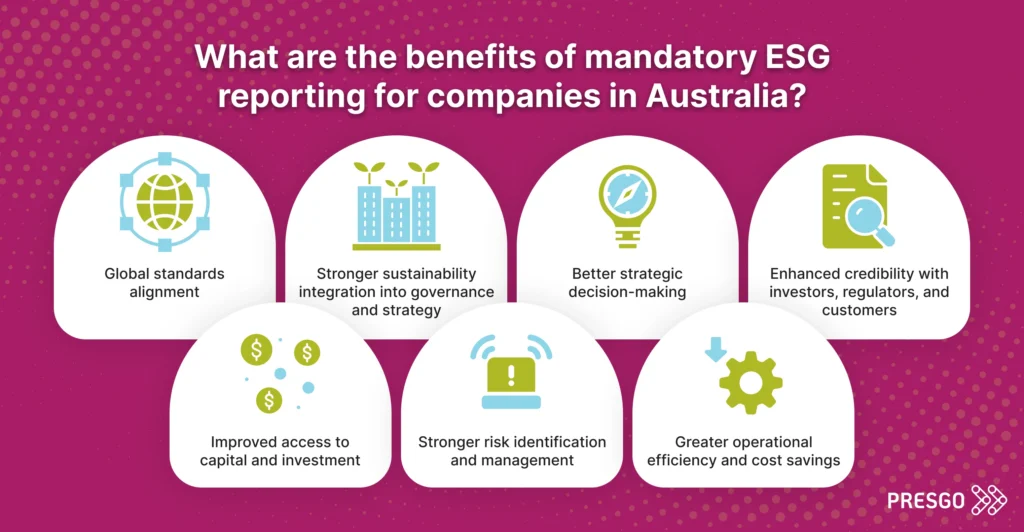
Mandatory reporting ensures alignment with international standards, enabling companies to remain competitive in global supply chains where sustainability disclosures are increasingly required.
Stronger sustainability integration into governance and long-term strategy
Sustainability can no longer be treated as a side activity; it must be integrated into the core of business decision-making. A deeper understanding of sustainability impacts allows businesses to strengthen resilience and better prepare for long-term environmental, social, and regulatory changes.
Better strategic decision-making
Including sustainability information in reports helps businesses make smarter decisions by connecting ESG factors to financial results and planning.
Enhanced credibility with investors, regulators, and customers
One of the most immediate benefits of ESG reporting is enhanced reputation. Producing standardised and comparable disclosures improves transparency and builds trust among key stakeholders.
Improved access to capital and investment
As investors increasingly factor ESG performance into their decisions, companies that provide credible and high-quality sustainability disclosures are viewed as lower risk. This can lead to easier access to finance, lower borrowing costs, and stronger valuations.
Stronger risk identification and management
ESG reporting requires businesses to systematically assess environmental and social risks, such as climate impacts, labour practices, and supply-chain vulnerabilities. Identifying these risks early enables proactive management, reducing the likelihood of disruptions, financial losses, or regulatory penalties.
Greater operational efficiency and cost savings
Collecting and analysing ESG data often reveals inefficiencies in energy use, resource consumption, and waste management. Addressing these issues improves sustainability performance while also lowering costs and supporting more efficient operations.
How to make an effective ESG report?
While compliance with the law is the minimum requirement, truly effective ESG reports go beyond ticking requirement boxes. They tell a clear and credible story about how an organisation incorporates sustainability into its strategy. To apply these, companies need to consider the relevant and important points.
1. Identify a clear purpose
The reporting process begins with recognising the main objectives. Companies should consider who the primary audience of their report is and what information they need. For investors, financial impacts and risk management strategies are essential. For employees and customers, the company’s values and commitments may be more relevant.
2. Align with frameworks
To enhance the comparability and credibility of the ESG report, companies need to align with recognised ESG frameworks, such as the Global Reporting Initiative (GRI), the Sustainability Accounting Standards Board (SASB), or the Task Force on Climate-related Financial Disclosures (TCFD) recommendations.
3. Conduct a materiality assessment
Conducting a materiality assessment ensures that the report focuses on the issues most important to both the business and its stakeholders.
4. Balance between narrative and data
Reports should combine leadership vision and strategic priorities with measurable performance data and concrete examples of impact. Transparency and honesty build trust, and this is why companies should not shy away from disclosing challenges or areas needing improvement.
5. Get independent assurance
Whether an ESG audit is done internally or through a third-party agency, assurance and verification further enhance the credibility of disclosures.
6. Assess design and accessibility
Reports should be clear, structured, and easy to navigate. The use of ESG software‘s data visualisation tools can help communicate complex information in a way that is engaging and understandable for a broad audience.
Turn Australia’s Mandatory ESG Reporting into a Business Advantage with Presgo
Mandatory ESG reporting represents a new chapter for Australian businesses. With the right combination of leadership commitment and robust systems, Australian businesses will not only meet their legal obligations but also secure a sustainable future. Technological support can fast-track this path, and the use of ESG reporting software makes a practical difference. Purpose-built platforms help businesses move beyond manual processes and fragmented data, providing a reliable foundation for reporting, performance tracking, and decision-making.
Presgo is designed to support Australian organisations as they respond to mandatory ESG and climate reporting requirements. The AI-first ESG reporting software brings sustainability data, governance, and reporting into one system. This allows teams to collect information across departments and the supply chain, apply validation checks, and track progress in real time. Presgo supports alignment with Australian Sustainability Reporting Standards as well as international frameworks, helping businesses meet local obligations while maintaining consistency across global disclosures.
With built-in analytics, benchmarking, and audit-ready reporting, Presgo supports both compliance and performance improvement for your ESG journey. Get a demo today.